

Magic players have become well-accustomed to Universes Beyond products of late. We’re reaching the point where it’s no longer a novelty seeing pop-culture icons clash with planeswalkers on the tabletop. But the upcoming Marvel’s Spider-Man release is an exception even in its own exceptional class.
Despite a huge number of flashy legendary cards, with effects primed to appeal to casual and commander audiences… this is a Standard set! A Standard set with smaller than usual card count, very skewed creature type counts, and no accompanying Commander decks despite a high concentration of legendary creatures. There’s a lot of questions that are raised just by that unique profile.

The only other Universes Beyond set that fit a similar mold was Assassin’s Creed – and that could hardly be seen as a model of success. So, have Wizards appeared to learn from that experience how to best handle Spider-Man?
SERVING TWO MASTERS
It’s not that these design decisions around Marvel’s Spider-Man are illogical. On the contrary, they make perfect sense when you consider the premise and design goals of this specific product. You need lots of legendary cards to depict all the famous characters which make up the Spider-Man mythos.

The fact that so many of those cards have the types Spider, Symbiote, Hero and Villain is obviously just the reality of focusing on a single Marvel character and their supporting cast. Traditionally, Magic’s worlds feature a variety of different factions and environments which can easily be mapped onto the color pie.

But as we’ve seen repeatedly with Universes Beyond, designers are often forced to compromise between traditional color pie balance and the need to include all the most recognizable characters and features of the IP. In Assassin’s Creed we saw this challenged immediately with the Assassin creature type. This is a creature type which is historically tied to black mana and effects which destroy creatures (especially damaged creatures) or more rarely, players.
There’s no way you can make creature cards for the protagonists of the Assassin’s Creed series without making them Assassins. Fans of the series will want to play them in themed decks, so you’ll want to give them some typal support as well to encourage that. So are you going to print an entire set of black Assassin creatures? That’s not just an issue mechanically, it’s going to fail the expectations of Assassin’s Creed fans.

PARALLEL UNIVERSES
Just because Magic has always associated Assassins or Spiders with particular colors and effects, doesn’t mean that’s true for these outside IPs. At least all the Assassin’s Creed protagonists are proficient enough killers for creature removal effects to make sense – but do you really want them all to play so similarly?
A Magic card only has a couple of lines of text to capture the essence of a beloved Universes Beyond character and make them feel recognizable to fans. That’s even harder when you’re trying to create cards for a ton of heroes with similar outfits, outlooks and special abilities. In sets like Final Fantasy and Spider-Man we’re seeing a lot of instances where the same character features on multiple cards in the same set!
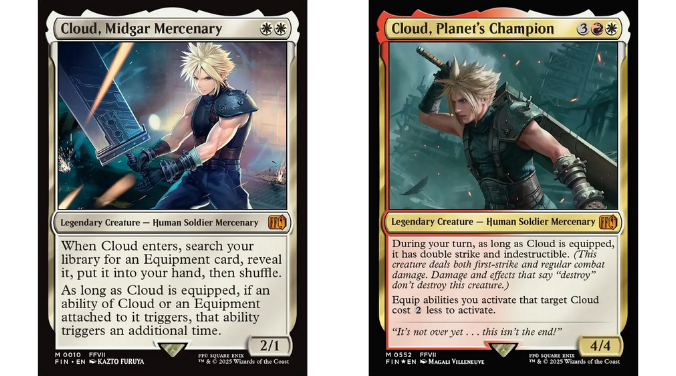
So designers look outside the box and try to have cards that elaborate on different aspects of the heroes in question. Yeah, some of the Spider Hero cards have webslinging or traditional Spider type abilities like reach and deathtouch. But the “classic” Peter Parker Spider-Man cards have more of a focus on white’s self-bounce and lifegain mechanics to represent saving innocents.
The more esoteric “Spiderverse” variants of Spidey seem to be allocated to red and green. In red, these cards focus on impulse draw to represent the unpredictable but explosive potential of interdimensional team-ups. Meanwhile the green Spiders-Men (including, of course, Spiders-Man) emphasize +1/+1 counters and going wide to show how this multiversal support network helps its members.

These are all cool ideas and they can all make sense for the characters they represent when you think them through. But as we discussed the other week, it’s a bit of a curveball for anyone who was hoping these Spider-themed support cards would help build up the Spider mechanics Magic has been building up for the past 30 years.
I’ll admit that in my opinion, Wizards actually made the right call for both of these small sets. The fact that both IPs have the creature type right there in the name and as THE source of identity for the characters… there’s just no way you were going to avoid using the matching creature type. It’s also true that while Assassin and Spider aren’t total afterthought types in Magic, they’re nowhere near being pillars of the community like Elves, Goblins, Merfolk or Vampires. So the compromise seems justifiable in order to make these Universes Beyond products live up to the hype.
Now given that these are smaller sets, I think you COULD have made the Universes Beyond creatures align more closely with Magic’s conventions for their type. This would arguably have made it easier to put all the Spider-Man heroes in a synergistic deck, and I doubt anyone coming over from the Marvel fandom would be upset if Peter Parker’s card was green. However, you CANNOT do that if you’re also determined to make this a Draft format.
LIMITED EXPERIENCE
One of the inspirations for this blog was Mark Rosewater’s explanation for an apparent design-phase change where Marvel’s Spider-Man went from a “small set” to a “medium set” (in terms of unique card count). Magic’s lead designer gave a number of reasons for the change, including wanting more space to feature different characters and supporting the desired Draft experience.

Assassin’s Creed wasn’t mentioned by name, but it was one of two recent small sets, and did feature a unique booster pack configuration which made Limited play impossible. If MaRo is acknowledging that “players were less satisfied with smaller set sizes” and then significant effort was made to re-design Spider-Man around a specific Draft experience, then that says perhaps Limited play is still a vital piece of the Magic puzzle.
Even with how much I love Draft, I do understand why Wizards might be longing to unshackle some sets from the need to support it. Without Limited, you could arguably ignore the whole idea of “set design” and just think up individually cool cards that would get deckbuilders excited to crack packs. It’s only Draft and Sealed play where suddenly you need to worry about workhorse commons, balancing support for different colors and themes, or “as-fan” ratios for key card types.

But the lesson from Asssassin’s Creed and March of the Machine: Aftermath seems clear: if you’re going to bother marketing a randomized booster set and not just a Secret Lair or set of Commander precons, then some form of Limited format must be playable with it. There are players who treat boosters as loot boxes and simply buy them to open – but not enough to get the sales you want. More importantly, the draw of casual Limited events is a vital part of the local game store ecosystem.
Even minor changes to booster packs and booster boxes can have significant ripple effects in these key facets of the game, so hopefully this pivot with Marvel’s Spider-Man shows Wizards are done touching that particular stove. And hey – it means more cool Spider-Man cards, so who’s complaining?
A STICKY END
We’ve seen Wizards refine the Universes Beyond model a lot by now, but there’s clearly still some kinks to work out. The forced scramble to produce new, Magic-generic versions of these Spider-Man cards to put on MTG Arena doesn’t seem like something you do on purpose if you can help it! But anything you survive you can learn from, and they are definitely learning.

The whole point of Universes Beyond is to authentically and satisfyingly represent these IPs within Magic. So there’s no future in designing these products to a safe formula. We might as well figure out now how to properly balance and promote unique sets like Marvel’s Spider-Man, however big or small they are.

Tom’s fate was sealed in 7th grade when his friend lent him a pile of commons to play Magic. He quickly picked up Boros and Orzhov decks in Ravnica block and has remained a staunch white magician ever since. A fan of all Constructed formats, he enjoys studying the history of the tournament meta. He specializes in midrange decks, especially Death & Taxes and Martyr Proc. One day, he swears he will win an MCQ with Evershrike. Ask him how at @AWanderingBard, or watch him stream Magic at twitch.tv/TheWanderingBard.