
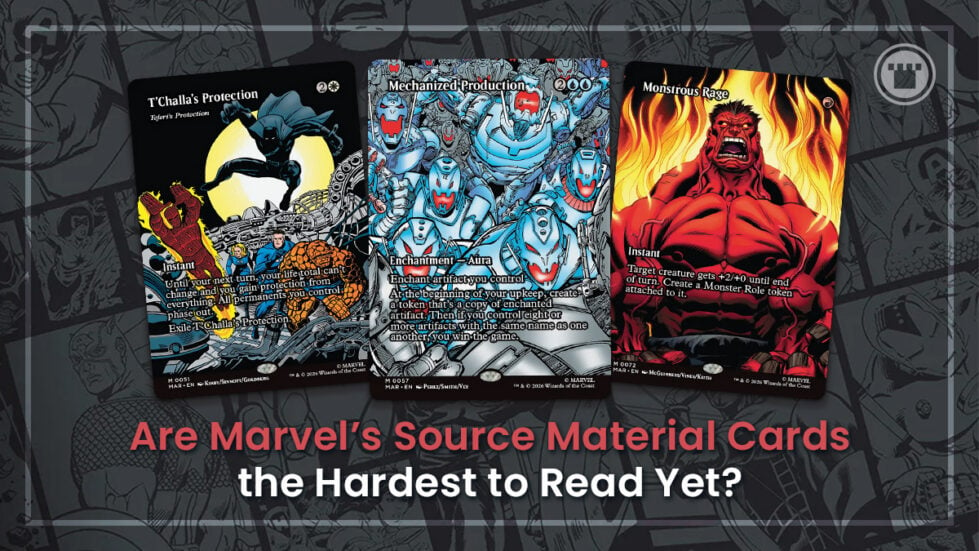
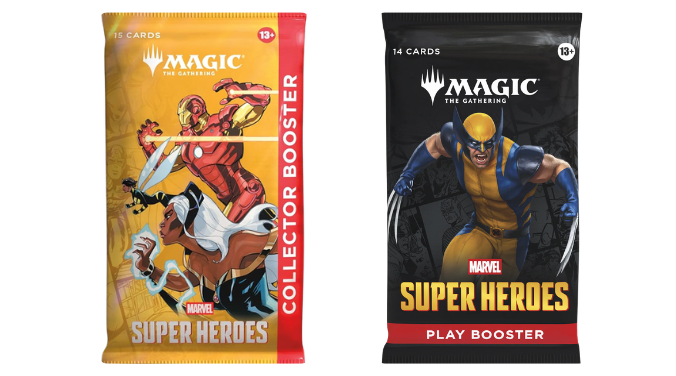
Magic: The Gathering | Marvel Super Heroes releases on June 26th. As has become the norm for Universes Beyond sets, there is a “Source Material” bonus sheet in addition to the main set. This is a curated subset of 60 cards and you can find one of these in every Collector Booster and 1 in 24 Play Boosters.
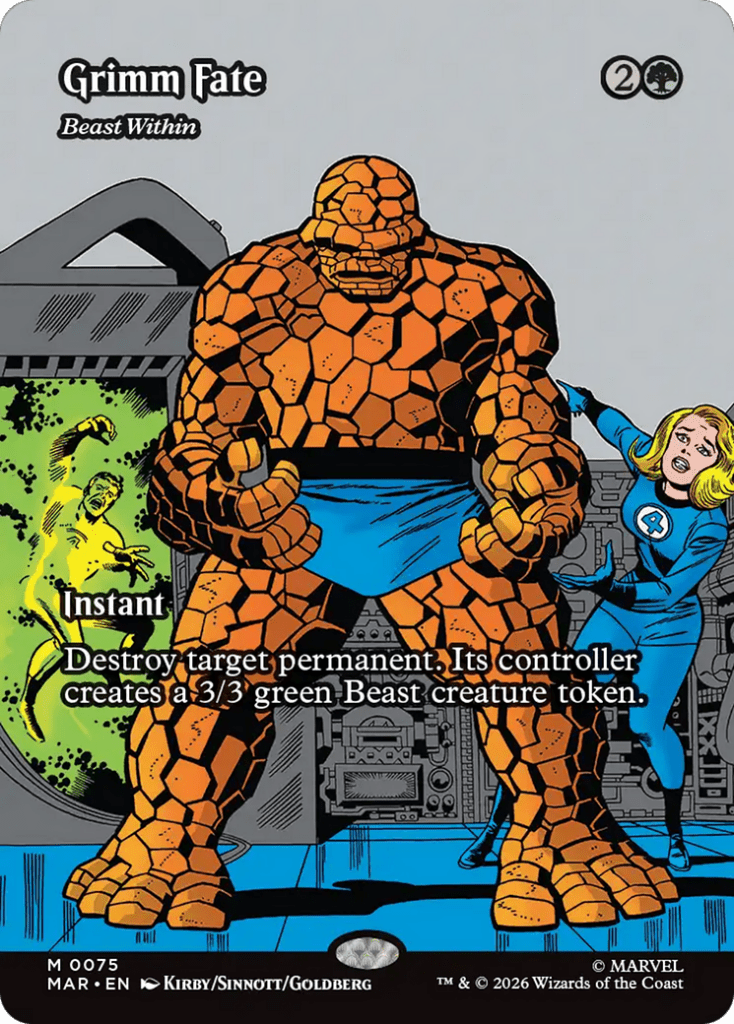
As with the past Universes Beyond bonus sheets, each card is a reprint that features original art from the set’s IP – in this case, these cards use comic book art from Marvel Comics. Some of them are even reskinned cards with different names, like Grimm Fate.
I think it’s really cool to get art from throughout Marvel’s history on cards from throughout Magic’s history, but I’m pretty disappointed with the execution. As with previous incarnations of this type of bonus sheet, there can be some problems with the actual appearance of these cards and how they can affect a game, especially at pre-release.
PROBLEM 1: READABILITY
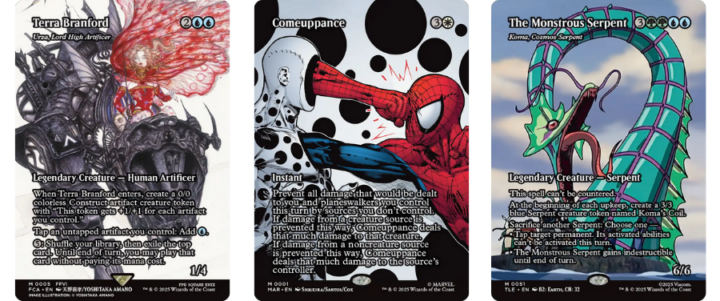
In the past, I’ve argued that bonus sheets are a net positive for Limited. They tend to make Limited formats more dynamic and interesting even several drafts in, and it’s also just fun to play with iconic old Magic cards in draft. So I’m not arguing that they should be abolished or anything like that.
Bonus sheets are also great for players of other formats as you can get some cool alternate art cards for your Commander or Modern decks. I’ll be one of the first to admit that bonus sheet cards often look really cool, and that’s no different for Source Material cards.
However, source material bonus sheets run into a pretty basic problem – they’re really freaking hard to read. Every one of these bonus sheets so far uses a borderless design where they just take the art and slap all the text of a Magic card onto that card. Thankfully they give this text a black outline so it’s not entirely inscrutable, but it’s only a couple of steps above that.
This problem gets particularly pronounced the denser a card’s text box is. I think these cards would still look cool if they added some version of the traditional Magic frame to them. They would also be a lot easier to read.
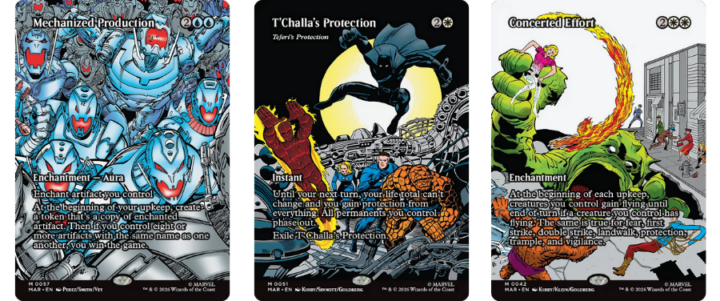
Marvel Super Heroes continues this tradition of cards that make you strain your eyes with cards like Mechanized Production, T’Challa’s Protection, and Concerted Effort. All three of them have incredibly busy art that makes it hard to focus on the actual effect of the card.
In fact, I think there’s a chance the Marvel Super Heroes source material sheet might have some of the hardest to read text yet. This is because a lot of classic comic book art has a lot going on it, as with these three cards which feature multiple figures that have had text slapped on top of them.
PROBLEM 2: COLORS ARE AMBIGUOUS

One of the great things about Magic design is that it’s often easy to tell what color a card is even just by glancing at it. This is not only because of the card’s frame, but also because the card’s art usually has a tint to it of that particular color. This can be particularly useful in the later stages of a draft, where you’re locked in on some particular colors and you want to streamline your decision process.
Unfortunately, you can’t do that with Source Material cards. By their very nature, they use art that wasn’t originally intended for Magic, so this general principle is abandoned. For example, there’s a good chance that you’ll initially think Deadly Dispute looks like a Red card, T’Challa’s Protection is a Black one, and Unnatural Growth is Blue.
PROBLEM 3: NO REMINDER TEXT

While the cards not having clear card text or color identities is definitely a problem, they are admittedly both problems that can be solved just by looking at the card for a little bit longer than usual. However, that’s not the case for this last problem – they completely forgo the use of reminder text on Source Material Bonus Sheets.
While it might sound strange that I’m complaining about these cards being hard to read and suggesting they add even more text, I think reminder text is incredibly important.
Reminder text shows up in parentheses and italics on Magic cards and its purpose is to well – remind you – of how a particular mechanic or keyword works. This is especially useful in a set where a mechanic only has a very small presence. And by the nature of bonus sheets, they often contain mechanics that don’t appear in the main set at all.
It’s even more important for newer players who don’t just need to be reminded about how a mechanic works, they need the reminder text to understand how the card works at all. UB sets like Marvel Super Heroes are likely to draw in lots of new players, but unfortunately they’re going to encounter cards at the pre-release with effects that they won’t be able to understand just by reading the card.
They won’t know what Ravenous Tyrranosaurus’s “Devour 3” means, or what Monstrous Rage’s “Monster Role” token is, or what the heck “Rebound” means on Ephemerate. These are also by no means the only cards on the bonus sheet that have this problem. Here’s a list of every card on the bonus sheet that uses a mechanic that isn’t explained anywhere within the set:
- Ravenous Tyrannosaurus (Devour)
- Monstrous Rage (Monster Role Token)
- Ephemerate (Rebound)
- Wolverine, Best There Is (Regenerate)
- Seize the Day (Flashback)
- Reconnaissance Mission (Cycling)
- Final Showdown (Spree)
- Return to the Ranks (Convoke)
- Widow-Making Infiltrator (Shadow)
- Dig Through Time (Delve)
- T’Challa’s Protection (Protection)
- Sundering Growth (Populate)
While I understand that they are avoiding using the reminder text in order to make the cards text boxes even more unwieldy, I think sacrificing function for form is a bad idea. These cards all directly counter the principle of “Reading the Card Explains the Card,” and that’s a massive problem.
So, if you encounter some new players at the pre-release who are completely baffled by what these cards do, make sure to help them out.
END STEP
What do you think about “Source Material” bonus sheets? Am I blowing things out of proportion? Or is there something else you don’t like about them? Let me know over on X or Bluesky.

Jacob has been playing Magic for the better part of 24 years, and he especially loves playing Magic’s Limited formats. He also holds a PhD in history from the University of Oklahoma. In 2015, he started his YouTube channel, “Nizzahon Magic,” where he combines his interests with many videos covering Magic’s competitive history. When he’s not playing Magic or making Magic content, he can be found teaching college-level history courses or caring for a menagerie of pets with his wife.