
In Magic: the Gathering, the “Legend Rule” refers to the special way that legendary permanents are treated within the game’s rules. It’s meant to make such creatures and the characters they represent feel like unique individuals, objects, or locations.

The legend rule has undergone many changes over the years, but the rule has always revolved around limiting the number of copies of an identical legendary permanent that can be in play. Currently, if a single player controls two of the same legendary permanent, they choose one to keep in play and the other goes to the graveyard.
For most of Magic’s history, legendary permanents have appeared at higher rarities to further cement their distinctiveness. However, we have recently received a preponderance of lower rarity legendary creatures and it has had a major impact on Limited formats. In this article, I’m going to discuss whether or not the legend rule should apply in Draft and Sealed.
THE EARLIEST UNCOMMON LEGENDARY PERMANENTS
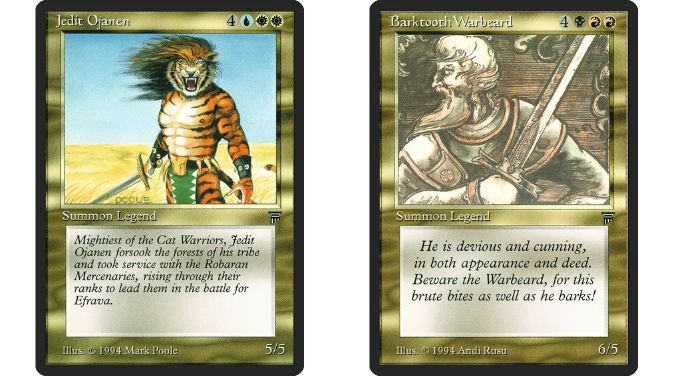
The “Legendary” supertype was originally introduced in 1994’s Legends, and that very first set also featured the very first uncommon legendary permanents. They came in the form of largely vanilla (and largely terrible) creatures. In 1995, Homelands also featured a few uncommon and common legendary creatures.
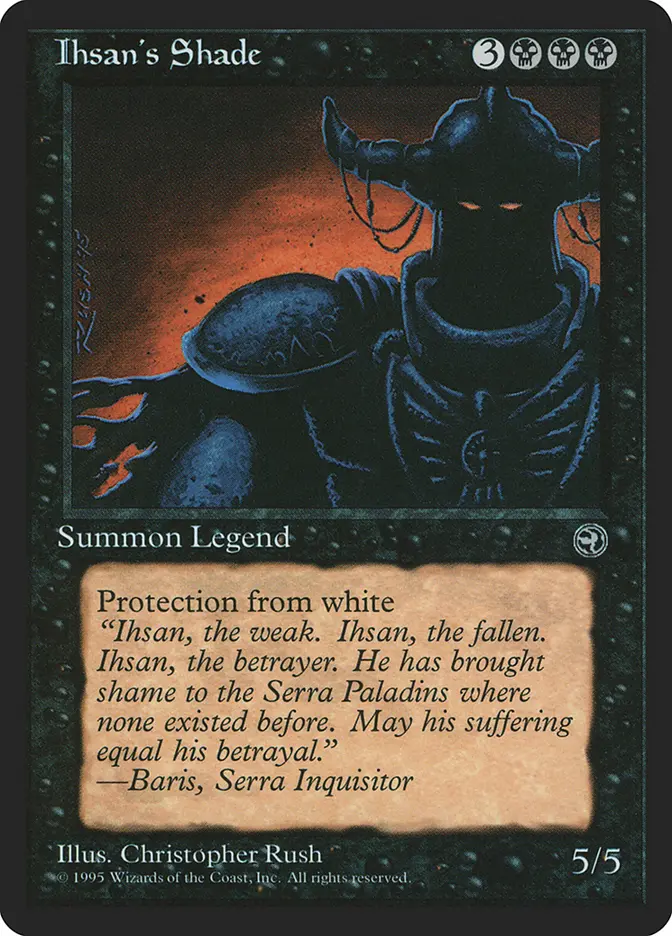
However, these sets are outliers in the early history of legendary permanents. They were still working out the kinks when it came to legendary creatures. Furthermore, Limited Magic hadn’t really been born yet as a full-fledged way to play the game, so the issue of lower rarity legendary creatures wasn’t really a factor yet.
KAMIGAWA AND UNCOMMON LEGENDARIES
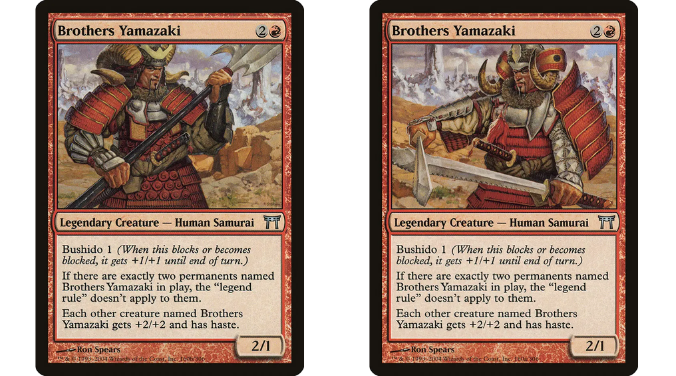
After Homelands, lower-rarity legendary creatures wouldn’t make another appearance until 2004’s Champions of Kamigawa. This set had a massive “legendary matters” theme, and to reflect that it gave us Uncommon legendary permanents. However, even as focused as Kamigawa Block was on legendary permanents, the number of lower-rarity legendary cards in those sets was a drop in the bucket compared to what we see today.
Across the 636 cards in those three sets, there were only 21 Uncommon legendary permanents. And one of them was the Brothers Yamazaki, who got around the problem of being a more common legendary creature by turning off the legend rule for a second copy of itself. In other words, if you were playing Kamigawa Limited, the legend rule didn’t come up very much.
DOMINARIA AND LEGENDARY SIGNPOST UNCOMMONS
After Kamigawa Block concluded, there would be another massive stretch of time where we didn’t see lower rarity legendary permanents. The next major shift would occur with the release of 2018’s Dominaria. Like Kamigawa, this was another set that had a major focus on legendary creatures. And this is also where we first saw Uncommon legendary creatures become a huge part of a Limited format.
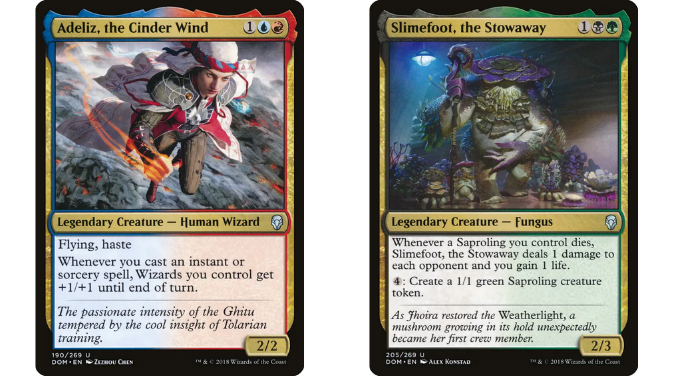
That set featured a cycle of legendary signpost Uncommons. A “signpost Uncommon,” is a card that is in a specific color pair and meant to tell Limited players what that particular archetype is supposed to do in a Limited format. In Dominaria, every color pair got one of them. This set a precedent. Ever since Dominaria a majority of sets have featured uncommon legendary signpost Uncommons.
These were far from the only Legendary permanents at Uncommon in Dominaria. The set featured 22 of them, which is one more than all of Kamigawa Block had. This too set a precedent, as uncommon legendary creatures have only become more common over the last 6 years.
On the whole, I actually like the idea of using legendary creatures as signpost Uncommons. This makes the archetypes in Limited formats feel a lot more fleshed out when the key card in the color pair is a unique individual. Sometimes you run into a problem where you have a second copy of that creature stuck in your hand, but that’s just a downside these powerful cards happen to have.
UNIVERSES BEYOND AND THE PROBLEM WITH LEGENDARY COMMONS

While having some Uncommon legendary creatures hasn’t resulted in a ton of feel-bad moments, the same can’t be said of the introduction of Common Legendary creatures. This hadn’t had a significant presence in Magic until the Universes Beyond era. By their nature, UB sets have to include lots of unique individuals from their respective IP, and this has resulted in legendary creatures even appearing at Common.
Not every Universes Beyond set has gone this route. Spider-Man was the first set to feature several Common legendaries and Teenage Mutant Ninja Turtles followed suit. This means the legend rule comes up all the time. This problem was further exacerbated by the fact that both Spider-Man and TMNT were smaller sets, so you saw these Commons even more than you would in a typical set.
As a result, if you played either of those Limited formats even a couple of times, you’ve ended up in spots where you can’t play out your Common because of the legend rule. And boy does it feel bad to get punished for having multiple copies of them.
SOLUTIONS TO THE LEGENDARY COMMON PROBLEM
The best way to deal with this kind of negative experience is simply to stop printing legendary creatures at Common. And there’s more than one reason to do that.
In addition to creating lots of feel-bad moments for players who end up with dead or sub-optimal cards in hand all the time, it also cheapens the feel of legendary cards on the whole. Iconic characters like Spider-Man and Donatello really don’t make sense at Common. They should really make commons like these represent non-legendary characters from these IPs.
However, the use of Common legendary creatures feels like a conscious decision by Wizards of the Coast. It’s true that by printing legendary creatures at this rarity you can really feel immersed in that particular IP no matter what cards you get in your booster pack. We didn’t get any Common legendary creatures in Marvel Super Heroes, so maybe they’ve already chosen this route.
But in the event Wizards of the Coast is planning on printing more Common legendary creatures, there are some other potential solutions.
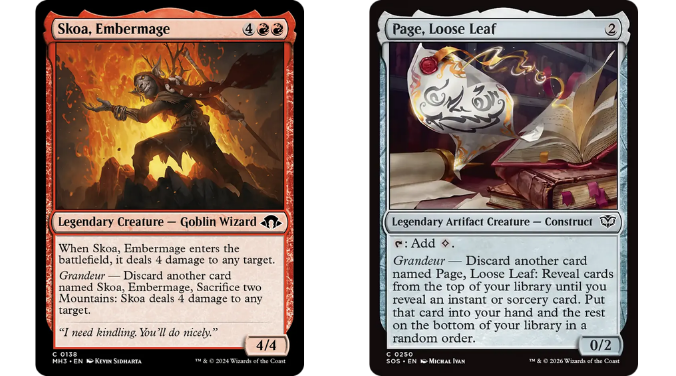
In the recent past, Wizards of the Coast has experimented with Common legendaries by giving them Grandeur. This is an activated ability that lets you discard a copy of a legendary Common you have in play to get some sort of effect. This is a nice solution, as it makes sure your additional copies of legendary permanents are never dead cards. However, if a set has more than just a single cycle of legendary Commons, this wouldn’t really feel like a good solution.
DOES THE LEGEND RULE NEED TO BE RETIRED IN LIMITED?

The other solution is the nuclear option – just get rid of the legend rule in Limited. This would remove the negative feeling you have when you open 3+ copies of the same legendary Common in your Sealed pool. It would make sure that all of your Commons can be played when you have the mana to cast them. And in general, it would make formats with legendary Commons in them a lot more fun.
It might sound like this is completely insane. After all Magic is Magic, right? You can’t just change a rule in a single format like that. However, there’s precedent for this. After all, in Limited you’re allowed to play more than 4 copies of a card with the same name.
Still, I’m somewhat hesitant to go this route because it is so extreme. If Wizards of the Coast dials it back on legendary Commons, I don’t think it’s necessary. Having legendary Uncommons so far hasn’t been a massive problem, and I can live with the legend rule applying to those.
Let’s hope there’s a solution out there to make Limited Magic go more smoothly.
END STEP
What do you think? Does something need to be done to make Common legendary creatures feel less bad in Limited? Let me know over on X or Bluesky.

Jacob has been playing Magic for the better part of 24 years, and he especially loves playing Magic’s Limited formats. He also holds a PhD in history from the University of Oklahoma. In 2015, he started his YouTube channel, “Nizzahon Magic,” where he combines his interests with many videos covering Magic’s competitive history. When he’s not playing Magic or making Magic content, he can be found teaching college-level history courses or caring for a menagerie of pets with his wife.