
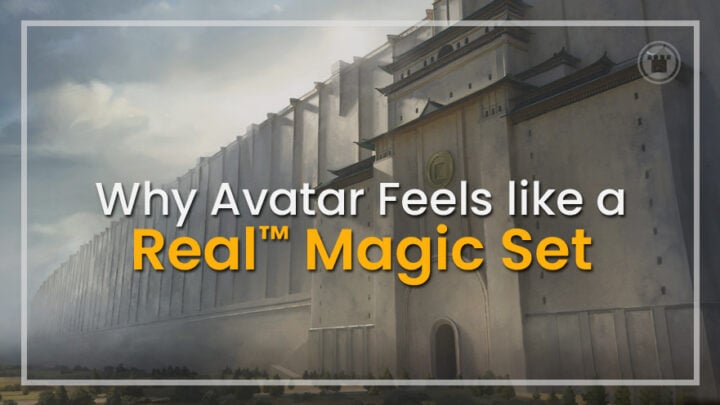
Some Universes Beyond sets fit better than others. What makes Avatar: the Last Airbender slot into the upper echelon of Magic tie-in sets, and why does it feel so natural? As someone completely unfamiliar with the franchise, Kristen takes us through her thoughts.
I can sum up for you in a short paragraph how familiar I am with Avatar. I know it’s set in an East-Asian setting, with more of a China vibe, but clear borrowing from other cultures like Japanese and Vietnamese. It seemingly takes inspiration from Buddhism and Hinduism (and the Book of Five Rings) with the element system, and in general, has a fairly generic eastern fantasy anime meets wuxia vibe. Oh and the main guy has a blue arrow on his head, which I assume demarcates him as the Avatar. Oh and Toph is blind. We love Toph, apparently.

That’s about where my Avatar knowledge ends, but I’ll be honest… that’s a similar amount of set up and basic worldbuilding as a lot of Magic sets. It’s not crazy to suggest that the Avatar set slots in nicely between Khans of Tarkir, Champions of Kamigawa, Kamigawa: Neon Dynasty and a more eastern take on Zendikar or even Adventures in the Forgotten Realms.
But that’s just the overall vibe, right? It’s fantasy in a historical time period, without all the mod-cons of Duskmourn or Doctor Who. What in particular does the set get right, though, that makes it feel like a Magic set?
PEOPLE

All great Magic sets have clear factions. If you were to ask Rebell, she’d say that the great sets also have a clear resistance theme, and a clear antagonist or existential threat to ally against. When I think of the best draft environments and the sets with the most cohesive worldbuilding, and the sets that players can identify with the most, it’s usually the ones with factions. Think the Guilds of Ravnica, the Clans of Tarkir, the Schools of Strixhaven. It’s the Mirrans vs the Phyrexians, the Innistrad citizens vs the Monsters (and later both, against the Eldrazi). It’s an easy way to get people invested and tell a story.
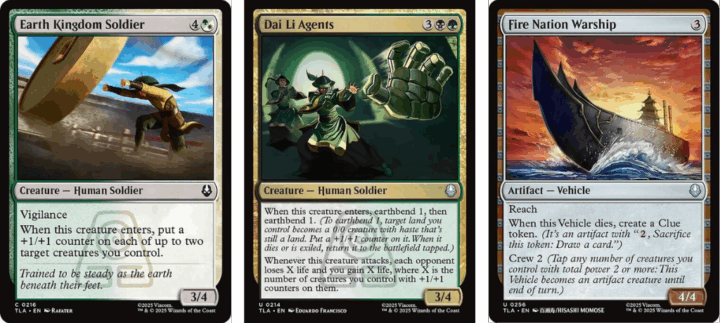
Even as someone who has no idea about what the story of Avatar is (and I can surmise it’s a typical Hero’s Journey for Aang, mixed with the other protagonists having their own arcs, and an overarching background political situation that erupts into war), I can easily grok on the cards who the factions are and what the general gist of the conflict is. The Fire Nation seem like the antagonists, and the other clans/tribes/nations (Earth, Water and Air) seem like disparate factions that ultimately unite (which you can see really well with Katara and Sokka and the Ally mechanics in general).
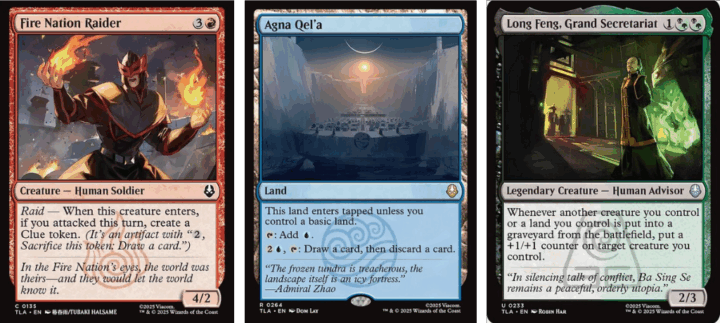
What’s more, the different factions not only have strong art direction to make them instantly recognizable, but they also bear an iconic piece of Magic frame technology: the watermark. All of this adds up into conveying to us the conflict and the players, and it makes the set one that is easy to pick up. Folks will be naturally drawn toward the faction they identify the most with.
PLACE
Hand in hand with people goes place. Place is one of the hardest things to communicate in Magic’s current approach to storytelling. When you move away from block-based storytelling, you lose (some of) the ability to convey a journey, displacement, or movement of the protagonists. You also lose the ability to convey the passage of time; actions and consequences, the toll of war, the subversion or destruction of a plane by an existential threat, the overthrow of regimes.
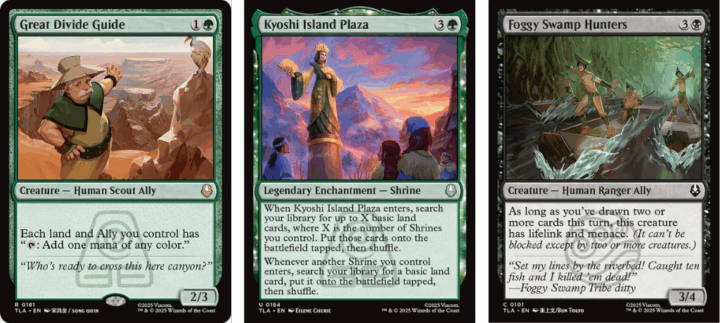
Avatar, like any Magic set still suffers from this lack of block based structure, particularly in how it rams an entire story into one set. It’s hard to figure out the starting point of the story, and the main story beats. That said, it doesn’t detract from it in a way that totally negates the storytelling it sets out to do. One of the reasons for this is that the sense of place in Avatar is so strong. You have the Water Tribes, the Air Nomads and their Monasteries, the Earth Kingdom, the Fire Nation, and the miscellaneous people and places in the surrounding lands.
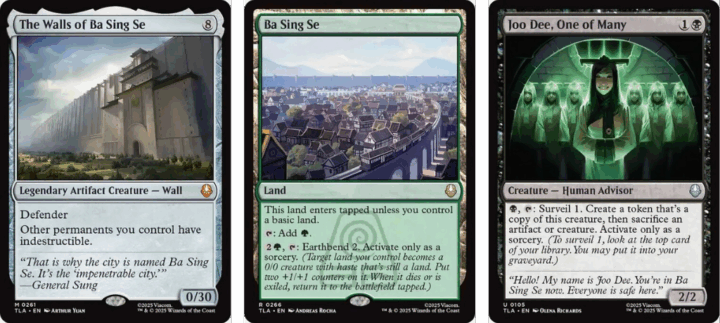
The art direction for the places is just as strong as that of the people, and we feel real divides in how these places affect how the people live, and the politics therein. Ba Sing Se, for instance, is shown to us to be a bulwark. The 0/30 wall tells me all I need to know, and I can put that together with the iconic “there is no war in Ba Sing Se” meme-worthy line to understand that this is a faction who are perhaps the strongest in opposition to the Fire Nation, and one that resembles Qing dynasty China. The propaganda of the aforementioned meme also alludes to the fact that all is not what it seems.


The obvious place to look for solid reinforcements of Place is in the lands. The different Basic artworks tell us how these peoples live.
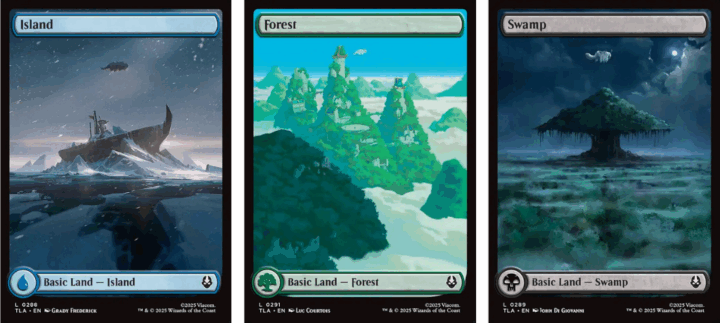
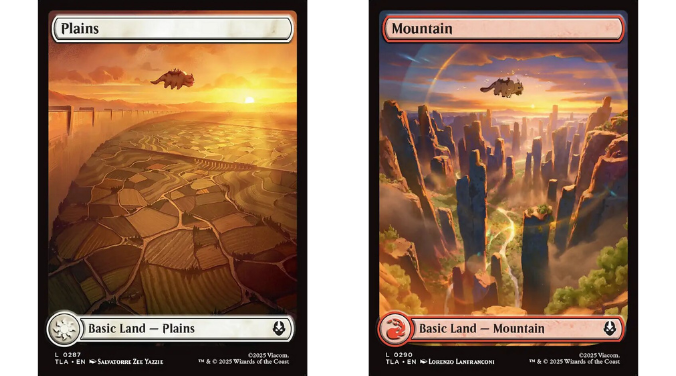
The Full Art lands show the journey of Aang and company.

The dual color lands have succinct and effective flavor text, telling us all we need to know. Kyoshi Island, for instance, seeks to be safe from Invaders. Meanwhile, the Fire Nation are expanding, and their penal policies are on the fascist side.
This feels far more in keeping with regular Magic sets than other recent sets. One of the biggest failings of Duskmourn was that we never got to see the plane before the House took it over. It’s already the end point, and so we don’t know what we lost, or what we’re rooting for. When you compare Avatar with Spider-Man, too, you see a stark contrast in how place is handled. New York isn’t a particularly exciting place for a Magic set, and its very hard to communicate any of those normal things that place communicates on Magic cards when that place is a bland cityscape where nothing really changes aside from the odd explosion or crash. This was compounded by how many disparate characters and storybeats were crammed into that set; it was less of a story and more of an expanded Secret Lair.
ART DIRECTION
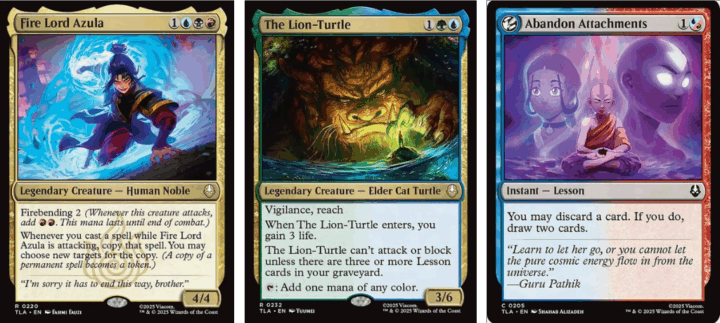
The art direction is what ties together the people and the places, and it’s highly effective at doing just that. One aspect of this is the generous use of color. This isn’t the drab and tired aesthetics of a typical war-torn Magic plane. You have rich blues, greens, and reds, vibrant orange and yellow, and everything in between.
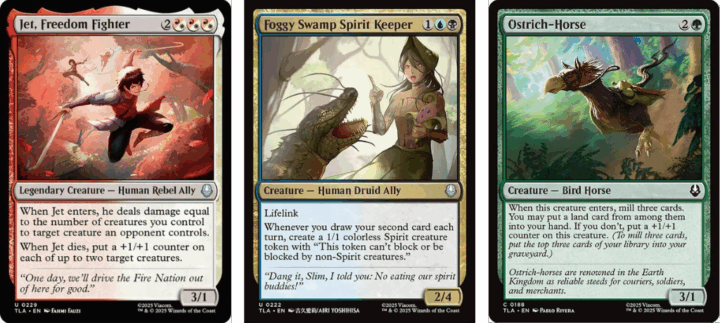
The art direction for the set (aside from some of the bonus sheet cards, which I don’t want to talk about here) is also stellar. It might seem alien in its anime aesthetic if not for the “priming” we’ve had from other sets. It’s less manufactured consent here, though, and more just a natural evolution of what we’ve already seen in recent years.
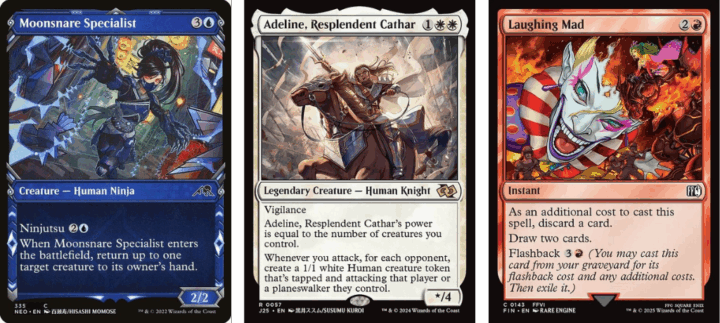
Anime art that is even more radical has shown up in Kamigawa: Neon Dynasty. We’ve had the anime art of Jumpstart cards, and most recently, we’ve had a Final Fantasy set. Given what has come before, the art of Avatar (barring a few exceptions of goofiness) is essentially more of the same.
MECHANICS
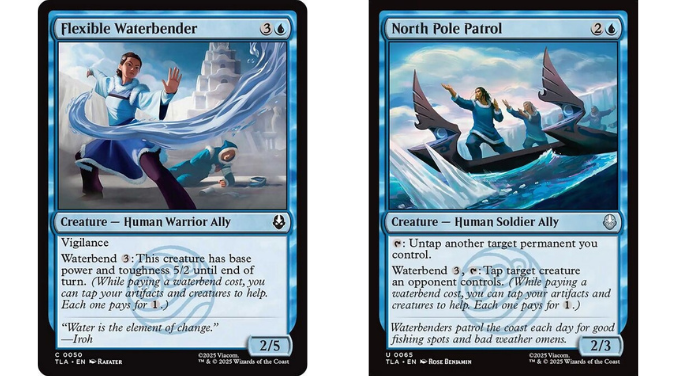
Tying it all together are some solid mechanics that are unique to each faction – mechanics that are also fun to play with, and feel unique enough to this setting. While Waterbend just feels like mashing Convoke and Improvise together, it still has the feel that you are putting more effort into bending the element involved – which evokes the sweeping arcs and graceful movements of the Tai’Chi’Chuan which inspires it.

The Shaolin flavor of firebending evokes the rapid strikes and lethality of the Fire element, and feels quite close to the Jeskai in Tarkir – which to me feels like a massive flavor win, and again communicates to the player the overall vibe of this mechanic well. It’s all about frontloading information to help people catch on, and this does exactly that.

Other martial arts styles lend themselves to Airbending and Earthbending, but those mechanics are based on two of the most recognizable and fun mechanics in Magic history – blink, and animating lands. Both succeed in offering both something new, but also something that feels unique, which I’d say is a challenge in this well-trodden space.
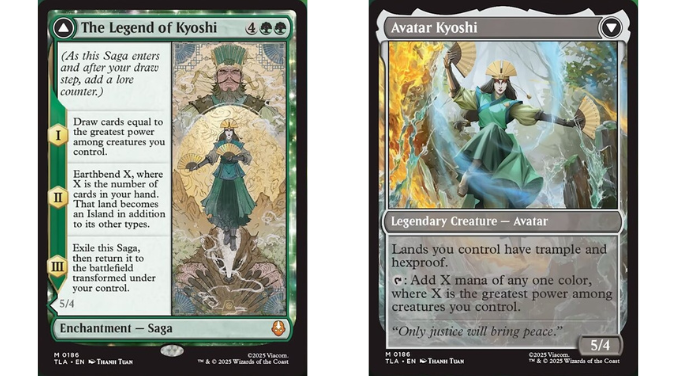
Rounding things out are Sagas and Transform cards, staples of Universes Beyond storytelling. They give us some of the sense of “place” where it intersects with “time” that we otherwise miss by not being in a block of sets. I haven’t even mentioned how the Shrine cards cement a sense of place amidst the turmoil, or how Lesson cards convey the growth of the journey Aang is on.
It all comes together to feel like the vision really played out in the cards, and the set is stronger for it.
END STEP

The narrower focus on what makes a good Magic set has done wonders for Avatar’s reception, as it feels more like a Magic set than many other Universes Beyond products. Crowbarring in so many Spider-men into Spider-Man made it chaotic and messy, and New York didn’t give it a strong enough sense of place. Even well-received products like the Fallout Commander decks had to cram multiple entries in and covered such a broad range of mechanics that they felt less cohesive than Avatar.
Ultimately, Avatar benefits from faction-based storytelling and conceptualization, and it benefits from being historical fantasy. It also benefits massively from being just one story in one set, rather than the multiple we get in other Universes Beyond sets. The story, even if I don’t know it? It has stakes. And it makes me want to learn more about it. When all of that aligns, you end up with some of the best Magic sets of all time. Is it any wonder that this set is a hit?

Kristen is Card Kingdom’s Head Writer and a member of the Commander Format Panel. Formerly a competitive Pokémon TCG grinder, she has been playing Magic since Shadows Over Innistrad, which in her opinion, was a great set to start with. When she’s not taking names with Equipment and Aggro strategies in Commander, she loves to play any form of Limited.