

Most of the popular Commander decks are quite conventional when you strip back a few pet cards and the choice of what basic lands to run. Further still, the most popular typal decks are the very definition of convention, with lists varying only in small ways. Today I want to talk unconventional – because unconventional Commanders can be way more fun.
THE PROBLEM WITH STICKING TO CONVENTION
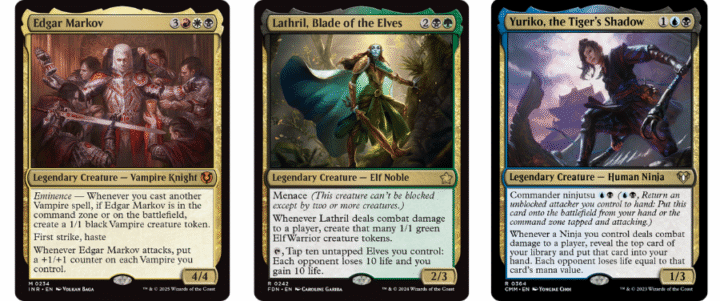
Edgar Markov. Lathril, Blade of the Elves. Yuriko, the Tiger’s Shadow. If you’ve played against them once, you’ve played against them all – because the small differences in iteration between anyone’s list for these decks can be so minute you’d feel like you’re playing against a stock list. While there are ways to make the most popular decks in the format more unique – like running Tap/Untap matters Lathril, Changelings Ur-Dragon, or running a mostly Orzhov Edgar deck with a budget manabase – by and large these decks play out the same way every time.
Some folks aren’t a fan of type matters gameplay, so it’s much easier to pick something else in that case. Many of us still enjoy playing typal decks, though, so what’s to be done?
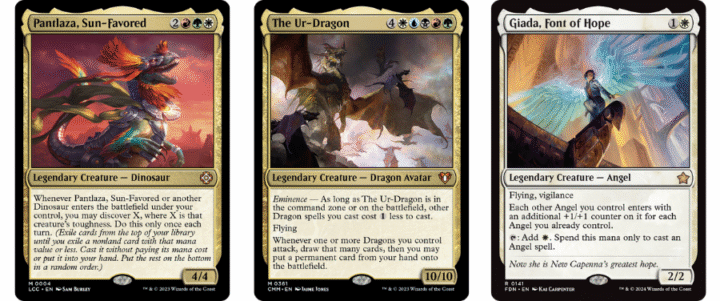
Well, it’s time to dig for something a little more unconventional in order to get your kicks. I want to look at three popular Typal Commanders today – Pantlaza, Sun-Favored, The Ur-Dragon, and Giada, Font of Hope – and throw a curve ball at you with a new way to try these iconic archetypes.
And I promise you – you will have a lot more fun, and so will the rest of the table. Novelty is fun. Repetition, less so.
TRY PLAYING FEWER COLORS
One way to change-up a mainstay archetype is by restricting yourself on colors. Pantlaza is indisputably the most powerful Dinosaurs Commander because it has access to white’s flicker effects, red’s haste and damage amplification/burn, and green’s ramp. It comes down earlier than previous Dino staple Gishath or the combo-tastic Zacama – which let’s be honest, is less of a Dino deck and more of a combo deck. What if you removed access to the Etali cards, and the powerful support of white and red?

Surrak and Goreclaw is my friend’s answer, and it’s a deck that I always have to keep on my toes for. Surrak and Goreclaw is the anchor of the deck in that it gives your board trample and haste, and buffs the power of creatures that enter play. You get all of the ramp and haymakers you want in green, and you also – and this is pretty key – get to keep the haste part from red.

Wayward Swordtooth and Tranquil Frillback make up your early curve, with the deck able to take advantage of Emerald Medalion as a ramp piece, and Tribute to the World Tree as card advantage. Going monocolor unlocks some cards like this, which S&G really take advantage of, considering you want to flood the board with multiple creatures as early as possible. Given your board usually has Trample, Unnatural Growth gets much better (and easier to cast), and an Ohran Frostfang provides not only draw, but a way to push damage through blockers.

Of course, while you don’t have the likes of Etali, you still get to play haymakers like Ghalta, Stampede Tyrant and Vaultborn Tyrant, which are rightfully feared in our playgroup. Oh, and just when you think the deck might be on the way out, a cheeky Verdant Sun’s Avatar can create a huge tempo swing. Oh, and if you need someone dead quick, there’s always Tyrannex Rex, right?
Mono-green is a really fun way to play a Dinosaurs deck, and if you want to check out my friend’s deck, you can do so here.
FEWER COLORS, AND A DIFFERENT STRATEGY, TOO
One interesting part about Surrak and Goreclaw is that neither of them are Dinosaurs. Like all of the alternative Commanders I’m going to propose today, they aren’t of the type that the deck is built around. That’s something I want to emphasize when you’re looking for a good typal Commander to try – don’t limit yourself to the more cookie-cutter options, as you could well find something that’s way more interesting.

Last week I mentioned how Twilight Diviner was making me want to rebuild a Chainer, Nightmare Adept deck. I’ve gone over some ideas for the deck, and rather than making a generic Reanimator list – which is what I ran last time, and what I more or less have in an existing Henzie deck right now – I decided to narrow the focus. I ended up at Rakdos Dragons.

Rakdos Dragons is not something you see every day. While in recent years Rivaz of the Claw has become quite popular, Ur-Dragon, Miirym and Tiamat are all ahead, with Lathliss, Kaalia and Scion of the Ur-Dragon not far behind. While I find Rivaz interesting, I wanted to explore the archetype deeper in Chainer.

Chainer offers a more consistent and repeatable form of Reanimator, and couples it with a discard outlet and haste. While the mana from Rivaz is nice, I’m happy to just plug it in the 99, and enjoy the anchor piece of Chainer in the command zone. We can still build around Dragons and payoffs – like the damage wrath wincon of Wrathful Red Dragon – but use Chainer staples like Doomed Necromancer and Archpriest of Shadows to cheat out our high-mana beasties way ahead of curve – and arguably more efficiently than a Rivaz deck.

Coupling Dragons with the kind of engines and payoffs a Chainer deck has access to is one way to make a Dragon deck that stands out from the usual “ramp and card advantage” three-to-five color builds. You also get to capitalize on the red burn aspect, with haste, in a way that the multicolor decks sometimes scale back on due to their overreliance on green and blue.
Overall, having this focus means your Rakdos Dragons deck will feel more like it has a gameplan than the average Ur-Dragon deck, and that’s pretty cool.
SOMETIMES, YOU GOTTA ADD COLORS AND POWER UP
While the previous two sections discussed narrowing a focus and powering down by removing colors, some decks actually benefit from going in the opposite direction. Angels decks, for instance, currently find themselves in a bit of a weird spot. They get to play clunky mono-white Lyra Dawnbringer or clunkier still Rodolf Duskbringer or Shilgengar. The most popular options tends to be mono-white Giada – which solves some issues, sure – or Kaalia, which is often not purely an Angel typal deck.
Angels lack card advantage and ramp compared to other high-mana value archetypes, and so this is an issue that can be solved by going a little outside of the box.
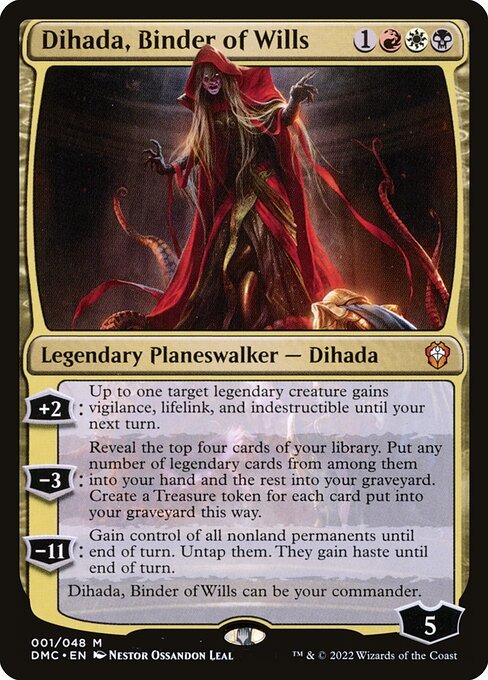
Dihada, Binder of Wills might not be what you think of when you think of an Angel typal Commander, but stick with me. First off, she solves wanting to play multiple colors other than mono-white, while both mana fixing, ramping, and letting you dig to find the angels you want. She also helps dole out vigilance, lifelink and indestructible, keywords Angels love to make good use of.

There are already a whole host of Legendary Angels to play in these colors, from Aurelia, Lyra and Giada to Liesa, Firja and Akroma. By packing your deck with legendary lands and select legends like Odric, Lunarch Marshal, you get to share keywords among the team and hit in for big damage, while protecting Dihada with chunky flyers.

Even though Dihada is geared towards Legends, you can run plenty of non-legendary Angels alongside your legends. Karmic Guide is just good whichever way you slice it, much like Righteous Valkyrie. If you mill some non-legends it’s fine, as you can reanimate them later with big swings like Living Death or Patriarch’s Bidding.
Dihada solves a lot of issues that casual Angels decks suffer from, and so she’s a fine option to delve into the archetype deeper. She also lets you run your favorite Planeswalkers – like Serra or any of the Elspeths – in a shell that is already geared toward protecting a Planeswalker in the command zone. By giving Angels access to more colors, more mana, and more ways to get them into play, you end up giving them basically what a lot of other creature types natively have access to in their own Commanders already.
That can be the difference between feeling like you’re punching up, and feeling like you’re on a level.
END STEP
Conventional Commanders can get tiring, especially if multiple people in your playgroup or local game store run the same Commanders. Chances are, when it comes to those popular archetypes, other folks will be running them too. If you can divorce yourself from the typical go-to Commanders and explore something off the beaten track, you might end up with a deck that’s more unique, more fun, and more timeless.

Kristen is Card Kingdom’s Head Writer and a member of the Commander Format Panel. Formerly a competitive Pokémon TCG grinder, she has been playing Magic since Shadows Over Innistrad, which in her opinion, was a great set to start with. When she’s not taking names with Equipment and Aggro strategies in Commander, she loves to play any form of Limited.