

Magic’s next set is Teenage Mutant Ninja Turtles, which releases on March 6th and is available for preorder here at Card Kingdom. Unsurprisingly, the Mutant, Ninja, and Turtle creature types are all quite prominent in the set.

While “Mutant” might seem like the kind of creature type that is exclusive to Universes Beyond sets like TMNT and the upcoming Marvel Superheroes, it’s actually a creature type with a fairly long history in Magic: the Gathering. In this article, I’m going to take a look at Mutants throughout Magic’s history, taking a look at their lore as well as the most prominent Mutant cards so far.
In the Magic story, mutants are beings that have been changed from their normal state by some sort of external source. These external factors are often magical. While Ice Age’s Goblin Mutant is technically the oldest card with the Mutant type, it only gained it retroactively after the Mutant type was officially created in 2002’s Onslaught.

THE MIRARI MUTANTS

On the plane of Dominaria, there’s a powerful artifact called the Mirari, which is capable of granting the wishes of whomever wields it, often with disastrous results. The Mirari ultimately ended up in the hands of a Barbarian named Kamahl who for a time had the legendary artifact in the hilt of his sword.
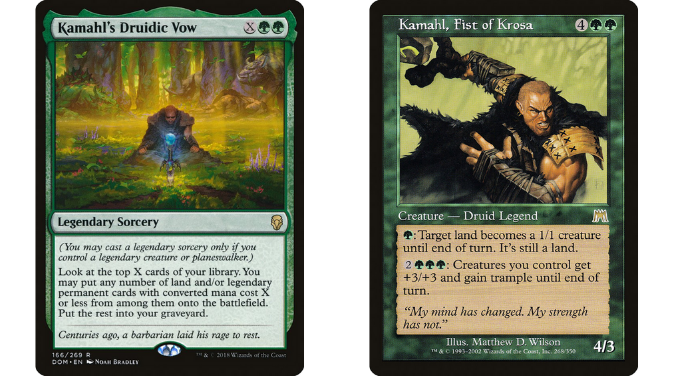
After realizing the Mirari caused more harm than good, Kamahl hid it on the continent of Otaria, in the Krosan forest. He became a druid who guarded the Mirari to prevent anyone else from making the mistake of wielding it.
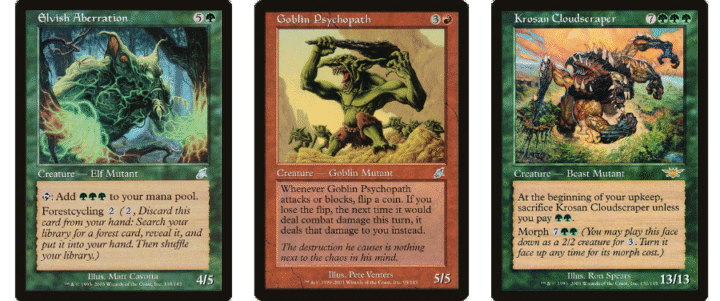
However, even without a wielder, the continent of Otaria itself began absorbing the Mirari’s magic, and its residents became mutants as a result. Most Mirari mutants are hulking, crazed versions of their former selves. Ultimately, these mutants overran the entire continent.
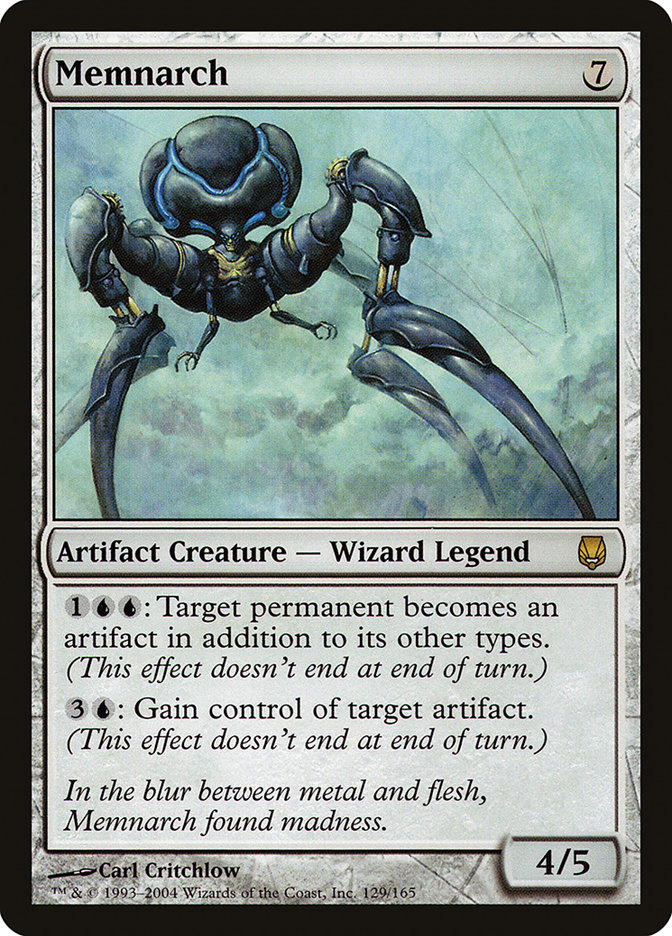
Eventually, the creator of the Mirari – the planeswalker Karn – reclaims it, and removing it from Dominaria meant the end of that plane’s mutants. He had only intended the Mirari to be a device that would allow him to keep an eye on his home plane while he was away, and all of its additional effects were unintended consequences. In the end, he takes it to a plane of his own creation – Mirrodin, and animates it, resulting in the creation of Memnarch who, curiously, is not a mutant himself.
NOTABLE MIRARI MUTANTS

When it comes to 60-card formats, Goblin Goon was the most successful of the Mirari Mutants, putting up several Top 8s in Block, Standard, and Extended between 2003 and 2005. His 4-mana 6/6 body was huge at the time, especially when paired with the plethora of Goblin payoffs introduced in Onslaught Block. His downsides were pretty trivial in a deck that virtually always controlled tons of creatures.
In Commander, Sliver Overlord is undoubtedly the most prominent Mirari Mutant. It can tutor up whatever Sliver you want, which is especially potent in a Sliver deck. This is because virtually all Slivers come with effects that buff all Slivers, and being able to grab the right one for the job is pretty nasty. As such, it’s a staple in Sliver decks, even regularly appearing as a Commander.
THE MUTANTS OF THE SIMIC COMBINE
MOMIR VIG’S MUTANTS
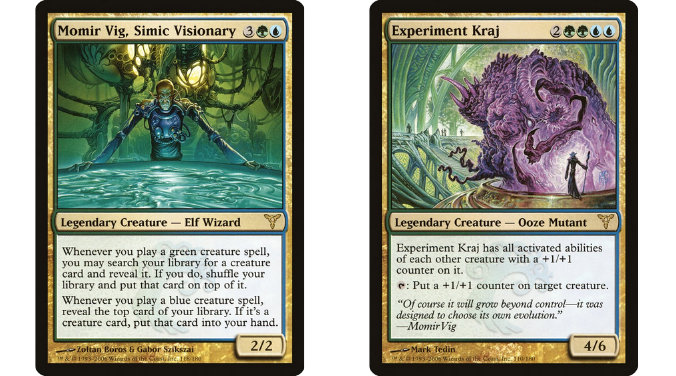
Following Onslaught Block, mutants didn’t become prominent again until 2006’s Dissension, the first set to ever feature Ravnica’s Simic Combine. The Simic’s role on the plane is to preserve, observe, and improve the natural world. The guild’s biomancers specialize in combining magic and science to create mutated beings that often have the combined features of several different organisms.
The greatest of these biomancers (in his opinion) was Momir Vig, who was also the guildmaster during the events of Dissension. He created cytoplasts, little orbs that share the genetic information of different organisms with one another.
His greatest creation was Experiment Kraj, a colossal Ooze Mutant that was essentially created from a blob of cytoplasts. Momir and his cytoplasts were conveyed in Dissension with the Graft mechanic, which allows creatures to share traits with one another in the form of +1/+1 counters.

RETURN TO RAVNICA’S MUTANTS
Momir Vig died during the events of Dissension, and while the Simic Combine would change, its focus on creating new and “better” organisms would continue, as we would see in Return to Ravnica Block (2012-2013) . However, they no longer used cytoplasts, instead looking to create beings that physically have the traits of more than one organism. This mutated mixture of two species is known as a krasis.

VANNIFAR’S MUTANTS

We next got an extended look at the Simic in 2019’s Ravnica Allegiance. By this point, an elf named Vannifar was the guildmaster. Under her leadership, mutants continued to be created, but she drastically changed the purpose of these mutants. She created the Guardian Project, which sought to create super soldiers whose job was to protect the Combine.

These soldiers could gain traits and adapt during battle to increase their combat effectiveness. Many of those working on the Guardian Project experimented on themselves.

The greatest success of the Guardian Project was Roalesk, who himself would not look out of place in a Marvel Super Heroes set. After all, he has a cape-like appendage and possesses a slew of abilities – including flight and super strength. He was instrumental in fighting for the Simic during two cataclysmic conflicts – the War of the Spark and the New Phyrexian invasion. So ultimately, the Guardian Project did exactly what it set out to.
NOTABLE SIMIC MUTANTS
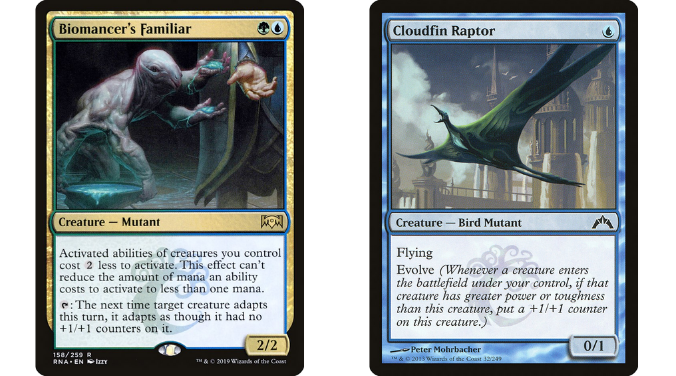
In 60-card formats, Cloudfin Raptor is the most successful Simic mutant as it saw very heavy play in Standard. It was a frightening one drop, since its Evolve ability would allow it to grow as you continued to curve out. Paying one mana for a ⅘ flyer is a pretty amazing deal.
In Commander, Biomancer’s Familiar is the most successful Simic mutant. Its ability to reduce the cost of activated abilities makes it a useful inclusion in any deck with a Commander that has such an ability.
OTHER ASSORTED MUTANTS

While most of Magic’s mutants were either created by the Mirari or the Simic, mutants have made brief appearances elsewhere, although we don’t always get a detailed explanation for what makes them mutants. For example, on Alara’s Grixis shard, there are Ogre Mutants known as “Incurables,” who have been altered by a mysterious curse.
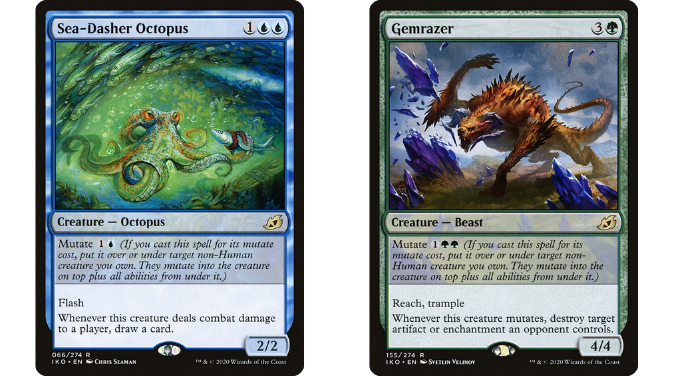
You might also be thinking that creatures from Ikoria: Lair of Behemoths who can mutate would have the Mutant type – but they don’t! I mean, the definition of “Mutant” is ‘“one that has undergone a mutation.” So, once creatures are mutated together, they should definitely gain the “Mutant” type. This is a pretty big flavor fail.
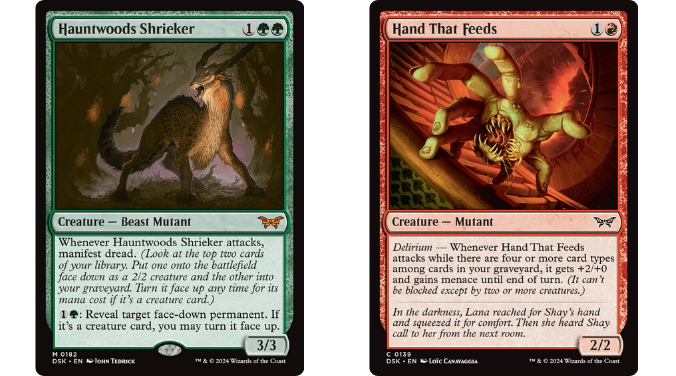
More recently, Duskmourn featured a handful of mutants. Duskmourn is a world that has been warped around the powerful demon Valgavoth, and its denizens are often transformed to suit his purposes, so it’s fairly safe to assume that’s what created them.
UNIVERSES BEYOND MUTANTS
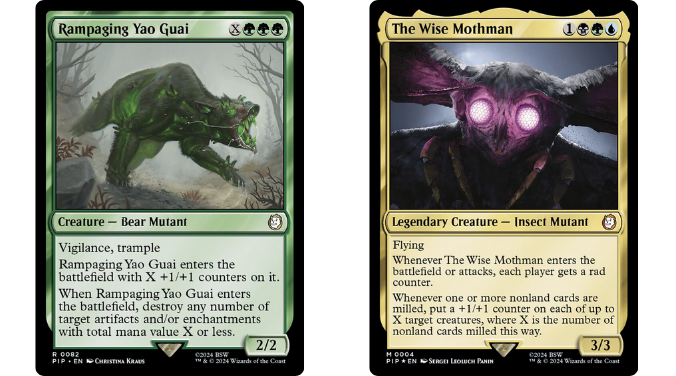
While the “Mutant” creature type has a fairly long history in Magic, it is also true that Universes Beyond sets have also resulted in many more creatures bearing the type to be released. This was most notable with Fallout. That IP is all about a world that has suffered the mutually assured destruction of atomic war, and the world’s beings have been heavily mutated by radiation.
FUTURE MUTANTS

We’re going to get many more Mutants over the next year or so. In fact, 2026 will probably be the most Mutant-heavy year in Magic history. Teenage Mutant Ninja Turtles will undoubtedly feature dozens of new Mutants, and June’s Marvel Super Heroes is also going to heavily feature them. We haven’t seen much of that set so far, but we have already seen that Marvel’s Mutants will be making a significant appearance.
In the Marvel Universe, Mutants are a little bit different from what we’ve seen so far in Magic. They aren’t beings that were once “normal” and then exposed to something that altered them. Instead, Marvel’s mutants are simply born with a mutation – one that conveniently grants them super powers. Most notably, the X-Men are made up entirely of Mutants.
END STEP
That does it for this week. What Magic mutants are you favorite? Are you looking forward to more being printed this year? Let me know your take over on X or Bluesky.
Also, if you’re interested in an even deeper dive on the most important Mutants in the history of competitive Magic: the Gathering, I have a Top 10 list for that over on my YouTube channel.

Jacob has been playing Magic for the better part of 24 years, and he especially loves playing Magic’s Limited formats. He also holds a PhD in history from the University of Oklahoma. In 2015, he started his YouTube channel, “Nizzahon Magic,” where he combines his interests with many videos covering Magic’s competitive history. When he’s not playing Magic or making Magic content, he can be found teaching college-level history courses or caring for a menagerie of pets with his wife.