
Aristocrats is a popular archetype in Commander. It involves sacrificing the peons, the proles and the plebians in order to advance your cause, crushing the tokens and small creatures underfoot in a relentless pursuit of power. But is it all that it’s cracked up to be, or is it something of a trap?
THE ALLURE OF ARISTOCRATS DECKS

Aristocrats decks can be attractive. Even as I write this article, Teysa Karlov is still #41 on the Top Commanders of all time. If you look for her contemporaries – other decks classed as aristocrats decks – on the same EDHRec rankings, you’ll find Meren of Clan Nel Toth at #40, but then a very steep drop off from there, with the other popular aristocrats decks barely breaking the top #300 (save for Chatterfang, at #21).

That’s not really the full story, though. Meren is more of a Reanimator deck that can do some sacrificing for value, and Chatterfang is a Squirrel typal list and also a tokens deck that wants to swarm the board, not chew through it. Hell, even looking at Teysa, I’d clarify her as way more of a lifedrain deck – a burn deck – than anything else, as her typical play pattern is to double life manipulation triggers.
Still, it remains a popular archetype, mostly because on paper, it sounds incredible.
You get to utilize repeatable mana and card draw engines, meaning you don’t run out of card draw spells. You get to take advantage of staying alive via lifegain synergies, and you can use edict effects to keep opponents in check. It’s a little grindy, but it’s a winning strategy, right?

ARISTOCRATS GETS STUCK SPINNING WHEELS
The problem with using your board state to generate value is that you end up chewing through your resources and end up either exactly where you started, or even behind.
Most strategies in Commander accrue draw or ramp by taking a game action that is – if not a net positive, as you go down a card – at least positive to your board state. You end up with one or more extra permanents, and closer to critical mass.
Aristocrats, on the other hand, likes to throw away those incremental accruals of resources in favor of churning through the deck to find something. Regardless of how powerful that thing you’re trying to build to or find is, you’re spending your turns depleting the board state you’ve spent mana and cards on. While that might not seem like much of an issue when viewing Magic through the scope of 1v1, it does end up being an issue in multiplayer.
When three players are constantly adding to the board and you’re spending similar amounts of resources to add to yours while also deleting parts of it to achieve what they are achieving through curving out, you’re going to end up usually playing from behind.
But that’s what edicts are for, right? The ability to sacrifice your permanent for value, while forcing everyone else to sacrifice theirs for zero value? Well, it ain’t so cut and dry. While edict effects will force opponents to sacrifice permanents for (usually) no value, the difference is that they’ve already gained value from an EtB or Attack trigger. So, while losing the permanent will set them back, they’re not being set back as far as you’d think.
Value generation has become so much easier in the almost 7 years since Teysa dropped in Ravnica Allegiance, arguably the peak of Aristocrats’ popularity. No longer are you stopping engines being set up with an edict – you’re effectively just playing removal spells that trim the verge.
The other problem, of course, is that the social contract forbids true feudalism.
NOBODY LIKES BILLIONAIRES
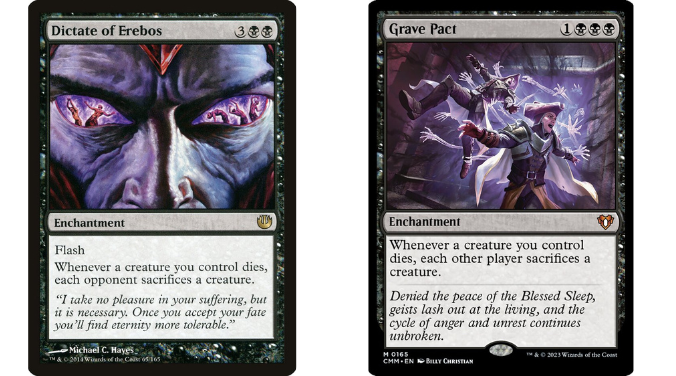
Much like the harder stax in white decks and the land destruction in red and white, black’s penchance for Grave Pact effects is stymied by the social contract.
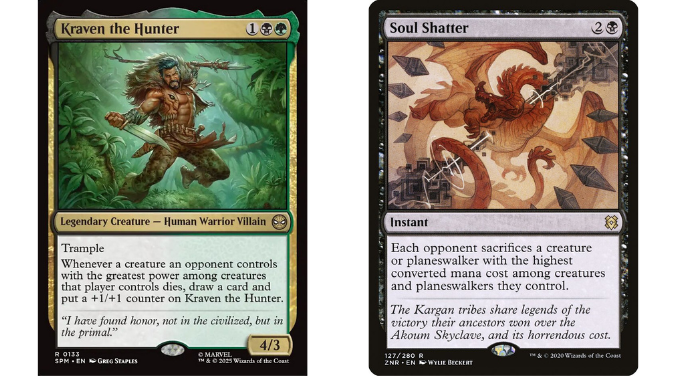
These effects – or decks like Kraven the Hunter, filled with Soul Shatter effects – are increasingly at the margins of the format, and even though they’re way more reasonable in Bracket 3 than below, folks still tend to shy away from them. The reason is that this strategy tends to just grind the game to a halt, and it doesn’t really win. It’s control for control’s sake, and without a combo finish or lifegain, you’ll just die really, really slowly.
That’s why Teysa tends to be the favored option for the strategy. She helps with gaining a lot more life – and increasing the rate at which opponents lose theirs.
ENTER SYR VONDAM
I loved Edge of Eternities, and one of the cards that I really loved was Syr Vondam, Sunstar Exemplar.

I loved the idea of the push and pull of whether folks would want to remove it or not. It represented a decent clock in the Command Zone, and a way to keep boards in check.
Before I played it in Commander, I hit the 1v1 Brawl queue on Arena. Syr Vondam did surprisingly well, and it’s because the tempo oriented nature of the card is perfect for 1v1 gameplay – there’s a reason it’s a top pick in Limited. Playing it alongside other low drops to keep the pressure on worked really.
In Commander, it was a different story. Folks saw it as a threat in a similar way to Ayli, Eternal Pilgrim. Vondam presented a known threat to other players, and so I was unable to get him big enough to pressure opponents. What’s more, the aristocrats engine that encouraged me to sacrifice my board (to fuel my Commander, too) left me without enough blockers or enough board presence to survive the mid game and convert to a win. I obviously didn’t build the deck as “Ooops All Edicts!” either, which left the deck feeling altogether a little weak and durdly.
ARISTOCRATS DECKS ARE A TRAP

After playing Syr Vondam (and later deconstructing it), I talked with some friends about it, and got to the point where I practically swore off of Orzhov. I’m a big Mardu™ gamer, but all said and done it’s Boros and Rakdos I enjoy, and I find red to ultimately be a better support color than black (which is an article for another time).
After sitting with these thoughts a few weeks more, I think it’s less about Vondam, and more about Aristocrats. Aristocrats decks are a trap. They’re just a wheel-spin, a way to sit there doing a fat lot of nothing. The best “aristocrats” decks sacrifice things incidentally, and are built around another strategy entirely.
But what do you think? Have you had a similar experience? Let us know on Socials.

Kristen is Card Kingdom’s Head Writer and a member of the Commander Format Panel. Formerly a competitive Pokémon TCG grinder, she has been playing Magic since Shadows Over Innistrad, which in her opinion, was a great set to start with. When she’s not taking names with Equipment and Aggro strategies in Commander, she loves to play any form of Limited.