
Feeling nostalgic this week, I decided to look back on a deck from 2019 to figure out just how many of the cards in it I’d be happy playing today, in 2026. How many cards have survived power creep – and how many have aged like a fine wine?
WHY I CHOSE AURELIA THE WARLEADER

So, in order to really get a good comparison going, I decided that the best comparison was a deck that:
- Won primarily through combat
- Had a higher curve than the curves of contemporary Commander
- Was in colors that have changed the most in the past decade
This quite neatly led me to looking at a Boros deck, given that red and white have received a lot of love in the past few years (particulalry in the case of card draw and mana), and in an archetype that has seen big gains in average turn to win. The aggressive decks of today could cream the aggressive decks of yesteryear, and would only really struggle with the extra boardwipes that used to be played.
The deck I chose was my 2019 Aurelia Reanimator deck – a time capsule of a deck.
So, let’s break it down by card type, and then we’ll look at the overall strategy and how it would fare today – including the differences I’d take in approach to building the same deck.
Let’s begin with the vegetables.
THE LAND BASE
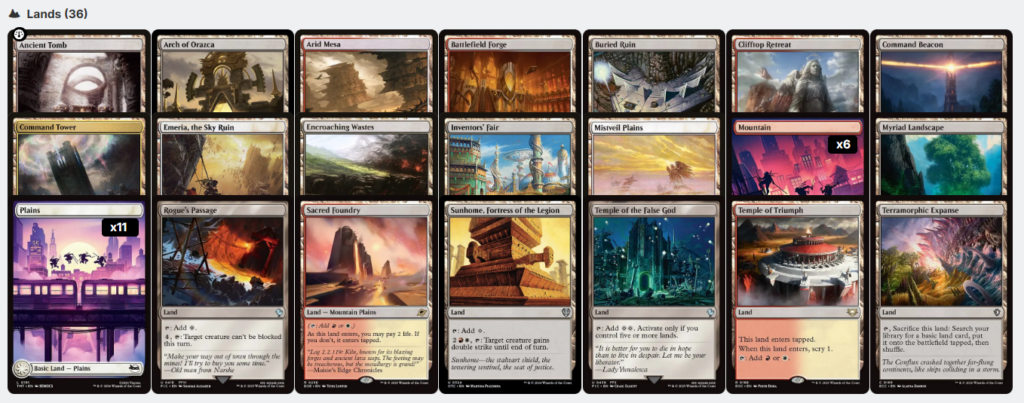
The land base, at first glance, is perfectly serviceable. It has our Boros shockland and Fetchland, some great utility lands, and even a cheeky Ancient Tomb. With eleven out of thirty-six lands unable to produce red or white, though, I’m not at all happy with how this looks in 2026.

Some lands immediately stand out. Arch of Orazca is today outclassed by Roadside Reliquary. We don’t appreciate Myriad Landscape entering tapped, and both it and Terramorphic Expanse can be replaced by a Fabled Passage or Prismatic Vista, or one of the newer RW lands – there are plenty to pick from, including Sundown Pass, Elegant Parlor and Radiant Summit. Encroaching Wastes isn’t even Ghost Quarter or Wasteland, and was definitely a budget pick back in the day.
Even Buried Ruin feels a little slow here, so that’s taking us to five cards I wouldn’t play, with a potential sixth in Command Beacon, if I’m honest. This isn’t the deck for it in 2026, which I’ll expand on a little later.
We can definitely fix the lands with ease here, and it’s not the first time today where I’ll look at the BAE (Boros Advantage Engine) to fix our problems.
PLANESWALKERS, REALLY?

The Planeswalkers in this deck all had a role to play, but it’s quite clear that their roles are all at odds with each other. This is a stellar example of how deckbuilding has changed over the years, as it highlights two main things. Firstly, that RW decks had to reach far and wide for effects they needed, like card draw. Chandra, Flamecaller is obviously getting cut here, but back in the day, a self-wheel on a ‘walker that could also wrath or represent six damage through combat with Aurelia in play was actually pretty good. It definitely met quadrant theory back in 2019.
Nahiri, likewise, offered an outlet for reanimator lines, and some solid removal. So why Elspeth, Knight Errant? Well, like Chandra, her +1 could offer a total of twelve extra damage though Aurelia – though this time, adding to the Commander Damage clock quite considerably. Elspeth is decidedly the weakest link in 2026, and of the three, I’d only really consider running Nahiri, which gives us another two cuts.
The second thing it highlights is the toolbox approach to singleton. Singleton Commander was a lot slower in pace seven years ago. While some games still ended around Turn 7-8, the journey to get there was often ended abruptly by a combo, rather than someone curving out. More commonly, games went to around Turn 9-10, and as such, a greater number of effects in a deck were relevant, and warranted. This’ll become apparent as we continue with our evaluation.
THE CREATURE BASE IS A PRODUCT OF THE TIMES
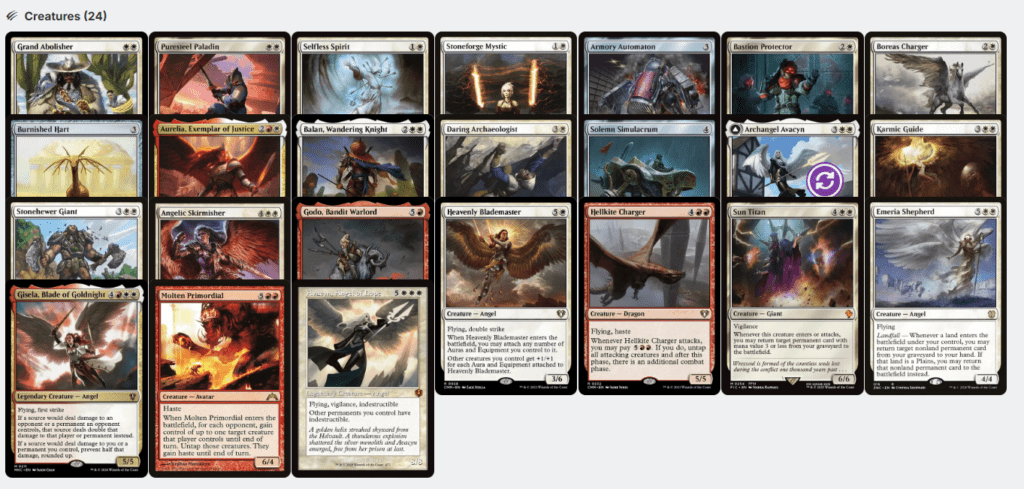
Looking at the creature base, we have a set of creatures trying to do radically different things. Again, this speaks to the square-peg-in-round-hole approach of trying to make Boros Reanimator work back before 2020. The archetype wasn’t adequately supported (and wouldn’t be until Strixhaven), and so when considering how the deck wins a game, a lot of space was given to Voltron/Commander Damage, with high-impact reanimation as something of a sub theme.

There are some quite obvious cuts I’d make in 2026, starting with the obvious: Boreas Charger sucks, and both Daring Archaeologist and Burnished Hart are dated in the extreme. Yes, ramping and recurring things in white was difficult before. This is the kind of jank we settled for – and we made it work. That’s in large part due to the longer games with more time to set up.

Elsewhere, the decks’ creatures fall into two main buckets: Equipment focused, and reanimator focused. Armory Automaton and Heavenly Blademaster are easy cuts here regardless, as the deck isn’t all in on Equipment, and we can be mana efficient in other ways these days (hello Forge Anew and Fighter Class). Likewise, Bastion Protector offers Indestructible, a keyword that matters a lot less now. Also, Aurelia, Exemplar of Justice just kinda sucks. A flavor pick for sure – and one I wouldn’t go near today.
It bears mentioning here before we go any further that while this style of schizophrenic deckbuilding isn’t appropriate to 2026 Commander and is one of the quickest ways for your deck to brick, it actually was pretty okay as an approach pre-FIRE design, and won me plenty of games. The rising tide raises all boats, and back then, the tide was a lot further out – and consequently, the velocity of games wasn’t near where it is today.

Back to today, and I’d look to cut Angelic Skirmisher, which doesn’t suit our build whichever direction we take it (Reanimator, or Equipment). Molten Primordial is better suited to a flicker build, and unless I’m all-in on Reanimator and also Angel typal, Avacyn, Angel of Hope is also way too costly. With Aurelia as our Commander, she functions as something of a curve-topper or game ender, and not a stepping stone to higher mana investments.

By taking a sneak peek at the Artifacts in the deck, it’s clear that this is both a Sunforger deck, and also a combo deck, that runs Helm of the Host and Sword of Feast and Famine. While I think I’d keep Godo if I was still running Helm of the Host, I think I’d be cutting Hellkite Charger for sure – and possibly Stonehewer Giant and Balan if I’m gutting the equipment theme.
That gives us another eleven cuts, taking us to nearly twenty already. It’s not looking good, is it?
Before we move to the next section, I’ll just cover that of our two enchantments, we’re good to keep Sigarda’s Aid and Land Tax at this stage.
ARTIFACTS

Our artifact selection isn’t all too horrendous, save for the glaring lack of ramp outside of a few key pieces. I’ll give 2019 Kristen credit for one thing, though, and that’s her being ahead of the curve on identifying that it’s more correct for aggressive decks to ramp by attacking than by playing mana rocks. It would take quite a few years for that to bear fruit, though.

There are some pretty suspect cards here, including Scroll Rack. Scroll Rack and Land Tax was Boros card advantage back in the day, and while today I’d still run Land Tax, Scroll Rack isn’t necessary – and is too durdly for this kind of deck. Again, Expedition Map suffers in 2026 from being a poor way to spend mana for a more combat oriented deck – even if it does find Emeria, the Sky Ruin. Also, is that a Relic of Progenitus?!
Relic of Progenitus is something of a time capsule here, isn’t it? Taking a main deck slot for a Relic of Progenitus is certainly a choice, and one that not only wasn’t punished back then, but was also clearly needed. Having access to repeatable cheap GY hate was crucial during longer games, where the graveyard was the waiting room between board wipes. Today I’d run something more proactive, or stapled to another effect I already wanted.

Blackblade is a little long in the tooth, and can be replaced by Excalibur. Hammer of Nazahn makes less sense if we’re not all in on Equipment (which I don’t think we are). Elsewhere everything seems pretty fine. I’d argue Thran Dynamo is still great in 2026, but that this deck isn’t best set up to play it.

That leads us to Sunforger. I love Sunforger. It gets better every year, as I wrote recently(ish). Is this the deck for it? No, not really. You need a Commander with free equips, in my opinion, or at least one cheaper to cast and equip to than Aurelia. That’s so. Much. mana.
I’m cutting it, which takes us neatly onto our instants and sorceries. Six more cuts, and we’re nearly to thirty. This Ship is going to end up Theseus’d beyond recognition, isn’t it?
INSTANTS AND SORCERIES

In light of cutting Sunforger, this section is one of the most interesting for sure. That said, there are some very obvious cuts.
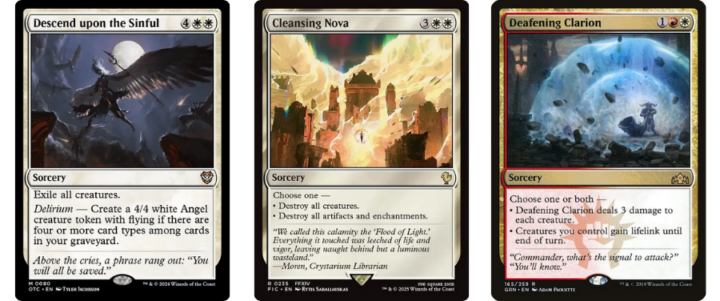
Our wraths beyond Austere Command leave us wanting. Descend Upon the Sinful might have got away with being a flavor pick in 2019, but today, it’s garbage. Cleansing Nova isn’t as good for us as Farewell, Hour of Revelation, Vanquish the Horde/Blasphemous Act, or Starfall Invocation. While I actually quite like Defeaning Clarion – and would go as far as to say it’s gotten better in 2026 – this isn’t really the build for it.

Both the removal and the protection in this deck is incredibly dated. Chaos Warp isn’t something we need in a post-Generous Gift/Solitude world, while Return to Dust has been, well, returned to dust. Comeuppance went from being a niche and explosive answer to less good than a myriad of other similar effects like Taunt from the Rampart.

Rebuff the Wicked and Wild Ricochet look awful when you have access to Bolt Bend, Untimely Malfunction, Deflecting Swat and Return the Favor. Lapse of Certainty is cute with Sunforger, but again… it’s just not that good, is it?
Beyond those, Wear and Tear isn’t my favorite option in this deck, though still fine. That’s another nine cuts, taking us beyond thirty, and rendering one-third of the deck decidedly unplayable in 2026. If we disregard the manabase, then we’re still approaching 50% of the cards in this build being unsuited to contemporary Commander.
Once we lock in on a strategy for an Aurelia deck in 2026, that number likely shoots up above 50% when we can cut more cards that don’t serve our overall gameplan. That’s quite the rotation – so what exactly should this deck look like in 2026?
HOW WOULD I BUILD AURELIA IN 2026?
The first consideration here is to choose a lane. If we’re in Bracket 4, then we’re all in on combo. We run the Godo and the Helm of the Host, and we go all in on equipment. Aurelia becomes a curve topper and a game ender, and our early game curve becomes quite similar to the one I run in Kassandra, Eagle-Bearer, a Bracket 4 Equipment deck that seeks to combo out as fast as possible.

If you want to min-max Aurelia, then this is likely where you want to be. The build would look a little different, with more attention paid to comboing with Aurelia (using any of the near twenty combos available, including those that flicker her using Sword of Hearth and Home/Ephemerate. Aurelia isn’t the best option as a Commander these days (being six mana, and not offering card advantage or mana advantage), but you can make her work.
If we’re going Bracket 3, I’m dropping Reanimator entirely, except for as a resource package to help us keep getting lands into play – using the Boros BAE. Reanimator in Boros is possible, sure, but doing it without a synergy piece in the Command Zone is hard, and not a way I’d advise to build your deck in 2026. If you want a higher or lower powered version of the archetype, then I’d suggest looking to a Commander like Hofri Ghostforge or Joshua, Phoenix’s Dominant, both of which I have lists for here and here.

For a Bracket 3 build, I’d be looking to curve out with value creatures that have strong mana and card generating ability, combined with strong attack triggers that Aurelia can come along and double up on. Creatures and non-creature permanents have gotten immeasurably stronger in the time since I had this deck in my rotation, and so focusing on combat – and winning plunder by attacking – should be the focus of the deck. You essentially want to end up as a Boros Isshin, Two Heavens As One. Depending how hard you go (or not), this deck could happily slot into Bracket 2 or 3, depending.
END STEP
Is it reasonable to see 50% of the nonland cards in a deck rotate in the last seven years? Is this number more inflated for red and white decks, and combat decks, than for other archetypes and colors? And would a deck built post-FIRE design last longer? All interesting questions. If you have thoughts, drop us a comment on socials.

Kristen is Card Kingdom’s Head Writer and a member of the Commander Format Panel. Formerly a competitive Pokémon TCG grinder, she has been playing Magic since Shadows Over Innistrad, which in her opinion, was a great set to start with. When she’s not taking names with Equipment and Aggro strategies in Commander, she loves to play any form of Limited.