
Today I want to talk about the Commander Bracket System, and one of the as-of-yet most debated about parts: the difference between Bracket 3 and 4. The throughline here is the question “Should you always tutor in Bracket 4 Commander games?”
BRACKET 4 COMMANDER
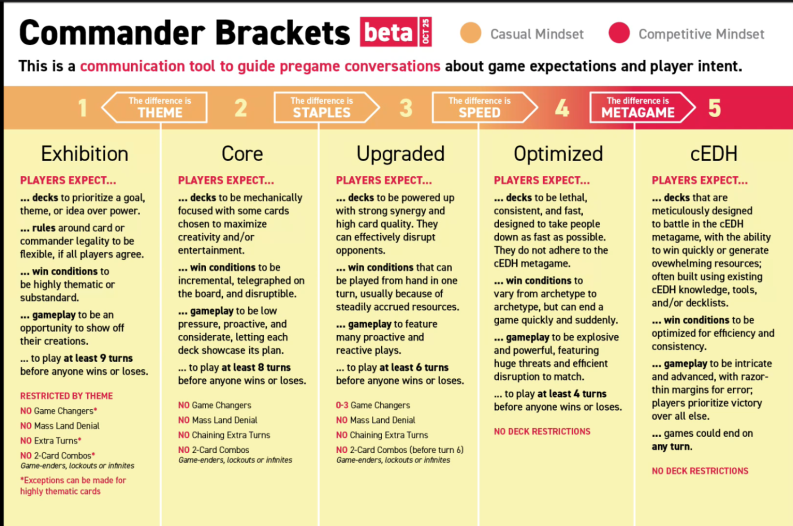
First up, let’s talk about Bracket 4 Commander. Currently, Bracket 4 is the highest power version of Casual Commander before you get to cEDH (competitive Commander) which features no-holds barred competitive Magic.
The difference between the two styles of play is ideological – they’re separated by intent. Where cEDH is a style of Commander where anything goes, Bracket 4 is still in the camp of Casual, in the sense that while the goals of the players are to win, they’re not usually resorting to every dirty trick in the barrel; they’re still using Commanders that speak to them, rather than only the metagame’s top lists; they’re still running some pet cards, or picking a less optimal strategy. Hell, they might not even be running all of the fast mana options.
That said, Bracket 4 is leagues away from Bracket 3 in the sense that there is a clear divide in speed. Bracket 4 decks are streamlined, and accelerate towards a winning board state much faster. They’re ready to deploy a combo much earlier in the game, and can assemble a board state that looks to close the door on the game a lot earlier – during the turns a Bracket 3 deck might still be accruing resources and finding the tools they need.
SHOULD YOU ALWAYS BE TUTORING?
What’s been on my mind a lot recently when thinking about Bracket 4 is whether you should always be tutoring. If decks at the table are all efficient and fast enough to deploy win conditions, then surely tutors must be a key part of that plan, right? How many should you be running, and which ones?

While the lack of Game Changer quantity restrictions in Bracket 4 tells you that you could be playing as many good ones as you can in order to find your pieces, it doesn’t always feel that straightforward.
The spirit of Commander, to me, has always been, to some extent, about embracing some degree of variance. If you’re wanting a linear gameplay experience, well, that’s what 1v1 60 card formats are for (and to a lesser degree, cEDH). If a player is intending to sit down and do the exact same thing each game by using tutors and redundancy, what really differentiates that from cEDH?
That, my friends, is the rub, isn’t it? What differentiates B3 from B4 is acceleration, but what separates B4 from B5 is metagame. Which, on the face of it, is mostly just vibes. Does the deck feel like a cEDH deck? Then it should be B5, right? What about if it uses a list with a lot of unique cards and a Commander not at top cEDH tables? Does that make it B4, or B5?
It’s entirely subjective, and so there must be more to explore here.
SHOULD THERE BE A BRACKET 3.5?
Nestled in this part of the discussion is the popular cry for a Bracket “3.5”. It’s become something of an emergent meme between playgroups that Bracket 3.5 is the new “7”, which is funny, but what else does that tell us? Well, it tells us that there still exists that cohort of decks – and by extension players – who are aiming for that elusive “7” area. Not too hot, not too cold – the goldilocks zone.

Classifying my decks in the bracket system this year has been an interesting process. It required both introspection on my part, but also “interviewing” other players after a game to get their thoughts on how a deck has performed. It was abundantly clear to me which decks I had were Bracket 1, 2 or 5, but 3 and 4 proved a little more interesting to figure out. My Henzie deck with no game changers or combos, and no mana dorks to get a T2 Henzie, is decidedly Bracket 3 – because B4 Henzie features all of the things this deck lacks. By the same merit, it isn’t B2, because it’s powerful and comes out of the gates swinging.

Other decks have proved a little more challenging. While some could be easily seen to be Bracket 3 – like Aurelia Humans/Tokens, or Nahiri Equipment (with that random impulse draw and lack of cheap tutoring) – others were a little harder to pin down. The unassailable Sigarda, Host of Herons Aura Enchantress, for instance. She’s like an Ice Road Truck once she gets going, but she’s still a lot slower than what should be a B4 deck, and lacks the tutors for assembling quick wins. Same for Syr Gwyn, Hero of Ashvale. The deck is very consistent and strong due to zero cost equips and Sunforger, but even despite the tutorability, I chose not to play Teferi’s Protection and similar effects as I wanted the game to be more challenging for me. I was also playing a six mana Commander, which makes the deck a lot slower. It was far apart from Kassandra, Eagle Bearer, which was by every metric a B4 deck.
The issue was that those decks could clean up a Bracket 3 table if people weren’t bringing a suitably decent deck, as they were built to be resilient, consistent, and powerful. So, while too slow for B4, I found myself time-and-again in pre-game chats talking about how the vibe was a “higher power 3” or – like the meme – joking about them being “3.5”. I know I’m not alone here, as investigating in multiple communities both online and offline had come up with the same idea.
One trend seems to have emerged here, which is the idea that either Bracket 3 or Bracket 4 is currently a little wide. But something else came up too.
Overwhelmingly, it was that players well versed enough to discuss in deeper detail about the power level and intent of their deck were quite happy to eschew the bracket system entirely when playing with friends and regular playgroups, as they’d already figured out their groove.
This makes sense, and to be fair, the Bracket System has been designed primarily for untrusted play anyways. If people are unsure if a deck is a 3 or a 4 in untrusted play, I’m going to assume that they edge on the side of caution, and then proceed to calibrate with the pod for game #2 – which is the same as it’s always been.
A NOTE ON A+B COMMANDERS
One layer of the conversation around the more linear playstyle that promotes constant tutoring is the concept of having your Commander be part A of an A+B combo.
It’s an aspect of what can make certain Commanders far faster and more consistent than others, especially in Bracket 4, and I believe one of the key components of picking a Commander for this style of play.
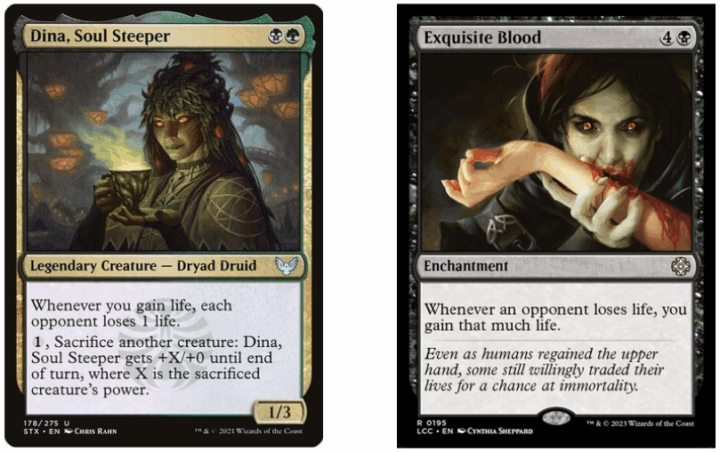
If you pick a Commander that isn’t part of an A+B, or doesn’t have the win condition printed on it (looking at you, Hearthhull), then your gameplan is bound to be less consistent, even if your Commander happens to be a value engine. The natural remedy for this is to stuff the deck full of tutors, right? This is how the cEDH lists with more value oriented Commanders work in the first place. They leverage the draw on Tymna, the free spells on Rograkh, and other value accrual, to find their tools – and tutors are the wildcards in abundance that help those decks dig for what they need in a timely fashion.
When you consider this in light of what makes a deck a Bracket 4 deck, then sure, lashings of tutoring is definitely on aspect to consider. That said, so is picking an A+B Commander, right?

This is ultimately what had me slot my Hofri Ghostforge deck into Bracket 3. The Commander is part C of an A+B+C three card combo, and it doesn’t draw cards or help with mana. It also comes down relatively late for five mana in Boros, one of the color combos that struggles to draw enough cards when it isn’t attacking – which this deck doesn’t do very often. It’s still a powerful deck, but it’s way too slow for B4. It’s not A+B or value generating in the command zone, and it isn’t dropping a win out of nowhere on turn 4-5.

Ultimately when I’ve considered if I should jam more tutors into the list to find my combo pieces (like Imperial Recruiter, or Enlightened Tutor), I’ve opted not to. Not because I’m against this method of deckbuilding, but because the list itself wouldn’t really rise fully into Bracket 4 without a major overhaul – and even then, I’d be running at a disadvantage against A+B Commanders. What’s the point in making the deck have some “spikes” in performance, if the average performance is still a lot lower? There isn’t one, because it makes your deck overperform and receive way too much aggro.
END STEP
Should you always tutor in Bracket 4? Well, the answer is probably. But there’s always the argument that Bracket 4 is currently home to decks at two ends of a spectrum, with less efficient Commanders with some combos at one end, and A+B Commanders with bags of tutors at the other. It’s really hard to sit down and have a consistent experience right now in Bracket 4, as that lower end of Commanders quite often are better suited to a good Bracket 3 pod that can still answer them handily.
Does that mean we need a Bracket “3.5” in between B3 and B4? Potentially. There are some compelling parameters for what that bracket could exclude (A+B Commanders, anyone?). But, while I think there’s a large number of players who would happily self select into that category, I’m also quite confident that those same players are eloquent enough to use the Bracket system as a foundational tool, and evolve their pre-game chats from there. It’s easy enough to say “lets go up/down a notch” if some decks are underperforming in B4, or overperforming in B3. And that’s fine.
As ever, let me know your thoughts on BlueSky.

Kristen is Card Kingdom’s Head Writer and a member of the Commander Format Panel. Formerly a competitive Pokémon TCG grinder, she has been playing Magic since Shadows Over Innistrad, which in her opinion, was a great set to start with. When she’s not taking names with Equipment and Aggro strategies in Commander, she loves to play any form of Limited.