

Transform Commanders are some of the most flavorful and fun Commanders you can choose, but they often come with significant drawbacks. Let’s look at the two sides of Transform Commanders.
DOUBLE-FACED TRANSFORM COMMANDERS
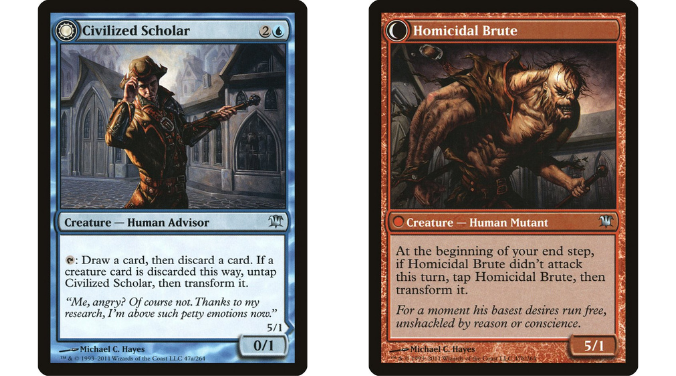
Double-faced Transform cards were first introduced in Innistrad, a gothic horror themed set, and they were used to represent the grisly transformations of denizens of the plane, often referencing iconic pop culture monsters – like Jekyll and Hyde, in Civilized Scholar // Homicidal Brute. It wasn’t until Magic Origins that we’d get Legendary Creature transform cards on the front side, with the origin cards of five Planeswalkers in the Gatewatch: Gideon, Jace, Liliana, Chandra and Nissa. These were the first to be eligible to be a Commander.

The first outing of these cards was to showcase sparks igniting, and they were both cool designs and well received. They were, however, a little weak to interaction and wraths, meaning the ones that didn’t have a strong EtB or easy way to flip them (like Liliana and Nissa) hinged on you keeping them in play. That said, they were and remain popular, with many a Chandra deck in Commander helmed by Chandra, Fire of Kaladesh.

“Planeswalker” Commanders are a rarity owing to the fact the only legal ones are the ones with text saying they’re legal, and so the DFC technology was a way to get more Planeswalker Commanders available. When it was done for such venerated villains as Nicol Bolas, it was a perfect unison of theme, flavor, form and… well, desire.
Most of these early transform Commanders were designed in an era when cards were still largely designed for 1v1 formats, though, and so there was one snag with putting them in the Command zone: they were a little bit slow.
TRANSFORM CARDS ARE COOL… BUT SLOW
While they might perfect flavor, form and function, transform cards can be a bit slow. In a format dominated by creatures with powerful EtB or attack triggers, the delayed gratification of playing with transform cards requires the willpower you’d cultivate in an ashram.
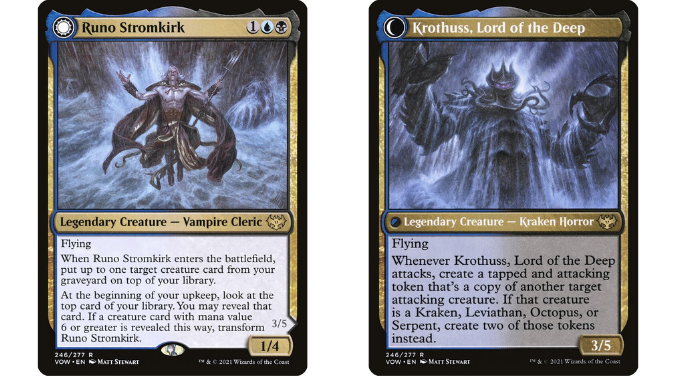
Take Runo Stromkirk. It’s a really cool sea creatures deck, but it’s a lot slower to get going than some of the other options available in blue or Simic decks. You have to dedicate deck slots not only to sea creatures, removal, reanimator and ramp, but also to top-deck manipulation. Runo also has to stay in play in order to be flipped. Once you do get him flipped, however, it is worth it – it’s just getting there can be quite difficult depending on your table.

Transform cards become even more cumbersome when their flip condition is like threading the needle. Jerren, Corrupted Bishop requires you to be at exactly 13 life on your end step, which is a big ask in a format where people can drop you from a life total in the mid-20s down to sub-10 in one swing – and that’s if they’re not killing you outright.
The reward you get for flipping Jerran is Ormendahl, the Corrupter, a reward that, while cool and powerful, might not feel worth the squeeze – especially if it eats a Swords to Plowshares right after.
So, how has this weakness in transform cards been worked on by Wizards?
POWERING UP DESIGNS FOR COMMANDER
Well, the first thing is that they’ve really hit the power + efficiency button when it comes to transform creatures that people want to put in the CZ.

Ulrich of the Krallenhorde was never the most interesting Werewolf Commander, as his synergy with the rest of the deck was basically non-existent. The old way to make Werewolves flip over was also obviously bad in Commander, and so Werewolf fans clamored for something better.

They got it, with Tovolar. Tovolar has card draw attached to it, has a way to auto-transform your board, and a way to push damage through when he transforms. Daybound/Nightbound also fixed the awkward transformation method, even if it did add annoying tracking to the game.
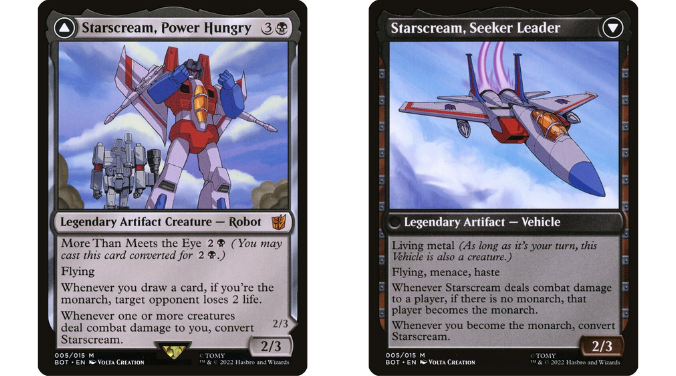
Another method I really liked that was tried was the Living Metal mechanic for the Transformers cards. While I’m pretty agnostic on their inclusion in Magic as a whole, I do really like the designs, and one that I’ve always enjoyed seeing at the table is Starscream. Tying Monarch mechanics into both sides of the card is super fun for the format.
While these designs are all really cool — and beyond some outliers, are reasonably balanced – some transform cards are very pushed.
TRANSFORMING THE META

Heliod, the Warped Eclipse is one such card. The UW Control player’s dream, this group hug looking deck gives cards to everyone, and then casts spells entirely at instant speed for as long as it can keep Heliod in play. If you’ve not played against it, you might not realise just how strong it is. Check out Josh Lee Kwai playing on Game Knights for some idea of the degeneracy you could assemble.

While the back side of some Transform Legendaries is really pushed to make them worth the hassle of flipping over, other designs have gone straight for making the front side as powerful as possible to make it worth playing them.
Etali, Primal Conqueror is one such design, and it honestly doesn’t even need the back side. This Commander is so powerful – and has so many synergistic cards available to keep chaining value – that it’s often a cEDH deck. The fact it turns into essentially a Blightsteel Colossus on the other side is so hilariously irrelevant in most games that it speaks to how powerful that front side actually is.
THE FUTURE OF TRANSFORM COMMANDERS
When you put too much power in the front side of a Transform Commander, you can lose sight of what makes them so popular in the first place. People like the transformation for lore reasons, and for showing the growth in power and perspective a character has. They also enjoy the hoop-jumping. Contrary to popular belief, Commander players like to have some challenge, and not just play bowling with the guard rails on.
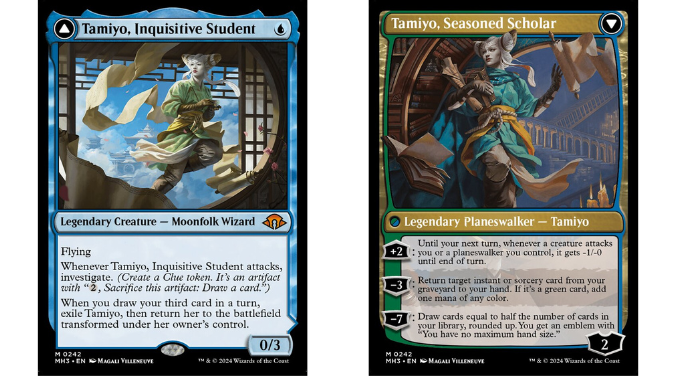
Planeswalkers remain popular characters, and the Modern Horizons 3 flip-walkers show that they are as popular as ever. Many people in my playgroups built Tamiyo, Inquisitive Student on release, because they love Tamiyo as a character. People also love going on “side quests” in Commander, as there’s a mine of dopamine waiting to be extracted whenever you achieve the transformation of your Commander.
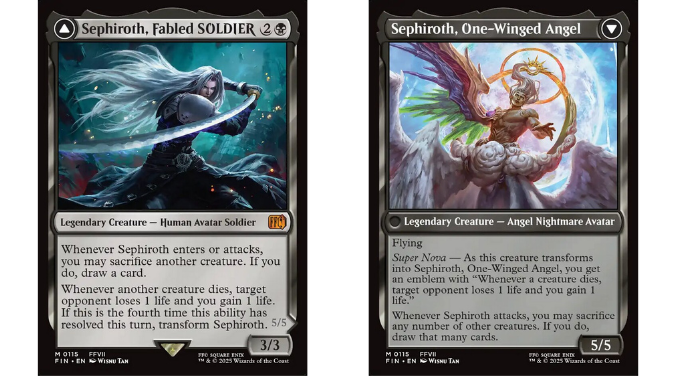
Transform Commanders are also a favored tool of Universes Beyond, especially when it comes to characters with multiple forms. For videogame baddies like Sephiroth, it’s only natural to make a transform version of the card for ultimate flavor.
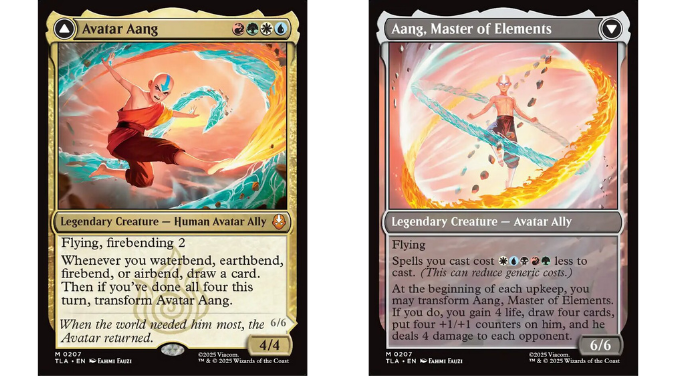
The other benefit to using DFC Commanders is that there end up overall fewer printings of the same legendary character in the set, which is better for everyone. Keeping track of all the Spider-Man variants was headache inducing. I much prefer seeing transform cards than separate entities to bloat a set.

Thinking about one of my favorite decks at the moment, Joshua, Phoenix’s Dominant, I really do love the transform and saga approach for showcasing transformations in the CZ. Many transform Commanders essentially function like sagas, if they aren’t sagas themselves – especially the Planeswalker ones, and we all know how linked ‘walkers and Sagas are in the history of design.
Sagas are an enduringly popular card type, and enduringly efficient at storytelling when it comes to in-universe and Universes Beyond. I feel like the technology of the transform-into-saga-creature cards from Final Fantasy are perhaps the peak of Legendary Transform designs, and I hope (and believe) we’ll see a lot more of this in the future. On top of it all, they’re a way to keep cards balanced, spreading value and utility across each stage of having the card in play. In effect, they have more than two sides, while remaining DFC cards.
END STEP
Balancing Transform cards that can be a Commander is a challenging task, but I believe Wizards have hit their stride now. We need more cards like the Final Fantasy flip cards, and fewer cards like Etali, basically. Spread that value around, because investing all those eggs in one basket makes transform Commanders real prone to eating removal – and that’s always sad.

Kristen is Card Kingdom’s Head Writer and a member of the Commander Format Panel. Formerly a competitive Pokémon TCG grinder, she has been playing Magic since Shadows Over Innistrad, which in her opinion, was a great set to start with. When she’s not taking names with Equipment and Aggro strategies in Commander, she loves to play any form of Limited.