
Edge of Eternities brought with it a bevy of new mechanics. While the likes of Lander tokens seem pretty well balanced, the Warp mechanic is a lot more pushed. I’m of the mind that Warp is a potentially problematic mechanic, and here’s why.
WARP

Some spells can be cast for their warp cost. It’s a discounted mode of casting that gives you the same permanent for the turn, but, should it survive the turn, it’s exiled at the end step. You can cast it again from exile on a later turn. You get all the EtBs, cast triggers and such when you Warp. In the case of Drix Assassin, you can use the 1W mode to remove a blocker temporarily, or exile a token, for instance. You might even use it as a Flickerwisp to reset one of your creatures and enjoy the EtB effect again.
THE BASELINE OF WARP
In limited, and at uncommon, Warp is a pretty interesting mechanic. It essentially gives you a modal spell, and it gives you some smoothing for your draws. It’s also similar to casting an Adventure, as you’ll get two spells in one should you draw it and want to cast it early.
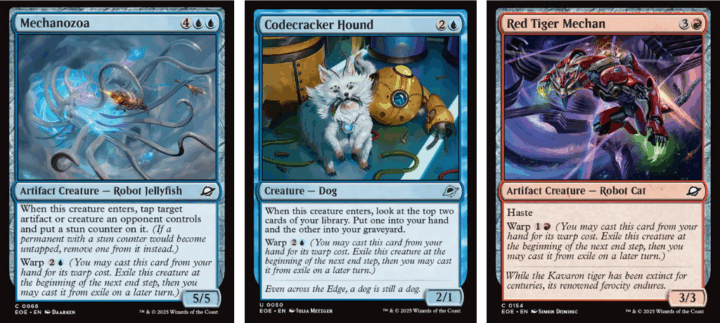
It makes playing a Control deck a little easier when you get to enjoy classic control effects like freezing down creatures and card selection up to twice rather than once per card. For more aggressive decks, it gives the option of a little more “reach” (in the game-term sense); you can spend less mana to get a quick snipe of damage early from Red Tiger Mechan, or try and multi spell with Memorial Team Leader to keep applying pressure.
Where Warp is a little more… shall we say, “pushed”… is when it comes to rares and mythics.
What if you could do the thing, but now? What if you could do the thing and not be scared about removal? What if you could do the thing, and have two chances to pop off on one card, at different points on the curve?
Those are all very enticing possibilities, and if you answered yes to them, then, well, of course you answered yes. We’re all “goopy goblin gamer brained” after all. We want to do the thing now.
WARP IS DESIGNED FOR 1V1 MAGIC
While I do want to talk about the effect of Warp on eternal formats like Commander, I want to stay for now talking about 1v1 Magic, because I feel like Warp was designed with that in mind, and in a lot of ways, it’s an admirable attempt at making higher mana value cards – and synergies that require multiple cards – relevant.
Standard these days can be pretty quick. The red decks of last year splashing for Warleader’s Call made short work of opponents in just a few turns. The current more aggressive decks like Izzet Prowess and Mono Green Landfall can punish stumbling starts and make mincemeat of decks that aren’t the top % of meta builds. The recent bannings that stymied the power of red decks haven’t completely shifted things away from Standard being a pretty aggressive format.
For decks to work in Standard (and by extension, Modern), they need to be quick to deploy their gameplan and have a good amount of redundancy. They need to not have clunky unworkable hands.

Things are also more interesting when you have spells like Change the Equation and Anoint with Affliction seeing play in Dimir and Azorious Control. Quantum Riddler gets around both removal and counter spell here, and replaces itself with a card (or two!) drawn should it not end up exiled to be Warped later. In this way, the format can be sculpted to allow for certain cards to emerge that avoid more common removal.
Consider also Arena, where a lot of 1v1 Magic is played. The design teams for Standard are constantly looking for new ways to remove dead draws and flooding to make 1v1 games more viable for casual players. Warp as a mechanic fits into this way of designing cards to be as modal and flexible as possible.
All in all, this makes Warp a potential hit of a mechanic, right? Well, kind of. There’s always an argument that the inherent speed/power creep you get with a mechanic like Warp ends up having a knock-on effect on Standard, only increasing the pace of play. While the Warped creature doesn’t stick around to block, it can be in play to turn on things like fight spells or other effects. It can allow decks to pop-off quicker, which hopefully does the job of balancing the metagame, and not just walling out archetypes completely in the same way a card like Fury did in Modern (nuking mana dorks and other go-wide decks for no mana).
But what about the other main format?
WARP… WARPS GAMES OF COMMANDER
The part where Warp starts to grate on me is in Commander. Instant gratification and smoothing out feels-bads is fine* for a format primarily played on Arena, where the economy and structure of the game is built entirely around getting people to have fun and keep playing. When I say fine, I mean I understand it and can forgive it, especially because it remains to be seen if Warp will unbalance 1v1 Magic – and I don’t think it will.
Commander, meanwhile, is plagued by speed creep and power creep. Decks pop off sooner and sooner with every passing year, and while part of that is due to the consistency and redundancy afforded to many archetypes through the sheer quantity of new cards being printed, a lot of that is tied to the Command Zone, and what is put inside of it.

Commanders like Eshki, Temur’s Roar are frankly absurd. You have a growing win condition of Commander Damage, you get to draw cards, and you have an alternate win condition in burn to each opponent. It shouldn’t be that easy to just play your deck and accidentally win, but it is. Eshki can close out a game by turn 5-6 with an average draw and a very minimal budget.
I wrote about what constitutes a Bracket 2 Commander the other week, and if there’s one headline from that article, I believe that Bracket 2 works best when Commanders choose from mana advantage, card advantage, and win condition, and don’t try and cram as many of them as possible into the ‘zone. In fact, it can be even more interesting and have that “classic EDH” feel when your Commander has none of these attributes.
So, what about the cards in the 99? Well, they keep getting better too – and I’ve done a deep dive into Equipment in general, talking about how when archetypes get peak support they start to become a little “too” good. Warp contributes to this phenomenon, and I’ll tell you why.

Orzhov decks up until now had access to a bunch of token doublers, with many at five to six mana outside of Anointed Procession. If you wanted to try and pop off earlier, you could run Kaya, Geist Hunter. While Kaya is cool, and has cool art, she isn’t by definition a card choice that satisfies quadrant theory (and I have a classic article about that and Cursed Mirror here, if you want to get on the same page).
Kaya is a card you take because “it’s better to be lucky than good” – the same reason I take Temple of the False God in a bunch of my lists with high mana value Commanders. You take her despite her being poor when you’re behind, and poor in the developing stages of the game. You take her because for three mana, you get to try and pop off sooner than people expect, or on a turn when you spend mana on a spell like Call the Coppercoats.

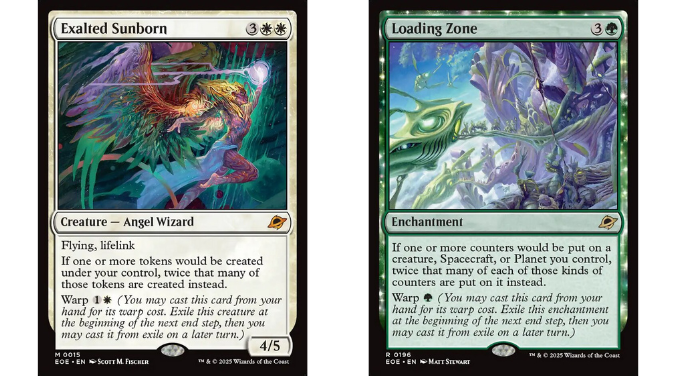
Compare that to Exalted Sunborn. Exalted Sunborn does what Kaya does but for one mana less. It also then sits in the exile zone, primed for you to recast again later, in a way that benefits you – dodging board wipes, and giving you essentially a bonus card in hand.
It also, crucially, provides a 4/5 Flying Lifelink body, which is just the kind of body you need to stabilize and turn the corner with. Even the very pushed Elspeth, Storm Slayer still costs five mana and can be attacked (with difficulty) off the board.
Exalted Sunborn satisfies Quadrant Theory much better than Kaya, and so we are left once again with a feeling that our decks are starting to solve themselves.
WHY IS WARP SO GOOD IN COMMANDER?
I mentioned that Warp cards sit in exile, giving you an extra card to cast later. What makes this so great is that they also dodge removal. You get to pop off for a turn, before kind of “phasing out” the threat. There’s already a dearth of removal in casual Commander, and Warp blanks all sorcery speed removal. It doesn’t care about a Vindicate or a creature with an EtB. It doesn’t get hit by a wrath.
And if they do want to exile the warped permanent at instant speed? Well, you paid a way reduced rate for it, so it doesn’t feel so bad.
In Commander right now, the quantity of mana needed to “do the thing” keeps ending up being less and less, and so games feel quicker and quicker. I don’t feel like Warp is a good thing for power/speed creep, and does a lot more to move the goalposts than cards that are “merely” strong staples.
COMPARING WARP TO BLITZ

One of the strongest Commanders in Bracket 3 and 4 is Henzie “Toolbox” Torre. Note how I didn’t say Bracket 2 – Henzie’s strength and consistency, and jund ‘em out playstyle makes it exceedingly hard to build a B2 Henzie deck with a straight face. Henzie is great because you get to swing in with haste, enjoy an EtB or attack trigger, and then cash in that body for a card and any dies/leaves triggers at the end of the turn.
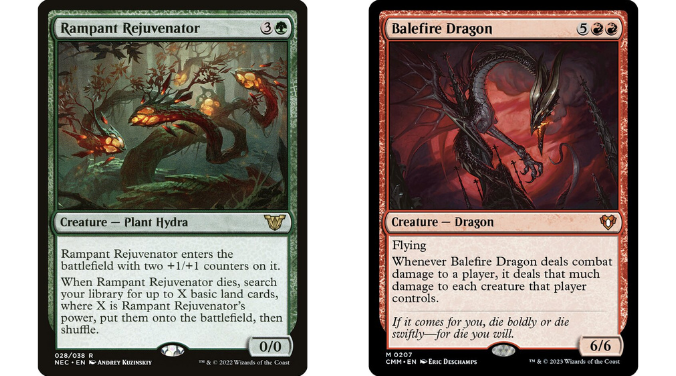
Henzie makes ramp cards like Rampant Rejuvenator feel decidedly playable, and helps you get a Balefire Dragon in cheaper and with the element of surprise. It’s somewhat balanced because you don’t get to keep the creature, and you need to put plenty of recursion in your deck to ensure you don’t let your graveyard go to waste.
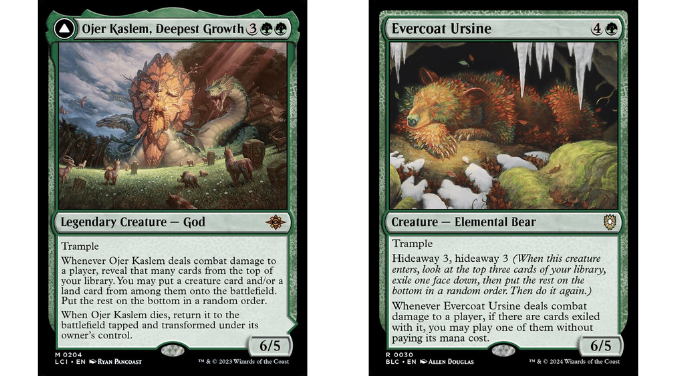
While there are some effects that can be “broken” with blitzing, they are still kind of one-and-done, and can even miss, hitting a mana dork or similar in the case of Ojer Kaslem and Evercoat Ursine.
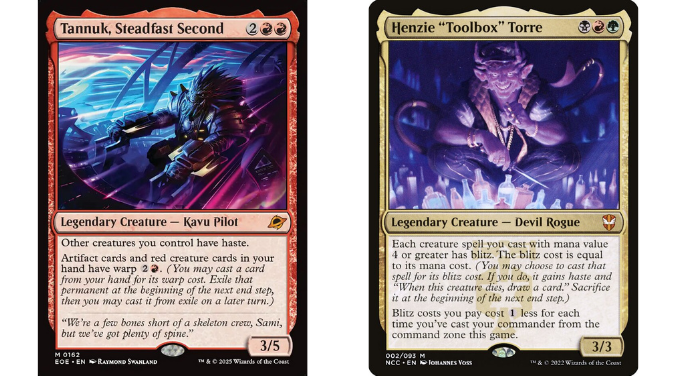
Warp is quite different to Blitz, and you can see that in comparing Tannuk, Steadfast Second to Henzie. Because Tannuk grants Haste, he ends up looking very similar to Henzie. Where they diverge is that, for Tannuk, you’re always going to be hasting in whatever you have for a flat rate of 2R. Instead of fishing things out of the graveyard, you get to recast them from exile later. This frees up deck slots in Tannuk for more big effects, and more ritual effects to help give the deck as many big turns as possible.
It also means that while Henzie can cheat out Blightsteel Colossus a turn or two early (if it chose to play it, which it wouldn’t, because of the shuffle – but stick with me), Tannuk can get it out as early as Turn 4 with Haste (or even earlier with Sol Ring and Rituals). This is in line with the reason I deconstructed Kassandra, Eagle Bearer – the possibility of killing a player on Turn 3-5 with Colossus Hammer, Spear of Leonidas and free equips was simply too fast.
STOP FEEDING THE GOOPY GOBLIN GAMER BRAINS, PLEASE, WIZARDS
Is Warp the issue here, or is Tannuk? Surely Tannuk must be balanced, not having access to green and black, right? Well, yeah, I’ll concede that as a mono-color card it’s a lot fairer than if it had access to more colors. It’s also okay for there to be some more pushed Commanders in a set, especially when they’re mono-colored.
But, if we focus on Tannuk, we ignore the fact that warping any synergy permanent into play earlier than other similar effects can blow a game wide open. Just look at the impact of Sol Ring on enacting any gameplan early. Warp is kind of like having a Sol Ring for a turn that taps to cast a specific effect.
This instant gratification has to slow down. It’s the reason that cards like Smothering Tithe and Rhystic Study aren’t played around. Players are impatient. It falls on Wizards to decide whether to indulge that impatience, or attempt to slow the natural entropy that speeds up all formats – but especially Commander.

Kristen is Card Kingdom’s Head Writer and a member of the Commander Format Panel. Formerly a competitive Pokémon TCG grinder, she has been playing Magic since Shadows Over Innistrad, which in her opinion, was a great set to start with. When she’s not taking names with Equipment and Aggro strategies in Commander, she loves to play any form of Limited.