
Reality Fracture is the biggest set for planeswalkers in a long time. For one, it printed the newest planeswalker cards of any set in the last three years, with seven brand-new planeswalkers added to the game.
That’s also not even counting the first EVER appearance of planeswalker tokens. If you added up all the cards which are capable of creating a planeswalker using the “empower Jace” set mechanic, then Reality Fracture has even War of the Spark outnumbered!
Some of those empower Jace cards also have a second effect, adding new loyalty abilities to planeswalkers you control. Modifying their text in this way is the most broken thing you can do with ‘walkers this side of Doubling Season, and we’re about to triple the number of cards that can do it.
I’m honoring this huge moment in planeswalker history the only way I know how: compiling a list of the best and most significant planeswalker cards released (prior to Reality Fracture – it’s too soon to judge those). Read on to discover the rankings and rationale of Magic’s Top 20 Planeswalker cards!
MORE THAN JUST A NUMBER
Planeswalkers are the hardest type of card to power-grade for lists like this. They have more text and abilities than most cards, and their performance is hugely influenced by the game state they’re cast in.
What I’m really rating is how flexibly the ‘walker performs across different situations. Does it help you capitalize and win while you’re ahead on board? Can it protect itself and you when it’s behind? Does it have explosive potential to flip a whole game in the right deck, and how specific a build does that require?
20. Kaya, Spirits’ Justice

Kaya, Spirits’ Justice has a rare advantage: two different uptick abilities, both of which are excellent in complementary ways. When board presence is at a premium, you can print flyers – also ensuring you have the necessary targets to make her downtick and triggered ability sing! If you need more specific utility than just bodies, the multi-purpose +2 probably does what you need.
The downtick is extremely cheap for what it does, and is what makes her a threat in 1v1 Constructed: when not removed, Kaya will basically delete every creature the opponent tries to play. We don’t have enough room to go into detail about her triggered ability here, other than to point out it’s as flexible as your deckbuilding imagination allows, and it’s amazing that she can trigger it off TWO of her own abilities while the third makes a token to target – Kaya sure is a powerful lady!
But I feel it’s necessary to note here at the outset how many cards on this list have a static or triggered ability in addition to their loyalty abilities. It’s not something I intentionally selected for, but I think it speaks for itself how much breaking the “can only influence the game once per turn cycle” rule increases a ‘walker’s power level. Count them yourself as we go!
19. Kaito, Bane of Nightmares
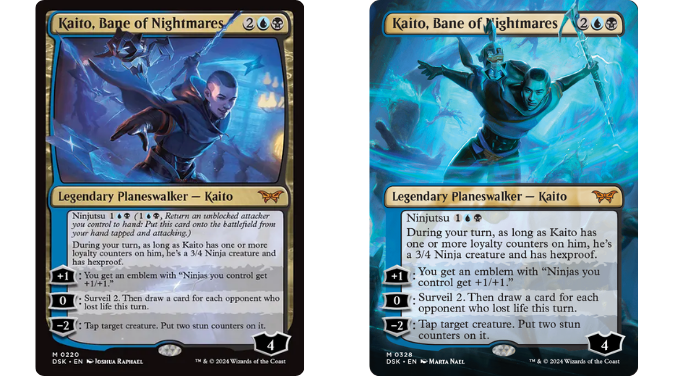
Kaito has a really cool and well-defined identity at this point, where most of his cards seem to double as creature threats while still giving you some kind of consistent card advantage. Bane of Nightmares has been the most successful version of this template. He has dominated his entire Standard run and shown clear potential in older formats as well.
You don’t see those results without a high power “floor”, and in fact Kaito is shockingly consistent for a three-mana creature-planeswalker. Ninjutsu is very easy to set up in UB tempo shells and massively warps Kaito’s profile. Deploy him this way and he’s a hasty, hexproof, uncounterable flyer that then gets to activate a loyalty ability in second main phase!
If you’re on the draw and the Kaito player does that to you turn three, it’s extremely difficult to recover. He’s not even vulnerable to creature removal due to his hexproof-ness, and with good starting loyalty and the option to stun up enemy attackers you simply won’t be killing him in combat that early. But the worst-case scenario when you don’t get the ninjutsu start is what limits him getting further up the list: his impact massively falls when you’re behind on board or you aren’t able to attack the opponent.
18. Comet, Stellar Pup
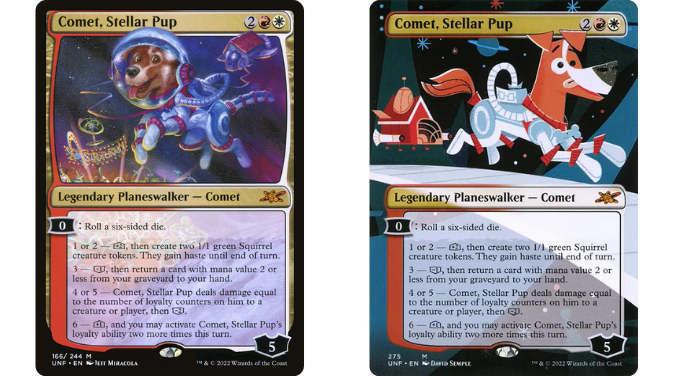
If you’ve never seen Comet cast in anger and you’re shocked to find the funny random dog on this list, all you need to understand is that you never really “miss”, despite the die-rolling shenanigans.
If you’re evaluating his first-turn impact (a good way to judge most walkers), then 33% of the time he’s at seven loyalty and made two blockers. Another 33% of the time he is at three loyalty and killed the opponent’s biggest threat (or Lava Axe’d them). Rolling a six is just two more chances to roll those good options!
So the only scenario where Comet’s first activation doesn’t have massive, immediate board impact is when you roll exactly a three. If you’re casting him on curve this ability might lack a target, and even if you get something back you likely can’t cast it the same turn. So our absolute floor is paying 2RW for a four-loyalty walker who may or may not have rebought us a spell, and which the opponent is under a lot of pressure to remove before he gets another roll. I’m sorry, but that’s what peak planeswalker performance looks like!
17. Chandra, Torch of Defiance

Four-mana four-ability mythic-rare planeswalkers have some serious pedigree in competitive Magic (particularly at the time Kaladesh released). Chandra, Torch of Defiance lived up to that standard, with a near-perfect kit that lets her contribute on any board state. There are other ‘walkers whose ultimates end the game faster or more directly, and some who apply greater pressure while upticking their loyalty. But very few combine these two aspects the way Torch of Defiance does.
The game-winning power of the ultimate immediately redefines the game around Chandra as soon as she’s played. If you have enough board presence that she doesn’t need her emergency removal downtick, Chandra effectively starts at five loyalty and gives the opponent exactly two turns to answer her. In the time she’s on board she continuously generates cards, mana and damage, so even chipping away to keep her from reaching seven probably isn’t a great position for the opponent.
That’s the kind of high-floor, high-ceiling card that was always going to make this list. But looking at her today, the hefty cost and limited killing power of the downtick and the fact her upticks don’t actually help you accrue permanent resource advantage hurt limit her role in the formats where she’s still legal.
16. Daretti, Scrap Savant
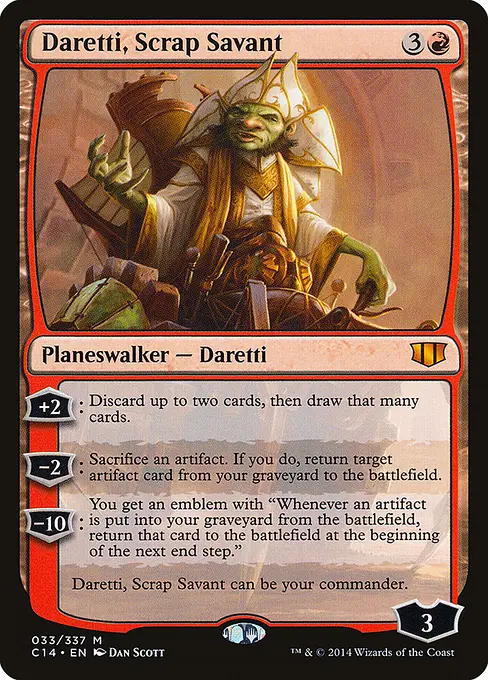
Planeswalkers tend to not be explosive cards by their “one use a turn” nature, but Daretti is an early example of how the right effect can break that stereotype wide open. He actually has two lines of text with such x-factor in my opinion: his -2 ability, and the part which says he can be your Commander.
The second is a force multiplier to the first: Trash for Treasure (or Goblin Welder if you prefer) is an ability that can absolutely win the game or generate massive momentum in any deck remotely built around it, and having access to that kind of combo piece in your Command Zone every game is amazing upside. The fact that Daretti can always use his best ability the turn he’s cast, and the insurance of being able to set up this combo with both his +2 and the -2 itself (it’s worded so you can bring back the same artifact you sac’d!) is the kind of redundancy and consistency that translates into lots of winning.
It’s a simple package, but one where almost every part of the card is a positive. It’s extremely rare to even approach a position where you can use the ultimate, but you will probably win the game if you make it there! He’s also great as part of the 99 in any artifact-focused Commander deck, or in non-Commander Constructed; all his text is still just as strong, so it just comes down to whether there’s a different effect (or color ID) you’d prefer in the Command Zone.
15. Grist, the Hunger Tide
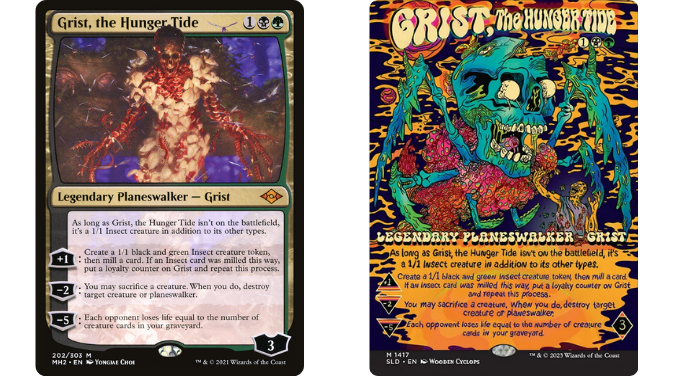
Unusually for a planeswalker, Grist gets a lot of its power from deckbuilding considerations rather than what it actually does on the battlefield.
Counting as a creature card in all other zones is very valuable, especially in green-black. Part of what makes creatures by far the strongest card type is how easily those game objects can be recurred and manipulated. Grist can easily be tutored, reanimated, copied, sacrificed, flickered, cheated into play, granted new abilities, used in combat and chosen as your commander – all things that are difficult or impossible for competing planeswalkers.
Yes, once you actually get Grist in play its impact is often limited to a single downtick and a couple of 1/1s. Its only real star performances are in Insect-themed decks and when you can exile Grist under Agatha’s Soul Cauldron. But even as a one-of utility target for spells like Green Sun’s Zenith and Chord of Calling, or a way to help turn on delirium, Grist is making an undeniable contribution to many competitive decks.
14. Liliana, Dreadhorde General
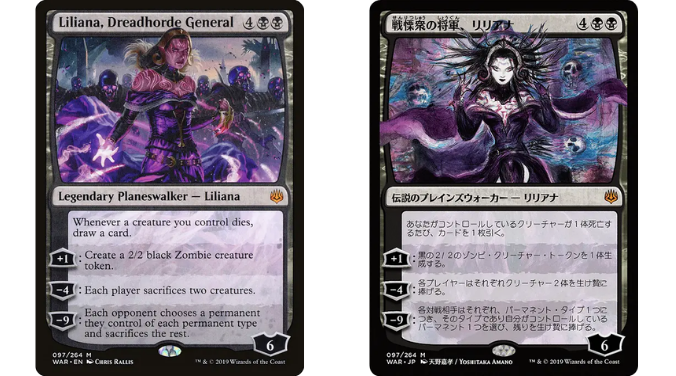
In the last decade or so we’ve seen the planeswalker card type struggle a little, due to the increasing pace of play and emphasis on mana efficiency. These cards cannot be too cheap due to their high ceiling, but since they need several turns to reach that ceiling and are hard to protect when behind, expensive planeswalkers grade out as almost impossibly risky. Liliana, Dreadhorde General is tied for the highest casting cost on our list (we all know colorless mana costs are fake), and you can see how much it takes to make a card like this worth touching for competitive Constructed.
The most important thing is giving her as high a floor as possible, which is achieved by the combination of her triggered ability and her downtick mode. It guarantees that you get immediate card advantage (and probably mana advantage) even if Lili only activates once: either you kill two of their creatures and lose nothing because your board was empty, or you trade two for two and go up two cards.
In both situations you also are left with a vestigial two-loyalty Lili that your opponent is nevertheless obliged to immediately answer. Should the Dreadhorde General be allowed to recover with some upticks after this (or heavens forbid, you cast her while ahead and don’t need to downtick at all) she becomes a consistent threat to win the game with either her ultimate or a steady stream of zombies, with the potential to fire off more -4 activations whenever the value proposition looks right.
13. Gideon of the Trials
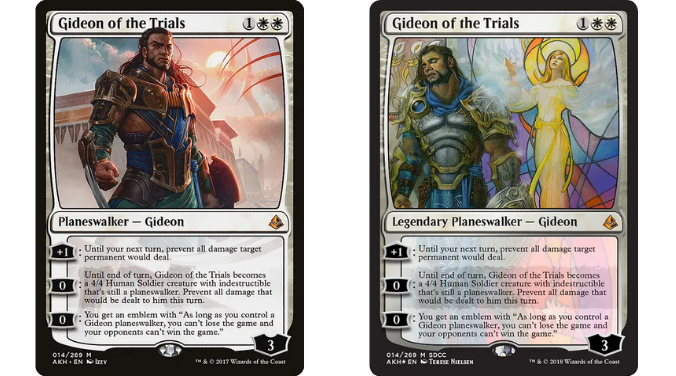
I’ve built more than one deck around this card, and I still think Gideon is underplayed to this day, even if you do need to be doing very particular things to get the most from him. His uptick alone is an excellent defensive tool for a three-drop walker, neutralizing their best threat while banking loyalty against future damage.
The only real argument against this being the best version of Gideon is that he can’t create creature tokens or produce any other kind of lasting resource besides his own loyalty and emblem. If you’re not under pressure on board, all Mr. of the Trials can do to capitalize is turn into a 4/4 and punch face. That’s good damage in an aggro deck, but not enough to really feel impactful in the kind of decks that run planewalkers (unless those other planeswalkers are also able to beat down).
Leaning into combat pressure is one reason to play Mr. Trials alongside other versions of Gideon; the more obvious reason is his emblem. Even without other Gideons, putting the Platinum Angel text on a three-mana permanent has great potential for hijinks. Most notably, you can ignore “lose the game” clauses on Pacts and spells like Chance for Glory or Final Fortune, leading to the improbable-yet-effective RW aggro Turns deck. But if you do add other versions of Gideon, this can definitely become a more prison-like win condition – particularly when combined with cards like Oath of Kaya, Deification and Kaya’s Ghostform.
12. Wrenn and Six
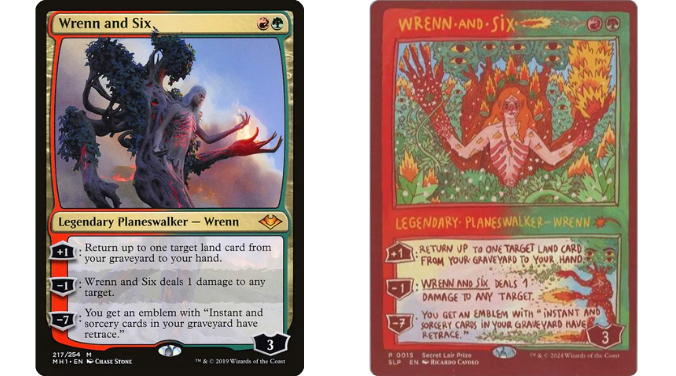
As we keep circling back to in this list, the performance of planeswalkers is extremely dependent on momentum. If you get them down earlier in the game, their abilities will have more impact relative to the other spells and abilities being played, making it easier to control the battlefield and prevent the opponent from disrupting them, which then helps them stick around longer, and so on. Wrenn and Six is a planeswalker which can be reliably deployed on turn two.
That by itself is actually not a guarantee of competitive viability – check out Tibalt, the Fiend-Blooded. But the other abilities here are also perfectly calibrated for the eternal Constructed metagame and Wrenn’s role as an early-game value engine.
When early pressure is coming from cards like Ocelot Pride, Ragavan, Thalia, Guardian of Thraben or Orcish Bowmasters, dealing one damage for one loyalty is extremely efficient. When you aren’t pressured, +1 to recur a land is close enough to drawing a card when you have fetches – and WAY nastier when you have Wasteland or Strip Mine. Likewise, the -7 is a bonafide “win the game” type ultimate, which not every low-cost ‘walker can boast. That’s a full suite of three excellent abilities which you can often deploy before the opponent even has a nonland permanent – what better start to a game could you ask for?
11. Nissa, Who Shakes the World
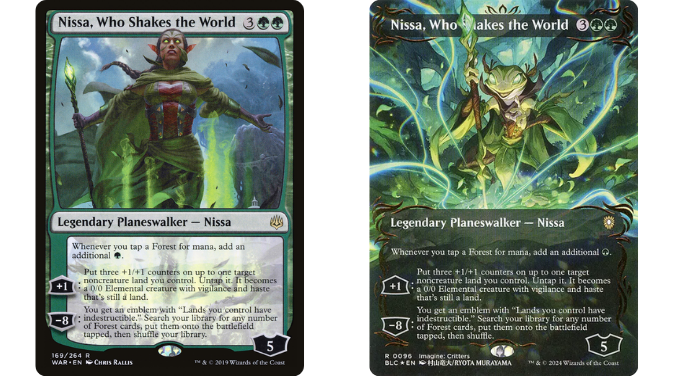
Somehow only the fourth-best planeswalker in her set, Nissa, Who Shakes the World still lives up to that grandiose title wherever she’s played. Unlike the choices afforded by other ‘walkers, Nissa feels more like two rare enchantments stapled together: one that doubles your mana, and one which permanently animates a land every turn. But those are both very useful effects, and considering that she immediately generates at least two extra mana the turn you play her, you get an exceedingly good deal for them.
Nissa’s “ultimate” isn’t really the game-ender you’d expect for a -8, although still worth using in situations where you think the game will drag on a few more turns. You can simply continue using the uptick over and over, targeting lands that are already animated to increase their power and toughness or to untap them for mana ramp and fixing purposes. If you’re ever able to ultimate and then untap with her still in play though (or deploy a second copy) you’ll have a truly game-wrecking amount of mana to cash in: take your chance to cast Mass Manipulation, Primal Surge, or something else really gross. Remember that she adds a green mana when you tap either basic or non-basic Forests – an amazing combination with Yavimaya, Cradle of Growth.
10. Elspeth, Sun’s Champion

Part of the reason it’s so important to get planeswalkers into play early is how badly they struggle if the opponent goes wide with creatures. Most planeswalker cards can, at best, neutralize a single attacker with their first activation. Six-mana Elspeth can chump block three at a time all on her own. That’s just using her uptick!
Situations where the wall of soldiers might not be enough to protect her, like a green deck full of enormous tramplers, are neatly mopped up by the -3 board wipe ability. Having enough loyalty to hit that button as soon as she enters the battlefield and still be alive afterwards to uptick as pressure when not removed makes her somewhat justifiable as a board wipe choice in true control decks (as opposed to just a win condition). And simple though it is, the play pattern of upticking and then ulting is incredibly good when it’s your turn to get proactive; making Elspeth a true Champion in all four quadrants of game state.
9. Narset, Parter of Veils

It’s objectively impressive that Narset, Parter of Veils can make it into the Top 10 Planeswalkers of all time without having a built-in way to increase her loyalty – but under no circumstances do you have to hand it to her. Her static ability is one of the most pure anti-fun lines of text ever printed, even when the opponent ISN’T actively trying to abuse it.
Drawing extra cards is very important to winning games of Magic, so unless you have a dominant board lead and are about to kill Narset’s controller, most decks are basically obliged to kill her on sight. If you do elect to leave her alive and your opponent follows up with a Wrath of God (more likely with help from her -2), your punishment is effectively losing the game on the spot. Of course, the real reason Narsty Narset gets this high on our list is easily you can abuse that text to “kill” opponents – or at least make them wish they were dead.
Her interaction with spells like Days Undoing, Echo of Eons and Windfall leaves you with a full grip and your opponents with either one or zero cards in hand. If that’s still one card too many, just activate Geier Reach Sanitarium and make them discard it; something you can also do on their draw step to instantly get rid of their one “allowed” card for turn. In Commander, you can automate this misery for all your opponents by simply casting Anvil of Bogardan. Are you having fun yet?
8. Teferi, Hero of Dominaria

In hindsight, “Big Teferi” was something of a harbinger for the massive power creep Magic would experience from around 2019 to 2022. The adoption of what Wizards dubbed “FIRE design” foreshadowed a wave of extremely pushed threats which swept away the previous metagames of literally every Constructed format. Teferi is a relatively fair card in comparison: he at least costs five mana, typical for this kind of game-winning planeswalker. But it’s hard to find any actual flaws in his power suite, or even weaknesses.
Most good planeswalkers have an uptick which either defends themselves or generates resources. The Hero of Dominaria does both, assuming you can use the untapped lands to cast a removal spell or other interaction on the opponent’s turn. If you can’t, then you’ll have to use his -3… which still leaves the opponent down their best threat and needing to immediately finish Teferi off before he makes things worse.
Getting a guaranteed immediate refund of your cards and mana spent while ALSO taking over the game if not removed was the hallmark of FIRE design; a catch-22 for the opponent which encourages more of a volume approach to casting threats, since you can’t ever lose by doing so. The closest thing to a downside here is how long it takes to generate enough loyalty to use the ultimate. But the fact many decks won exclusively by waiting to deck opponents post-emblem should tell you that “slow” does not mean “unreliable”.
7. Ugin, Eye of the Storms

As one of Magic’s newest planeswalkers, I assume the Eye of the Storms needs a little less context than his colleagues on this list. I also don’t think I need to explain how exceptional it is for any planeswalker to have “exile target permanent” as a triggered ability, completely uncoupled from his actual loyalty abilities (which are also cracked!). Even in a worst-case scenario where you can’t follow up Ugin by casting several cheap artifacts, he’ll still delete the opponent’s best card in play, profit you three life and a card, and sit there on a massive nine loyalty daring them to come get him.
Colorless cards are simply better than colored ones in several meaningful ways. Colorless mana is much easier to produce in large quantities, and colorless costs are much easier to reduce. Artifacts are the strongest card type in the game besides creatures and have the best support mechanics: most of them are colorless, and many cost one or even zero mana by default. Some of the zero-cost ones even produce mana the turn they enter, making them mana positive even without factoring in mechanics like affinity or improvise.
And all of these cards, that are already excellent and you already want to play, make Ugin better. He’s the one perfectly lethal weapon to hide in a deck full of free spells and resource generators, because he immediately turns all of those low-impact spells into boardstate-destroying bullets.
6. Karn, the Great Creator
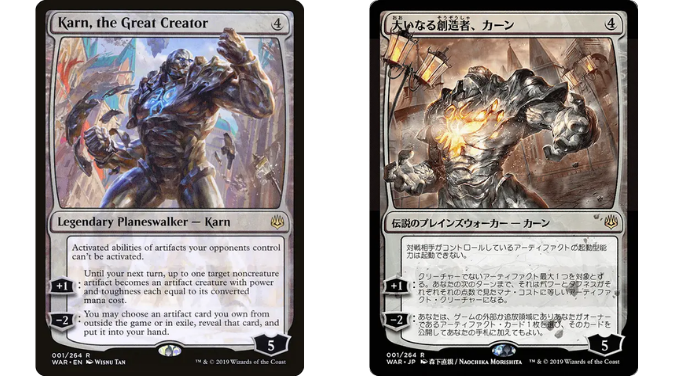
The Great Creator is defined by his -2 ability, and over time Magic’s competitive scene has come up with a pretty optimized package of sideboard artifacts for Karn to summon. But the two most infamous options are both ways to attack your opponent’s manabase.
Liquimetal Coating appears innocuous, but when combined with Karn’s +1 ability it turns the target land into a 0/0 creature, effectively destroying it. Giving a four-mana planeswalker “uptick: Stone Rain” can already take over many matchups, but that’s harmless compared to his combo with Mycosynth Lattice. Since Karn’s static ability doesn’t make exception for mana abilities, turning all lands into artifacts with Lattice instantly turns off your opponent’s ability to tap them (or anything else) for mana… for the rest of the game.
The one merciful thing about this combo is that in 2026, very few players have to worry about it. Mycosynth Lattice is currently banned in Modern, and Karn himself is banned in Pioneer. Both cards are legal in Commander, but they both have to be part of your 99 and drawn or tutored for like any other combo, rendering it much more pedestrian.
5. Jace, the Mind Sculptor
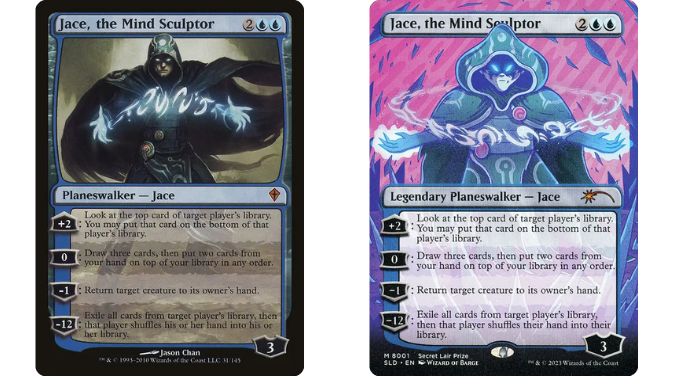
The first planeswalker to really warp the Magic metagame, the Mind Sculptor became truly iconic to the generation who witnessed his prime. Songs and essays have been written about him. Many players have adopted his image to brand themselves or their teams. Magic old heads literally talk about him in the same terms crime bosses talk about John Wick. Jace set a new benchmark for everything: how many abilities planeswalkers have, what a win condition looks like, how much a single Standard-legal card costs.
All things change though, and almost 17 years on from the release of Worldwake the rest of Magic has finally caught up with this former boogeyman. Don’t get me wrong, a reprinted Mind Sculptor would certainly be Standard-playable (and don’t tell me they didn’t at least flirt with putting him in Reality Fracture) but resolving a free Brainstorm every single turn is no longer the most broken thing our brains are able to process. Now it’s only like, top-five-most-broken-things at best. Please pay your respects for this loss however you feel appropriate.
4. Liliana of the Veil

Liliana of the Veil was printed in the same era as Jace, the Mind Sculptor, and the two cards have shared many a metagame. Both were amazing cards which defined not only their own colors, but how other colors and archetypes were building in an attempt to counteract them. I think Jace was a more dominant force at the time, but shifting metagame demands have led me to favor Liliana more as time passes.
Being three mana instead of four is probably the strongest argument for Lili. But she also makes a more reliable impact a little faster: both her +1 and her -2 immediately start cutting into the opponent’s available resources. Jace’s Brainstorm mode, while incredible, is still just a support ability for setting up other cards and spells. The Brainstorm is also a +0 loyalty ability, so it won’t be simultaneously advancing Jace’s built-in win condition the way Lili’s +1 does. You only have to uptick LotV 3 times to have that ultimate online, and it’s definitely the ability I’ve lost more real games to in my time.
Liliana of the Veil is not without drawbacks: her uptick also shreds her owner’s hand and her -2 can’t target specific threats, making her even more vulnerable to opponents setting up their board quickly. But that’s why this Liliana’s low mana value is so important. Especially when you’re behind, paying three mana and a card to kill one creature and still have a planeswalker that absorbs damage from a second creature next turn is a great deal. That’s the absolute floor on LotV, and that’s why she almost cracks the top three of our list.
3. Teferi, Time Raveler

No more of your boomer cards here grandad: the rest of this list is from 2019 or later! As I mentioned when discussing Teferi, Hero of Dominaria, Magic underwent a historically large power spike around that time. Few cards better represent that paradigm shift in my mind tan this other Teferi, Time Raveler (a.k.a. “T3feri” or “small Teferi” for his mana value.
This T3feri came out after the Hero of Dominaria and somehow managed to offer more for even less! For three mana you get the immediate board impact of bouncing their best permanent, the immediate resource return of drawing a card, and the ongoing threat of a planeswalker that’s regenerating loyalty while also getting ready to do it again. Oh, and you get another one of those incredibly nasty static abilities War of the Spark loved so much, which is somehow worth more than the rest of the card combined.
T3feri basically turns off playing the game at instant speed the way Narset turns off extra draws. That doesn’t just mean no counterspells, or no breaking up my combo kill. That means no cascade, no rebound, no Miracle, no discover. That means cards like Knowledege Pool become a hard lock that prevents opponents from ever resolving a spell again!
If only they had swapped the +1 and static effects around things could have been at least a bit more fair. But’ll I guess we’ll never know. I’m not the one who can unravel time to check how things are going!
2. Minsc & Boo, Timeless Heroes

I feel some people would be surprised if you said a Gruul planeswalker was close to topping this list – even though there’s been several strong Domri and Arlinn cards that repped these colors. Wrenn and Six is probably the next most famous competitive option, even if they’ve fallen off slightly in metagame popularity through time. But anybody who’s had even passing experience with Minsc & Boo will know exactly why they deserve to be treated with such reverence.
This card just seems like it does everything. It’s cool that the planeswalker comes with its own free chump blocker, one that even replenishes each turn cycle like an Ophiomancer. You then immediately get to upgrade the hamster with a bunch of +1/+1 counters and keywords. Depending on the boardstate, you can either immediately send Boo in to wreak havoc, or keep him back to block.
If Boo survives, your next activation could also cash him in for a bunch of cards and damage, or just fling some other creature normally. The flexibility and value of this -2 are terrifying and a big part of Minsc & Boo’s strength. It didn’t click for me how good this card was until I was playing against it and somebody made the comparison to Jace the Mind Sculptor – a comparison I agree clearly favors this duo. But there’s just one other Planeswalker I still think of as a bigger weapon…
1. Oko, Thief of Crowns
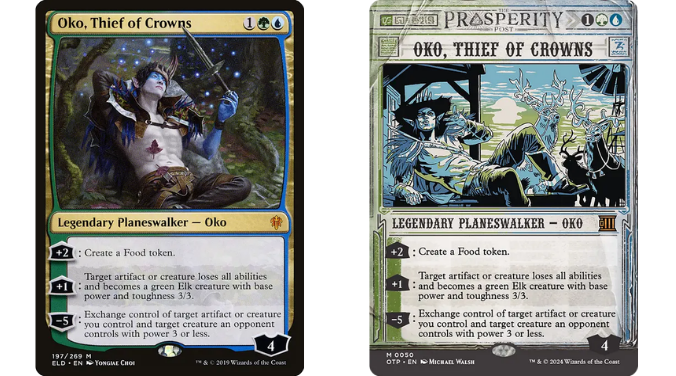
My pick for most dangerous and overall powerful planeswalker card of the last 20 years is Oko, Thief of Crowns. Anyone who has just scrolled down the whole article to check if they guessed right: yes, you’re very insightful, please consider now going back and reading the last fourty-eight-hundred words of explanation.
Oko is a three-mana planeswalker with naturally high base loyalty and loyalty gain. While he lacks a “true” game-winning ultimate, the -5 becomes available extremely early and is just devastating when you’re already fighting for board control. Oko’s play pattern feels a bit comparable to Liliana of the Veil, except HIS removal ability can target whatever he wants neutralized, AND it somehow is a +1-loyalty effect instead of -2.
There’s just no downides here on a card which is incredibly strong and flexible at its base. You might think that using his first activation to upgrade an opposing creature to 3/3 is actually bad, but those who’ve experienced it know that those elks he gives out aren’t really a risk to him at all 99% of the time. And if it does go wrong somehow – maybe their elk gets too many buffs on it – you can usually just -5 Oko to make its controller an offer they can’t refuse.
This card has dominated every format it appears in and been banned in most of them. There’s simply no way we will (or should) see its like again, no matter how many Reality Fracture type sets we get.
JUST KEEP ON ‘WALKING
Planeswalkers feel like they must be the hardest type of card to design and balance, and it’s not particularly close. Each one is like a puzzle-box of interconnected loyalty costs and effects, making it harder to approximate their value in an “average” game.
The combination of short-term flexibility and long-term efficiency seem to demand that most ‘walkers cost three mana to cast, if not more. On the other hand, planeswalkers are the only cards that can be directly attacked and destroyed by opposing creatures; the only type of card that can be cleanly answered without the opponent needing to spend cards or mana on removal. That’s very tiring to be on the receiving end of, especially if you just paid four or five mana to hire them and immediately lose their support.
The pace of play in today’s Magic sometimes feels too fast for the once-a-turn activations of planeswalkers to contribute. That’s doubly-true for multiplayer formats like Commander. But the design team have adapted well, adding static abilities and other useful features so that planeswalkers from more recent sets (including Reality Fracture) to feel as important and interesting as their forebears.

Tom’s fate was sealed in 7th grade when his friend lent him a pile of commons to play Magic. He quickly picked up Boros and Orzhov decks in Ravnica block and has remained a staunch white magician ever since. A fan of all Constructed formats, he enjoys studying the history of the tournament meta. He specializes in midrange decks, especially Death & Taxes and Martyr Proc. One day, he swears he will win an MCQ with Evershrike. Ask him how at @AWanderingBard, or watch him stream Magic at twitch.tv/TheWanderingBard.