
If I was asked what qualities which define the current era of Magic: The Gathering, there’s a few answers I could give. First, that more new cards are being released than ever before. Second, that cards are becoming more complicated, with even commons having more rules text on average than previous eras. Third, that thanks to Universes Beyond the game is more aggressively marketed to new players.
I don’t think it’s rude to point out that those points are in tension with each other. Magic has always been a challenge to new players, with a card pool so large that you’ll constantly be stumbling across things you haven’t seen before.
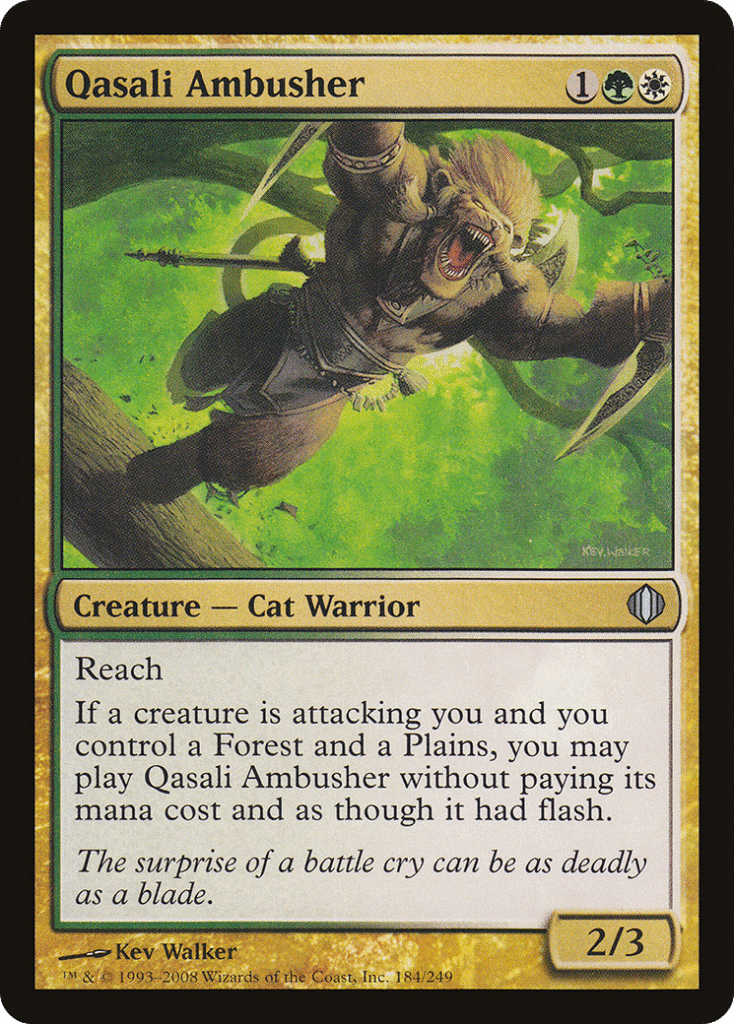
To combat this confusion, players (new and old) are given a fragment of folksy wisdom: “Reading the card explains the card”. But what does that oft-repeated catchphrase really mean, and how useful is it as an aid to understanding the Magic of 2026?
“READING THE CARD” EXPLAINED
The catchphrase was coined and popularized by The Professor, presenter for YouTube’s Tolarian Community College channel – itself a hub of wisdom and engagement for newer Magic players.
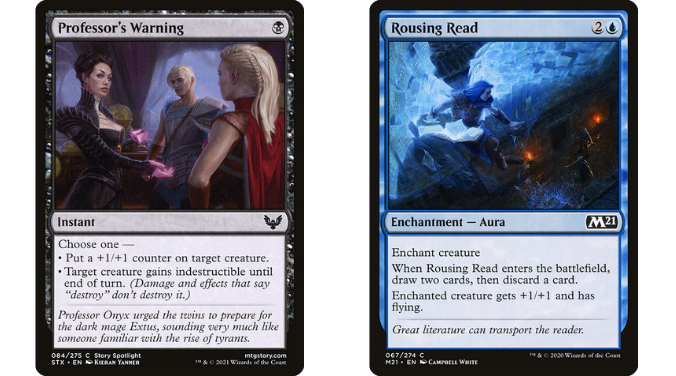
The message sounds somewhat smug (and it can certainly be delivered in that way) but being reminded to slow down and double-check the card text is never really bad advice in the complicated world of card games. But the meaning here does run deeper than just second guessing your reading comprehension.
One of the earliest and most important ways Magic evolved was by standardizing its rules text. If two cards produce the same kind of effect with their ability, it will be written the same way both times. Even if one card’s ability is activated and the other triggered, only part of the rules text will change, and it will change in a predictable way.
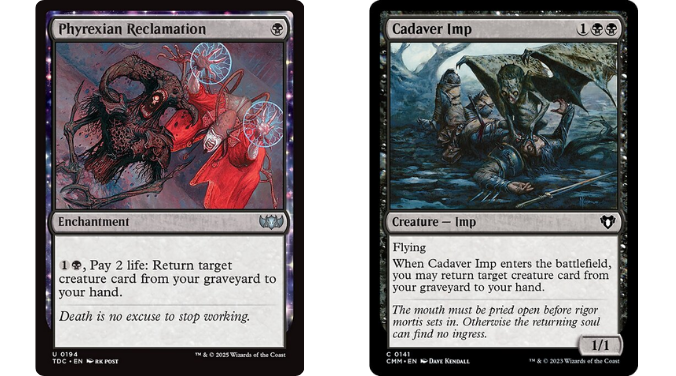
Making the language on cards so consistent means players can learn to read and “speak” that language, rather than just memorizing individual card effects. Once you become fluent in Magic-ese, the idea is that you should always be able to understand what the rules text describes even if you’ve never seen a particular card before.
Telling players “reading the card explains the card” is really a reminder of that principle: that learning how to read Magic rules is more important than learning and memorising every individual card.
…EXCEPT FOR WHEN IT DOESN’T
If you repeat any catchphrase or aphorism often enough, people will try and pick it apart. It’s a healthy instinct to make sure you understand what’s actually being said and avoid simple groupthink… plus some people just love being contrarian.
If you’re of that mindset, it’s actually very easy to find examples where reading a Magic card does NOT fully explain the card.
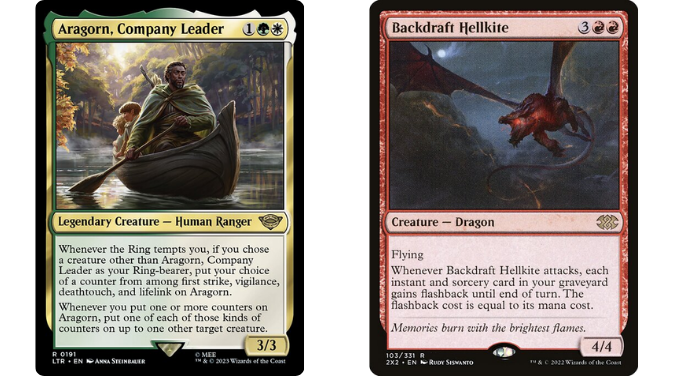
Magic uses a ton of keywords and ability words and symbols as shorthand, typically adding a few new ones every set. These sometimes appear with accompanying reminder text, but sometimes that explanation is cut to save space. Good luck interpreting “Equip” or “the Ring tempts you” if you haven’t seen those terms before – let alone the implications of an Energy symbol.
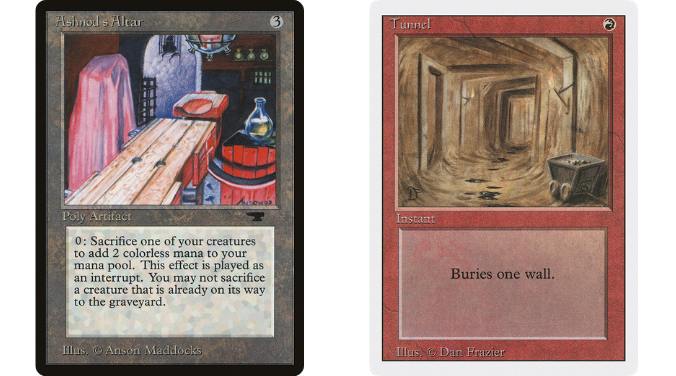
Another trick is the way Magic’s internal language has naturally evolved over time. Players who venture into Eternal formats (which thanks to Commander is virtually everyone) soon realize that cards from different eras are not consistent in their terms and phrasing. Outdated terms like “bury”, “interrupt”, “legend”, and “poly artifact” litter the game’s history like a minefield – and at least those are obviously foreign concepts at first glance.
There are totally ubiquitous terms which nevertheless change their meaning over time: Argothian Enchantress’s trigger has shifted from “whenever you successfully cast an enchantment” to “whenever you play an enchantment” and then back to “cast” again, despite there never being any change to how the card functions.

Of course some cards literally have been subject to errata which changes how their abilities work, with no regard for the originally printed text. While in most cases these changes try to update the language on the card while preserving the effect, sometimes that isn’t possible. Sometimes the whole point of the errata is to correct a major oversight in its printed text, as was the case with Hostage Taker from Ixalan.
It’s an extreme example, but still proof that some cards cannot be understood just by reading their printed text. And what about textless full-art cards, or promos which were deliberately printed in Phyrexian script? Even some of the more adventurous Secret Lair and showcase treatments stretch the presentation of card text to the edge of legibility.
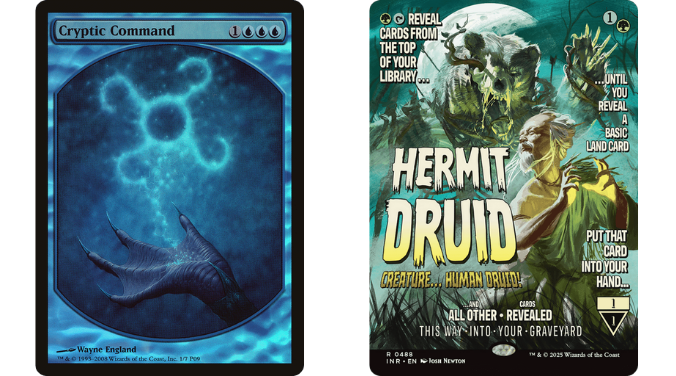
Perhaps in the modern era we should be telling people “reading the Oracle text explains the card” instead? But then why does the official Wizards card database frequently display long lists of additional rulings and clarifications next to that Oracle text?
ADDITIONAL READING REQUIRED
In defense of the RTCETC principle, a lot of the counter-examples I just gave are rather petty. Pedantically finding fault with the letter of a rule like this is not going to win you any friends or arguments.
But taking a step back, there is a much more substantive and important issue with this mantra as a teaching tool for new players. Even for cards printed with their full and accurate Oracle rules text, reading will only explain that card if you already have a strong grasp of how Magic’s underlying rules work – and even then, it will only explain that card’s self-contained effect, not any of the important interactions with other cards and rules which are often vital to understanding how cards are used.

I already pointed out that keywords like Ward or Flashback require outside knowledge of those mechanics to understand, but the same thing is true of more fundamental rules terms like “dies”, “color”, “combat damage”, “play”, “activated ability”, and all the rest.
If you’ve ever seen a new player struggle to correctly use the card Counterspell – about as simple and literal a textbox as there is in Magic – then you know how even seemingly straightforward effects can bamboozle the uninitiated.

What actually counts as a spell? If all non-land cards are spells then why can’t I counter the ones on the battlefield? Does “counter” mean the same as “destroy”? If I counter a spell that’s a creature, does it still go to the graveyard – and does that mean it “dies”?
To an enfranchised player those questions might sound absurd and facile, and most new players will be able to figure some of the answers out without asking – but they are all real questions I’ve had to answer more than once, and I don’t think any of them are “dumb questions” if you’re unfamiliar with Magic. Tell me every obscure ruling involving layers and Blood Moon if you’re so smart!

I’m not trying to blow any minds by saying “you need to know the Magic rules to understand what cards do”. But we should consider the dissonance felt by a new player who hears “reading the card explains the card” repeated over and over like the key to enlightenment, when they’re still trying to comprehend what “protection” does for the first time.
IT’S NOT TRUE – BUT IT IS RIGHT
Having just spent the bulk of this article rattling off arguments against RTCETC, it might surprise you to hear I’m still a fan of the saying – even as a teaching tool for newer players. It’s not the ONLY thing I tell those newbies, but to assume any single catchphrase is going to explain a game like Magic is ridiculous.
The idea that reading a card could tell you everything you need to know about how it works is directly counter to the premise of TCGs. The whole point is that the possibilities and interactions of a card are not limited to only the text printed on it, or even on all the other cards extant in the game of Magic. The meanings and effects of these cards can be modified as they bounce off each other during games – sometimes literally by editing their text box using a second card.

But by telling people that reading explains the card, we encourage them to trust that the card text is a source of truth and follows consistent patterns they can learn to recognize. Once they start to master the basics of Magic, reading the cards will be the main way to expand their horizons and test their knowledge. By the time they really understand and appreciate where these wise words fail, they will already know enough to carry on learning Magic without it.

Tom’s fate was sealed in 7th grade when his friend lent him a pile of commons to play Magic. He quickly picked up Boros and Orzhov decks in Ravnica block and has remained a staunch white magician ever since. A fan of all Constructed formats, he enjoys studying the history of the tournament meta. He specializes in midrange decks, especially Death & Taxes and Martyr Proc. One day, he swears he will win an MCQ with Evershrike. Ask him how at @AWanderingBard, or watch him stream Magic at twitch.tv/TheWanderingBard.