
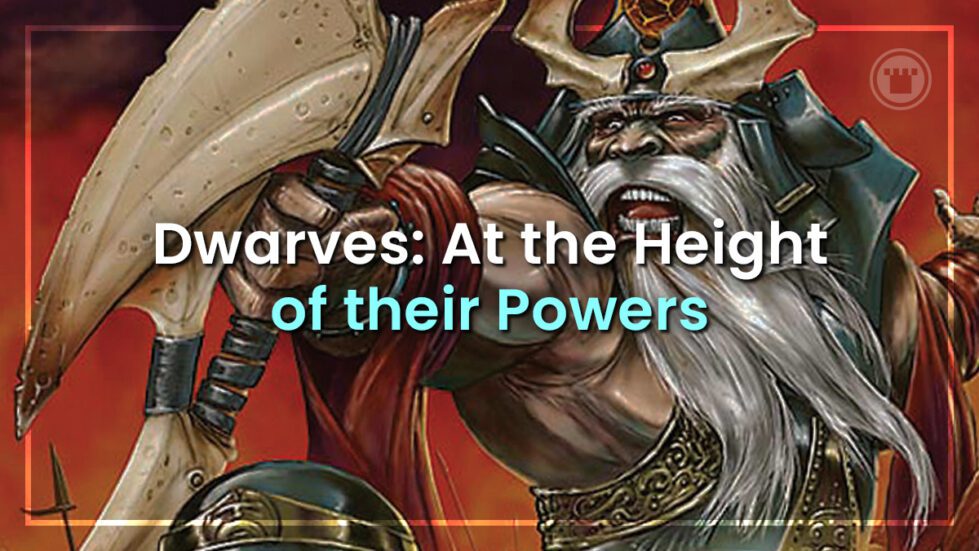
Before it established its own original fantasy worlds, Magic: The Gathering was one of many fantasy games to borrow heavily from The Lord of the Rings. Tolkien-esque elves, dwarves and goblins all featured prominently in its early sets, and were among the first creature types to receive dedicated typal support.
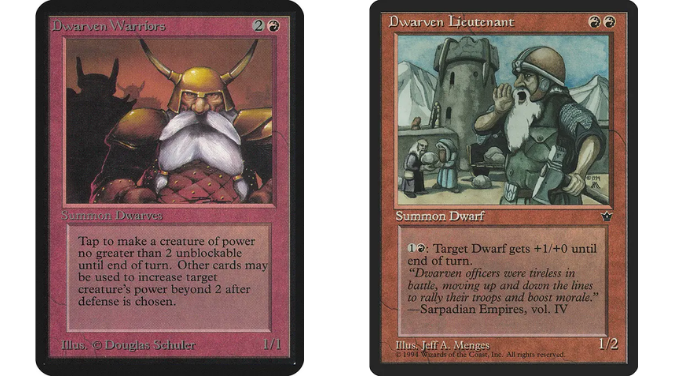
But where elves and goblins went on to become cornerstones of the color pie, represented prominently in almost every set for the next 30 years, dwarves dwindled and then seemingly vanished from the game completely.
But over the last decade the bearded folk have re-emerged from underground to reclaim their spotlight Dwarves are major players on the planes of Kaladesh, Eldraine, Kaldheim and Strixhaven, as well as in various Universes Beyond sets – including The Hobbit (which despite the title is, statistically speaking, a story about thirteen dwarves).
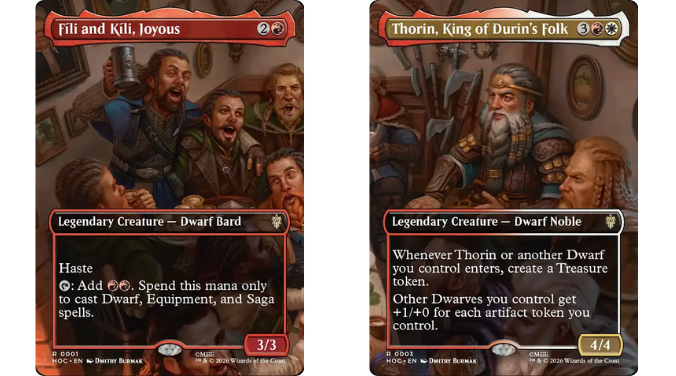
Their treasuries restocked and armies replenished by all these new cards, dwarf-themed decks are now a serious proposition for the first time since the 1990s! Let’s celebrate by exploring their mechanical strengths and how to build a proper dwarfish deck around them.
A DIFFERENT SHADE OF RED
The long absence of dwarves between Onslaught and Kaladesh is best explained as a sort of identity crisis. While the look and flavor of dwarves is a solved issue – thanks again to Tolkien – the question of what abilities and purpose they serve in Magic has been harder to answer.
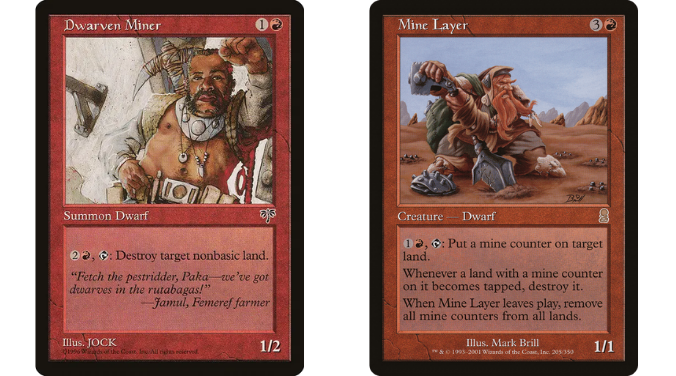
As mountain-folk with an affinity for stone, metal and warfare, dwarves slot straight into red’s slice of the color pie. Where goblins are reckless and anarchic, dwarves show a more cerebral, strategic side of their color. In the 90’s that mostly manifested as land destruction effects – back when those were a much more commonplace and accepted part of gameplay.
Old dwarves did also have a few other tricks which are still core to red’s gameplay today: dealing damage to all creatures, and making attackers unblockable by “tunneling” them behind enemy lines. Between the sappers, miners and engineers there is also a lineage of dwarf spellcasters providing utility effects, and smiths to enhance your creatures’ stats.
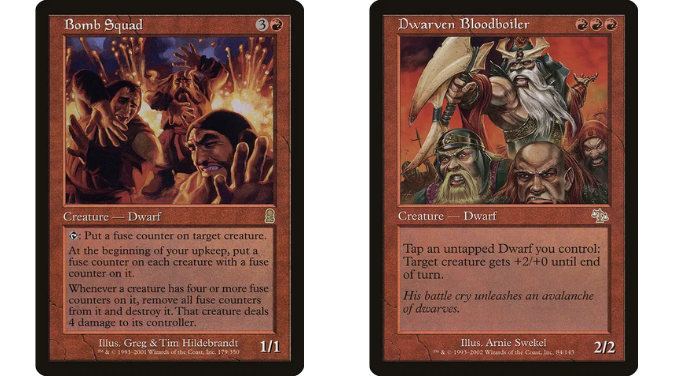
When dwarves made their big comeback some of these elements needed updating, but the overall themes of engineering, artifice and berserkers still carried through. Instead of land destruction, new dwarves often have synergy with artifacts – especially vehicles and equipment, which feels like a good fit for red’s aggressive tendencies. Associating dwarves with these themes also saw them start to overlap into white as a secondary color.

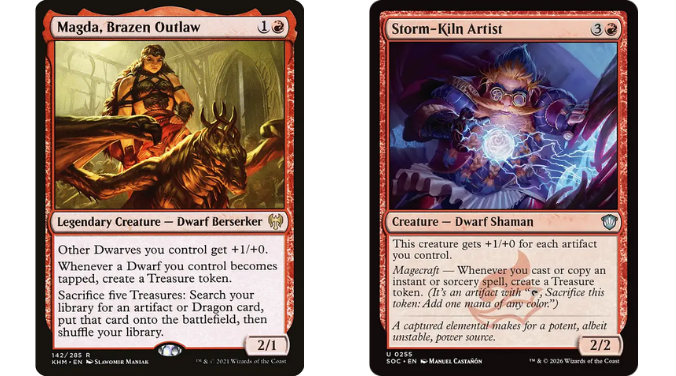
But probably the most natural and profitable new theme for dwarves has been synergy with Treasure tokens. The mechanic is perfect for the gold-obsessed, wealth-hoarding stereotype of dwarves set up by Tolkien – and of course it just so happens to be one of the most powerful mechanics to use in Commander. Treasure gave dwarves their first top-tier competitive deck thanks to Magda, Brazen Outlaw, and it seems like this will continue to be a key pillar of strength and identity for the creature type in future.
KINGS UNDER THE MOUNTAIN
Even if you’re building dwarf decks for non-Commander formats, your process almost certainly starts by looking at legendary creatures. The dwarf card pool is on the small size (there are ~160 cards that are dwarfs or care about them) but as we’ve just seen, they have quite a diverse list of associated mechanics.
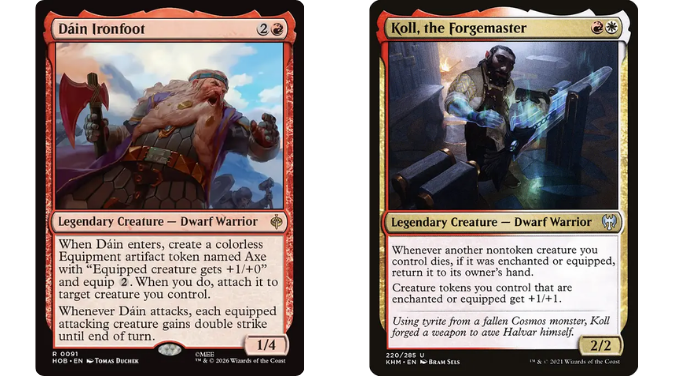
A lot of dwarf power comes through their common synergy with these mechanics, not directly buffing other dwarves. This means a good dwarf deck is often specialized towards one such theme, and mixes dwarf typal support with cards that support your subtheme (and perhaps also happen to be dwarves).
If it is a Commander deck you’re building, you also need to give consideration to color identity. Most dwarf cards are red or white. But there is a smattering across the other three colors, including valid commander options for most color combinations. Your choice of mechanical focus is closely linked to your color choice: equipment and vehicle decks gain a lot from white, while less combat-centric artifact builds may also want black or blue.
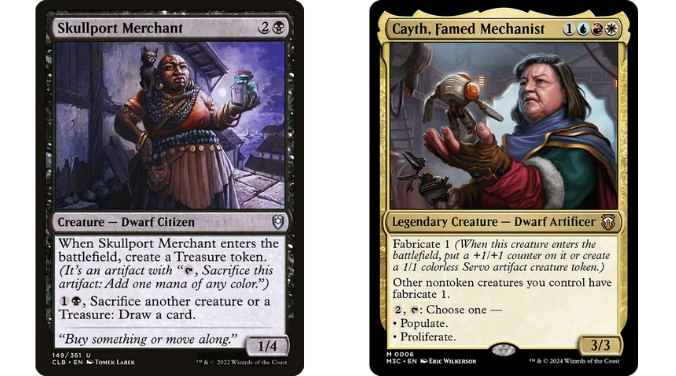
The Lord of the Rings: Tales of Middle-earth gave us some green dwarf cards which support an intriguing legends-matter theme, but it’s hard to find enough legendary dwarves without also having access to white. Of course, that’s only an issue in formats with color identity rules. The Lady of Otaria is perhaps the most unique and interesting dwarf commander: suitably for a card referencing Legends, she gives you reason to play the old blow-up-lands dwarves (so you can target yourself as a draw engine).

As I hinted before, the most powerful dwarf build is probably still Magda and her highly-specific combo. But if we look at the type more generally, I do think there’s a practical way to utilize most modern dwarf cards in the same engine.
UNITING THE CLANS
Most modern dwarf cards care about artifacts of one kind or another. The exceptions are mostly from Strixhaven or FINAL FANTASY, which are connected to noncreature spells or your graveyard instead. This means that a graveyard-centric artifact deck is the best way to build if you want to achieve maximum dwarfishness while keeping a potent, coherent gameplan.

Your gameplan probably still starts with generating early treasures. Quite a few dwarves are great at this: either version of Magda, Glóin, Dwarf Emissary, Gimli of the Glittering Caves, Vault Robber and Tataru Taru. Treasure tokens can power out more expensive dwarves and artifacts with better effects to snowball your early-to-midgame. Later on, accumulated Treasures can inflate your artifact count for cards like Digsite Engineer or Thorin, King of Durin’s Folk!
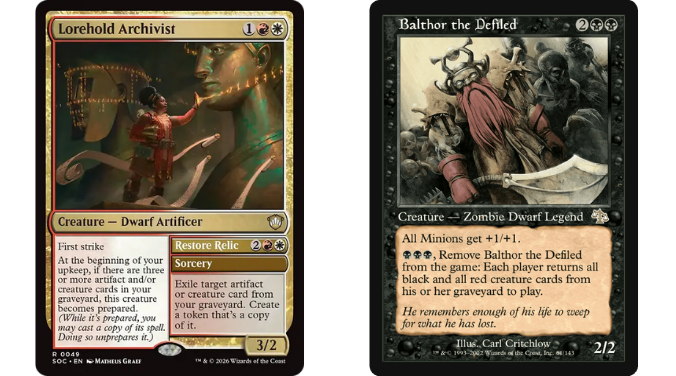
You should aggressively loot and mill over your more expensive artifacts to load up the graveyard so you can “excavate” them with effects like Lorehold Archivist, or reanimate them outright through Soul Salvage and Trash for Treasure. Krile Baldesion and Barrowin of Clan Undurr will help gradually recover any actual dwarf cards which end up in the graveyard this way. But if you have access to black mana (and preferably, nobody else does) then consider Balthor the Defiled. This old-timer favorite is still one of the most powerful reanimation effects ever printed!
Simply prioritizing value should put you in a winning position if the deck consistently starts fast and has strong synergy across all its cards. But for a more decisive win condition, you have multiple good options. You can “storm off” with treasures from Stormkiln Artist and a combination of Thunderdrum Soloist, Erebor Flamesmith, Aetherflux Reservoir and Papalymo Totolymo. You could also make a small creature unblockable using Dwarven Warriors or Dwarven Nomad, and then make it suddenly enormous with Bearded Axe, Dwarven Bloodboiler or Balthor the Stout.
Krile or Hofri Ghostforge can repeatedly recur dwarves like Practiced Scrollsmith or Blazing Firesinger to set up a three-card loop. Dwarven Recruiter can help you find the pieces of these combos, while Cadric, Soul Kindler and Bifur, Melodic Rider make it much easier to go fully infinite.

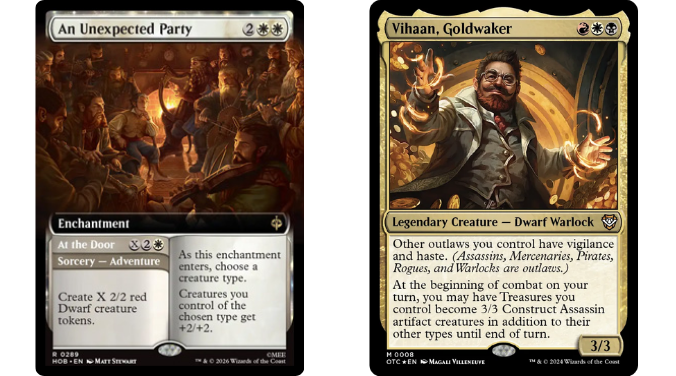
If you’d rather win through combat, there’s a surprising number of dwarf-specific ways to convert our artifact-value boardstate into humongous burst damage! We can cash in treasure for damage very efficiently with Magda, the Hoardmaster or Vihaan, Goldwaker. Thorin gives our team massive buffs no matter what artifacts we have, and Torbran (with or without Rankle) is another easy force multiplier.
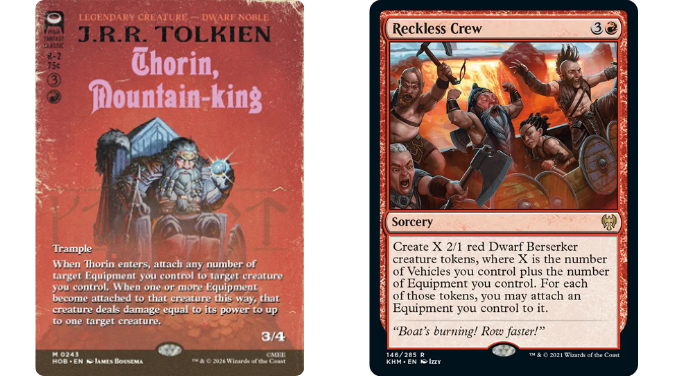
Some of our coolest win conditions depend on stacking equipment, which makes them harder to work into a non-specialised deck. But with Bludgeon Brawl, Arterial Alchemy or Armed with Proof we can convert our other kinds of artifact into equipment, then absolutely drop the bomb on somebody with Reckless Crew, Bruenor Battlehammer, or Thorin, Mountain-king!
ROCK AND STONE
I love when a typal deck in Magic can define a playstyle and mechanical identity beyond just going wide and stacking buffs from lords. Dwarves obviously fit that criteria, and I love the way they flesh out the flavor possibilities of a color which has previously been so dominated by goblins. Even the variety of decks you can craft within this one creature type is highly impressive, and worth exploring if any of the ideas I’ve mentioned excited you.
Given how integral dwarves are to the western fantasy milieu, and how enduringly popular they are with gamers, it’s actually remarkable that Magic left them on the shelf for so many years. But at least we’re quickly making up for lost time, and I’m looking forward to even more strong dwarf cards in The Hobbit and beyond!

Tom’s fate was sealed in 7th grade when his friend lent him a pile of commons to play Magic. He quickly picked up Boros and Orzhov decks in Ravnica block and has remained a staunch white magician ever since. A fan of all Constructed formats, he enjoys studying the history of the tournament meta. He specializes in midrange decks, especially Death & Taxes and Martyr Proc. One day, he swears he will win an MCQ with Evershrike. Ask him how at @AWanderingBard, or watch him stream Magic at twitch.tv/TheWanderingBard.