

For a set with a lot of expectations riding on it after an 18-year buildup, Lorwyn Eclipsed seems to be at least an initial success. While it’s hard to define exactly what makes a Magic set “good” overall, there’s a lot of specific qualitative boxes this one has managed to tick.
There’s a strong aesthetic and mechanical identity. The Limited format is robust (more on that next week!), and cards from Eclipsed are showing up across constructed formats from Standard to Legacy, but without completely re-writing the metagame. Its new cycle of mythic rare evoke elementals are among these leading representatives – powered by perhaps the most elegant and balanced version of that ability we’ve ever seen.

FABLE OF THE ELEMENTS
Fittingly, the first set to include evoke creatures was the original Lorwyn back in 2007. The set designers wanted to give a whimsical, ephemeral identity to the plane’s elemental creatures, since they were going to receive typal support and needed something to tie their cards together across all five colors.
The ability that they ended up with was revolutionary: essentially turning creatures into modal spells which could also be cast as sorceries (or sometimes instants).
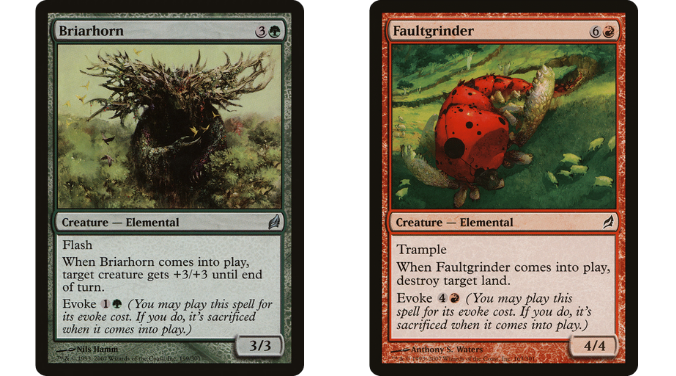
Evoke elementals would give you common utility spell like Giant Growth or Shatter as the creature’s ETB trigger. If you cast them for the evoke cost, the body would die right away, but you still got your spell effect. If you needed the body, or just happen to have enough mana, then you could cast these somewhat over-costed creatures the normal way, and still benefit from that desirable ETB.
These initial elementals from Lorwyn and Morningtide mostly played it safe when choosing the ETB effects, probably understanding that the mechanic on its own already added power and complexity. Indeed, every one is like its own different puzzle when it comes to figuring out when it’s optimal to evoke vs. hardcast, with varying price points and sizes of each creature complicating things.

You also had a few elementals which reversed the usual formula – setting the evoke cost to be MORE expensive than hard-casting, because it would allow you to immediately trigger a extremely powerful LTB effect instead of needing a sacrifice outlet. The most notable of these “reverse evokes” was Reveillark, thanks to its ability to combo kill with the help of Body Double and Murderous Redcap.
The ‘Lark, along with Mulldrifter, Shriekmaw and Cloudthresher, established the high watermark for competitive power of these original evoke creatures.
MULLING THINGS OVER
It would be some while before Wizards added any new evoke creatures, but that initial Lorwyn set ended up casting quite a long shadow. The late 2000s and early 2010s were a time of significant evolution in Magic’s overall balance: creatures became much more powerful and central to the game, and more cards were designed with alternate modes and costs to allow more consistent decks across all archetypes.
A seminal Magic strategy article dividing creatures into “Baneslayers and Mulldrifters” redefined how the community evaluated creature cards for the next 15 years; the title alone shows how important the Lorwyn elementals were in popularising the “value creature” concept which would dominate this era.

One reason Mulldrifter felt so powerful compared to older cards was its extremely high floor. The 2/2 flying body was certainly relevant, either as a blocker or an acceptable clock over the course of a longer game. But hitting that sucker with a Shock or trading it for your Tidehollow Strix also felt awful: you just went down a card to kill a creature that already drew them two more!
In an era where card advantage was king, this was an unwinnable situation – unless you killed it with a hardcast Shriekmaw or Cloudthresher, to get your own bonus body out of the trade.
However, the real reason that evoke redefined the role of creature cards so completely wasn’t their high floor – it was their stratospheric ceiling. Kamigawa block’s channel mechanic had already provided a similar creatures-with-spell-modes option, and those cards hadn’t broken out in anything like the same way.
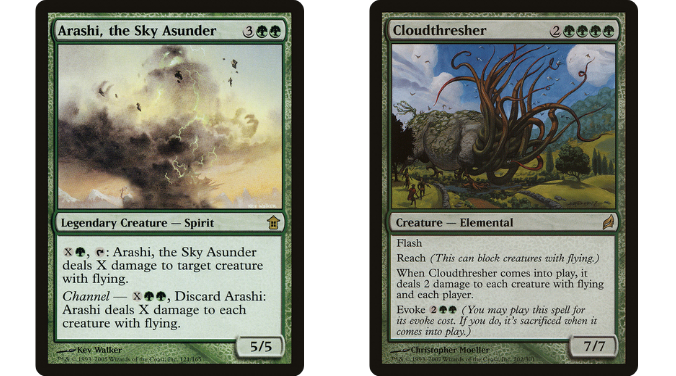
But since evoked creatures actually enter the battlefield, and their ETB effects trigger regardless of whether the evoke mode was used, this version of the mechanic offered a thousand times more potential for broken combos.
Flicker effects like Reveillark, Flickerwisp, Otherworldly Journey and Momentary Blink were also appearing more frequently in this era. From day one, players from Pauper on up were gleefully using Momentary Blink to double their Mulldrifter triggers for no extra mana – since they could cast it for the cheaper evoke cost and then Blink in response to the “sacrifice this” trigger to dodge the downside.
Of course, once you got an elemental in play “permanently”, you could continue to flicker, clone, and otherwise recur the ETB through all kinds of means. So as painful as it felt to spend a card killing these elementals post-ETB, leaving them alive gave your opponent a huge opportunity to get even further ahead!
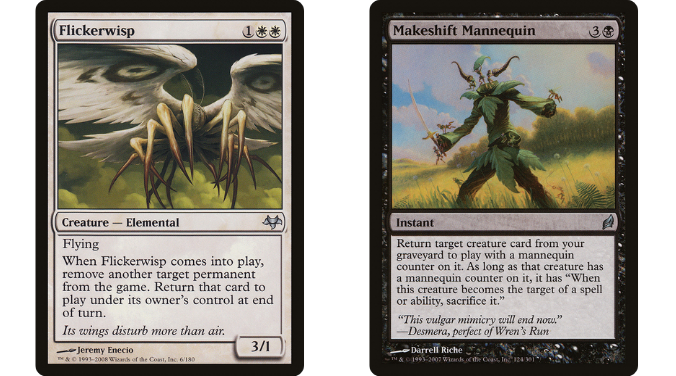
Ways to search for, discount, recur, copy, and generally synergize with creature cards are just much more commonplace, and even more efficient, than equivalent options for other card types. Throw in the huge inherent utility of putting bodies on board in a combat-centric game, and it’s clear why evoke creatures have had such an enormous effect on how Magic is balanced.
DANGER ON THE HORIZON
With the first batch of evoke elementals having made such a historic impact on how Magic is designed and played, there was an understandable delay before Wizards tried using the mechanic again.
They were never going to abandon it completely, but with the average power level and access to card advantage increasing a lot by the time Modern Horizons came out, you would assume that the next appearance of evoke would feel much less revolutionary. And indeed, Vesperlark (the single evoke elemental in MH1) was successfully released without setting the metagame on fire.
But that restraint was short lived, as MH2’s cycle of mythic “pitch elementals” soon made evoke infamous all over again.

Mulldrifter and friends had fallen out of mainstream Modern playability well before MH2’s 2021 release. The ongoing trend of card advantage becoming less important than mana efficiency undermined their inherent appeal, especially when the evoke cost was still more than the median cost of spells in the format.
What would need to change for evoke creatures to be back on top? How about a cycle of elementals whose ETBs provided huge immediate battlefield impact, suffered from no timing disadvantages, and cost ZERO mana to evoke?
These inherent advantages were enough to see Solitude, Fury, Endurance, Grief and Subtlety immediately and permanently integrate into the top level of all eternal constructed metagames. Grief in particular received multiple bannings for how brutal it could be if the ETB was immediately recurred (such as with fellow newcomer Ephemerate).

These MH2 cards were intentionally designed without real downsides – zero cost interactive spells which only get better with mana or synergistic effects. So when we got word of a new Lorwyn set, and naturally assumed that would mean bringing back its famous elemental mechanic, there was some understandable doubt about its implementation.
Would the new set designers be able to create a more reasonable, sane version of evoke that stayed interesting without blowing up the Magic metagame?
WE HAVE A LORWYNNER
I sort of gave it away in the intro, but yes! The new cycle of evoke elementals appears to have hit the mark as far as constructed playability, while cleverly addressing some of the inherent balance concerns.
One problem since the start has been the way evoke makes actually hard-casting the creature feel like a mediocre Plan B. Surely a creature card should be evaluated as a creature first, and have you be excited about casting that side?
By having the ETB effects scale up with which colors of mana were paid to cast them, the new elementals finally feel like hard-casting them is their peak form, the only way to access the full combination of effects and stats.
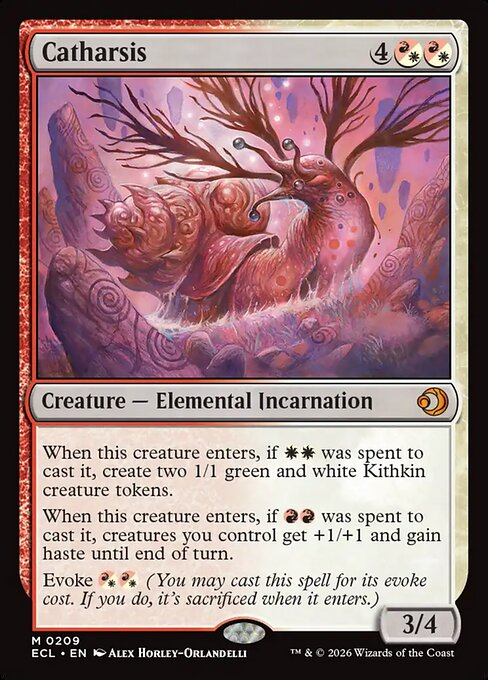
Catharsis is a beautiful example. I can imagine situations where a red-white deck would be okay with spending two mana either on making two tokens or pumping their team to swing. But IDEALLY you get to hard-cast the elemental and getting both ETBs to add a massive eight hasty power for your next attack!
The other eternal balance issue – how easy it is to farm ETB value and negate Evoke’s downside – is also addressed by this implementation. Since the new ETBs check for which mana was spent to cast the elemental, any other way of adding it to the battlefield (short of bouncing/airbending and recasting it) straight up can’t trigger the effects. Talk about two Avian Changelings with one stone!

You can still evoke a Wistfulness to draw cards and cast Ephemerate on it to permanently keep the body, but now that trick is exclusively about getting the discounted 6/5 body – not getting to cash in its trigger repeatedly on top of that.
FINAL FORM
The Lorwyn Eclipsed version of evoke is absolutely, by design the weakest incarnation of the mechanic. But it’s also the most reasonable, and by turning up other dials and levers of power on these cards Wizards have managed to still make them feel like big exciting bombs.
They seem to have committed to just giving the elemental a few extra power and toughness or an impressive internal synergy between its two ETBs, a source of strength far easier to anticipate and (thus balance) than the exploitable peaks of older cards.

Regardless of how you do it, designing rares to be weaker than player expectations is quite courageous in the year 2026. So I’m delighted to see that these new flagship cards, like the weird and ambitious set they come from, appear to have gotten off to a strong start.

Tom’s fate was sealed in 7th grade when his friend lent him a pile of commons to play Magic. He quickly picked up Boros and Orzhov decks in Ravnica block and has remained a staunch white magician ever since. A fan of all Constructed formats, he enjoys studying the history of the tournament meta. He specializes in midrange decks, especially Death & Taxes and Martyr Proc. One day, he swears he will win an MCQ with Evershrike. Ask him how at @AWanderingBard, or watch him stream Magic at twitch.tv/TheWanderingBard.