
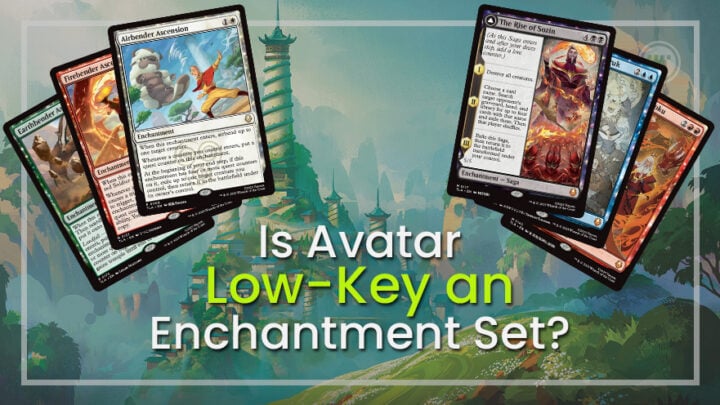
Nothing about the set previews or communicated design priorities would make you think that Avatar: The Last Airbender is an enchantment-focused set. It doesn’t have any new enchantress cards, or even other support cards specifically synergizing with enchantment-heavy decks. And still, a significant chunk of the set’s power is contained in a series of powerful rare enchantment cycles!
From the legendary past lives of the Avatar, to scaling Ascension and Shrine cards, these enchantments blend into the main themes and mechanics of the set. But in a broader constructed context, their designs are open ended enough to open up even more exciting opportunities.
As a long-time enchantress player and fan of the card type, let me walk through some of the biggest game-changers from the set and their potential uses.
HONOR THY ANCESTORS
The most prominent enchantments in Avatar: The Last Airbender are no doubt the Avatars themselves. The past lives of the prophesied elemental master are captured with appropriate grandeur, appearing on a cycle of mythic rare flip-sagas which become creatures in their final chapter. Oh, and historical bad dude Firelord Sozin is here too, filling out the black slot in the cycle.

Obviously from a Limited perspective these are all insane, deck-defining bombs and you’d be hard pressed not to play them. Even the slightly more narrow or build-around avatars have enough raw board impact across their two sides to easily make the cut in 40 card decks. But for Constructed, the evaluation gets a little more interesting.
The current efficiency of unconditional removal is so good, and the amount of card draw available in any deck so high, that committing to any threat at four mana or above is quite risky – especially if that card has to survive multiple turns to get its full value. It almost doesn’t matter what the Avatar sides do – to say you’re going to cast a five- or six-drop enchantment then wait three turns, and THEN start seeing a return on your awesome legendary… that’s ambitious to say the least.
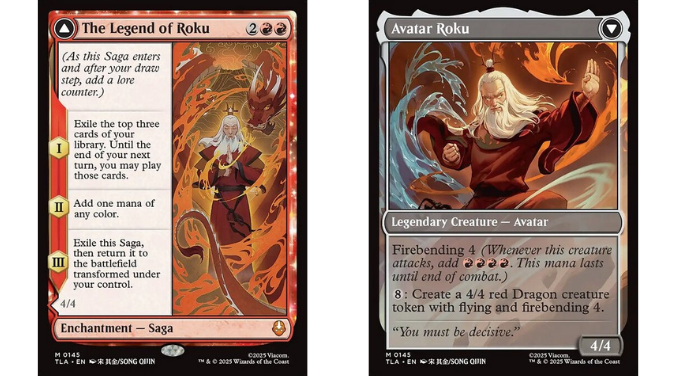
The blue and red avatars are each four mana and seemingly tuned to top the curve of aggressive burn or prowess lists – providing a burst of card draw and then a high-ceiling finisher which can carry those decks over the line. Slow as they are, I think they will have at least a decent chance there, and The Legend of Roku could also find a home in the middle of midrange or ramp decks, thanks to its value as a mana sink.

But I think that the slower and grinder a deck is, the more it will want these kinds of cards – and as a result, it’s actually The Legend Yangchen which I would pick as the best of this cycle. The Second-To-Last Airbender does everything she needs to, and in the right order: significant board impact on the ETB chapter, then a gush of resources, and finally a potent finisher as it transforms to the backside.

Yangchen’s second chapter will be the inflection point for most decks deciding whether to play her. Giving your opponent three cards is obviously not something to do lightly. But consider the following:
White still has the least card draw of all colors, so the draw-three is more relatively valuable to the white deck. And while normally I would not want to give opponents more looks at possible removal when I’ve got this sort of premium threat on board, the back side of Yangchen really rewards having this burst of extra gas.
That triggered ability is a great complement to the 4/5 flying body of Avatar Yangchen – either you can airbend away opposing creatures in a scenario where you’re racing, or you can draw out extra value by repeatedly airbending your strongest ETB permanent. Since replaying the card from exile counts as casting a spell, you only need one other spell each turn to re-trigger the Avatar and continue this steady loop!
ON THE UP-AND-UP
While not as significant from a lore perspective, the other rare enchantment cycle in A:TLA is just as powerful – maybe even moreso. Like previous “Ascension” cards, these are cheap enchantments which ask you to fulfill a certain condition enough times to prove your mastery of one element and unlock their excellent abilities.
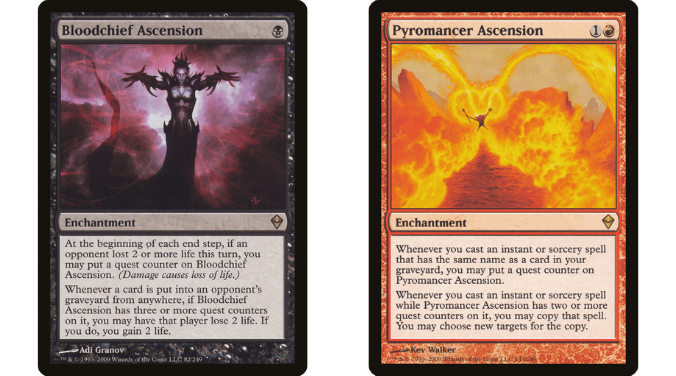
One big difference compared to that earlier cycle is that these bending Ascensions actually do have some initial impact beyond just starting up your “quest counter”. While this does result in less powerful payoff abilities, not having these spells be a total tempo loss is absolutely an upgrade to their playability. Not to mention that these initial abilities can all help you stack up quest counters faster: if you use Airbender Ascension’s ETB to target your own Beza or Overlord of the Mistmoors, you can almost reach four counters on the spot!

All four are good enough to be worth trying, especially given the low mana investment required – I’m sure you don’t need me to tell you that. But there is one of these cards that works a little differently to the others, and that’s Earthbender Ascension.
The earthbending mechanic has been the most hyped in the leadup and early days of this set, especially for players in eternal formats. Creating a land-creature is a really impactful bonus to tack onto most spells, helping in many situations even on face value. But the quirk of being able to “reanimate” the land card when it dies is what really creates potential for game-changing plays: the most obvious being to earthbend a fetchland to recur it as a ramp effect.

If 2G to ramp a land, fix your mana and make a body is a reasonable deal, then 2G to ramp by two mana is amazing – even if it takes until next turn to feel that benefit. And we haven’t even mentioned the other triggered ability, which sticks around and continues to pay off the initial investment as you ramp! For most of the Ascension cycle here this repeated trigger is the main attraction, but I think the frontloaded value here really pushes Earthbender Ascension over the top.
SHRINE ON, CRAZY DIAMOND
As a player who cut his teeth on the original Kamigawa block, I fully understand the excitement when a long-running synergy mechanic like shrines gets new support printed. If you’re already all-in on five-color shrines, especially in Commander or other singleton formats, it probably won’t matter how good or bad this new cycle is. You’re playing them all because the cumulative rewards for playing all available shrines are amazing, and we still don’t have enough of them to over-fill the available deck slots.

For the rest of us though, it’s worth looking at the new cycle with a critical eye. I’m sorry to say that these new shrines are probably the weakest yet from a Limited perspective. I expected that making the shrines triggering only on ETB instead of every turn should have at least allowed for lower mana values across the whole cycle – but only Northern Air Temple seems to follow that template. The other four are also blatantly overcosted if not played as part of a sequence: four mana to make a single monk or ramp one land is game-losing tempo, even in Draft.
That said, there is some upside to be found as well. Making the shrines less attractive individually should significantly improve your odds of securing them in multiples during drafts and actually “living the dream” of a dedicated shrine deck. Making them ETB triggers means there is now a good way to use redundant copies of these legendary enchantments that you might draw (as well as airbending or other means of recurring them). It also amps up the average impact of Hei Bai, Forest Guardian – maybe the best card this set has to contribute to a shrine-themed deck.

Lastly, there is particular value to be had in combining these with Go-Shintai of Life’s Origin, which is obviously the most likely commander for a shrine-centric deck. For the four more expensive pieces in the cycle, getting to immediately follow that introductory burst with a second trigger from the Shrine creature token is a massive improvement to their floor, even before you account for the near-certainty of having multiple other shrines in play.
LONE HEROES
I wouldn’t be writing this piece if the well of playable enchantments dried up after just those big-name cycles. There are at least as many standalone card designs which I feel are at least worth testing in some format or another.

Fated Firepower lives up to its mythic rare status with a unique twist on the Furnace of Rath/City on Fire type damage amplifier. XRRR may feel a little mana hungry for a hyper-aggressive red list, but this is clearly intended as a payoff for the extra mana generated by firebending attackers – and it’s good enough to have me seriously going through the list of such creatures to sketch out a decklist!
Adding flash to this enchantment is obviously a necessity to have it work with firebending, but I wouldn’t overlook how much extra pressure having that potential places on the defending player. If you have enough firebending mana to threaten it by turn three or four, then it starts looking a lot like Embercleave – except it can also be a force multiplier for noncombat damage. If you have a deck that both generates extra mana and wins through “pinging” (Storm with rituals and Grapeshot, artifact lists with mana rocks and Ghirapur Aether Grid/Reckless Fireweaver) then Fated Firepower could be a great backup plan for generating lethal through sideboard hate.

Aang’s Iceberg is not as fancy as some of my other standout picks from this set, but it does have some unique traits compared to the average white “Oblivion Ring” effect. For one, it has flash, which along with the ability to target all nonland permanents should be enough to offset its high-ish mana cost.
For two, it has the potential to target allied permanents as well – something it shares with the original O. Ring but not most other modern versions of the effect. This offers a lot of niche yet valuable opportunities for comboing or re-triggering ETB/LTB abilities, or even saving a high-cost threat from opposing removal. That last use-case seems a lot more realistic when you add a built-in ability to sac the Iceberg for a small-ish cost! It’s still probably too clunky to include this primarily as a defensive spell, but it’s flexibility that absolutely helps justify giving the Iceberg a slot in white midrange lists.

The last card I want to highlight today is Avatar Destiny. Four mana is really as expensive as an Aura can get and still be justifiable for competitive play, but it needs a lot of help. Avatar Destiny has a ton going in its favour, however. Obviously the initial impact has a high ceiling, one you can raise further by playing a creature deck that emphasizes self-mill or dredge.
But the impressive thing is that this potentially huge stat boost is only a set-up for the second half of the card. So long as the aura gets into play, the opponent will be under lots of pressure to remove whatever it’s on. When they do, they are gambling with their lives – they might just be donating you a free Atraxa, Griselbrand, or some huge Eldrazi!
It’s a factor which should strongly discourage idly killing the Destiny-bearing creature – even if you don’t consider the potential to re-cast the aura. Of course, if you do re-cast it every aspect of the aura is strengthened by the previous mill trigger. Just get a sacrifice outlet to control when you can set off that death effect and we have ourselves a bonafide once-card win condition!
ENCHANTING LEGACY
I don’t really think that the set designers on A:TLA set out to design an enchantment-centric set. It just so happens that a lot of the subtypes or design themes associated with enchantments are a good fit for the Avatar lore, and so we ended up with an unusually high concentration of noteworthy cards in that type.
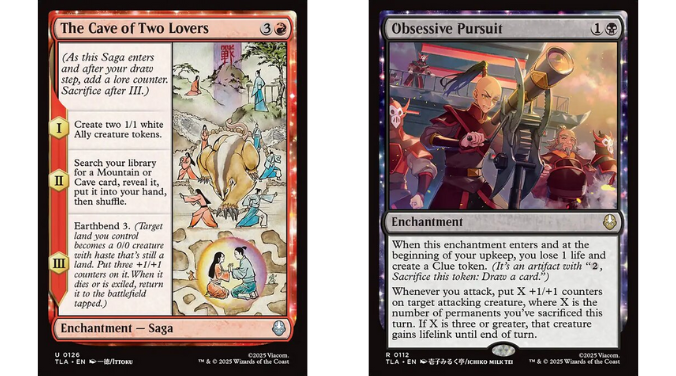
But I’m not going to waste my time wondering whether or not to lump this set into the same category as Theros, Duskmourn or Wilds of Eldraine. I’m going to be scheming up new decklists to utilise the legendary Avatars, or figuring out whether Aang’s Iceberg can help me sleeve up Parallax Wave in Legacy again.
Even uncommons I haven’t mentioned like Team Avatar and Honest Work could be powerful upgrades for the removal slots in any deck which specifically cares for enchantments. If there’s one lesson we should be taking on board from the source material, it’s that with a little effort, you can unlock incredible power even from unassuming places!

Tom’s fate was sealed in 7th grade when his friend lent him a pile of commons to play Magic. He quickly picked up Boros and Orzhov decks in Ravnica block and has remained a staunch white magician ever since. A fan of all Constructed formats, he enjoys studying the history of the tournament meta. He specializes in midrange decks, especially Death & Taxes and Martyr Proc. One day, he swears he will win an MCQ with Evershrike. Ask him how at @AWanderingBard, or watch him stream Magic at twitch.tv/TheWanderingBard.