
In a recent article on how high-level design choices made for The Hobbit, Mark Rosewater discussed which aspects of The Lord of the Rings: Tales of Middle-earth were worth carrying over to this new set.
There were several mechanical wins deemed “must re-use” for how well they captured the feeling of Tolkien’s world on the tabletop. Others were put in the “might re-use” bucket. Not because they had failed, as Mark saw it, but because they could be swapped out for something more unique. Only one mechanic received a firm rating of “don’t re-use” – and it was the signature mechanic of that entire set!
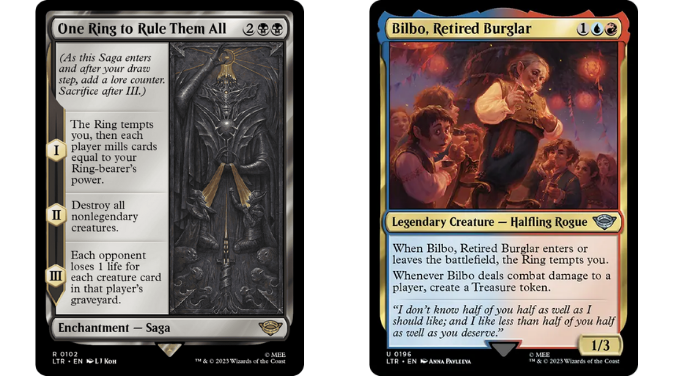
More design time and pre-release hype was devoted to “the Ring tempts you” than any other aspect of Tales of Middle-earth. But just a few short years later, and it is already a borderline forgotten mechanic, shunned by players and now judged by Wizards as unfit even for a new Lord of the Rings set!
What about this mechanic earned it such a negative reception? Could some version of it have been salvaged to the point it might escape that “don’t re-use” status? Now, with The Hobbit bringing us back to Middle-earth and the temptations of the Ring, seems as good a time as any to ask some hard questions.
PROBLEM ONE: TOO MUCH TO TRACK
I’m not being hyperbolic when I say that “the Ring tempts you” combined all the design sins of its era into one awkward package. Any one of these issues might have gotten a mechanic into the “don’t re-use” bin on their own. So as they stack up, it really becomes clear why it was so hard to love. Let’s try and fix these flaws one at a time.
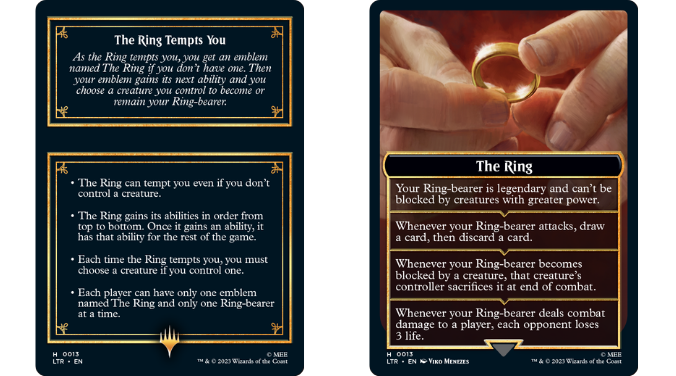
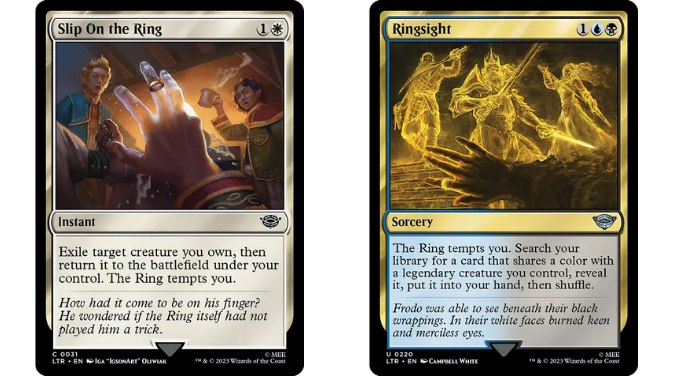
The most infamous issue with “the Ring tempts you” (TRTY) is its clumsy reliance on outside game pieces to track the current status of the mechanic. This was definitely the peak (or the nadir, perhaps) of Magic experimenting with using extra game pieces to track complex mechanics; players had already made their complaints heard about the awkwardness of Day//Night in Midnight Hunt, Initiative in Battle for Baldur’s Gate, and Attractions in UNFINITY.
TRTY managed to outdo the lot by requiring at least two, arguably three different extra game pieces per player to represent this single mechanic! Wizards included a tracking card in booster packs so you had something to represent the Ring emblem, but you still needed a way to track which of its abilities were currently unlocked.
In theory you could rip off the perforated bottom section of the emblem for this, or use a die. But neither of those solutions are robust enough for tournament play, and even casually the tearaway section was so easily knocked or moved as to be a constant frustration.
Also, if you used that little piece of cardboard to track emblem progress you now had nothing to identify which creature was your current Ring-bearer! No special counter was provided to help track this very important status, even though it could go on any creature and move between creatures easily.
Ironically, even if such a counter had been provided it would still have ended up causing confusion – because Ring-bearer is simply “a designation a permanent can have”, and is not (in strictest rules terms) indicated by any counter or game object at all. Forcing players to physically represent mechanics in a way which contradicts their underlying rules is deeply inelegant, the kind of thing Magic design has historically learned to avoid at all costs.
CAN IT BE FIXED?
It’s a drastic change, but I genuinely think the best way to fix this issue would be to delete the “choose a ring-bearer” part and just have the Ring emblem abilities concern the player directly. This would probably bring the Ring emblem much closer to what the actual card for The One Ring ended up being.
The idea of having a specific creature be your Ring-bearer is admittedly cool and flavorful, but that juice is not worth the squeeze of tracking it across a whole game. Especially when you look at what benefits being a Ring-bearer actually grants…
PROBLEM TWO: TOO WEAK, TOO WEIRD
Magic is a very complicated game, and players have learned to love some notoriously clunky cards and rules. Look at how many of us can recite the subtler rulings for things like Blood Moon or Chalice of the Void!
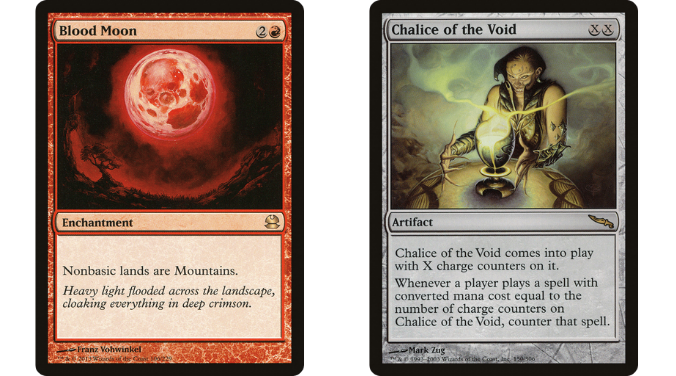
What this tells us is that Magic players are willing to embrace esoteric and unintuitive mechanics without complaint – so long as those mechanics serve an important role within the broader metagame of a format.
Maybe the extra hassle of outside game pieces and bizarre wording would have been worth it if TRTY had the strength to dominate opponents. The Initiative has seen plenty of play and relevance despite having most or all of the same shortcomings as TRTY. But the Ring emblem isn’t on the same power tier as the Undercity – it’s much closer to the original, disappointing dungeon cards from Adventures in the Forgotten Realms.
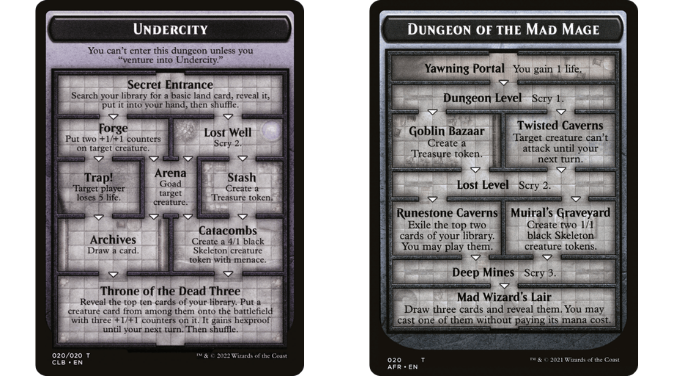
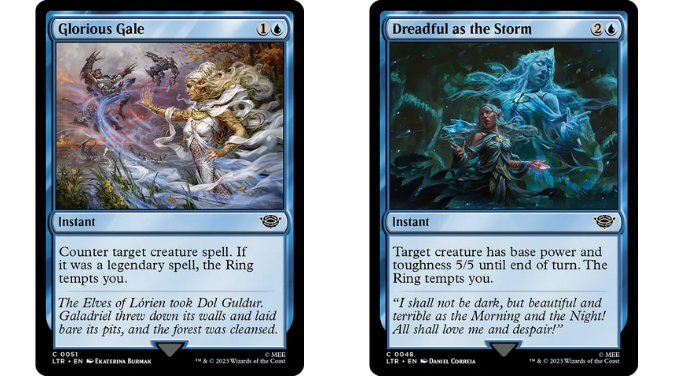
Two out of four abilities do very little other than make the Ring-bearer harder to block. The other two reward you for attacking with the Ring-bearer, which at least makes the “harder to block” parts feel more purposeful. But the size of those rewards feels meagre for how much work it is to unlock them, and how unreliable attacking is even with the Ring-bearer fully powered.
Keep in mind how hard it is to trigger TRTY more than once per turn cycle; most cards can only trigger it as a one-time effect. Does looting once and +3 damage on attack feel like an adequate payoff for four turns of work? Of course not!
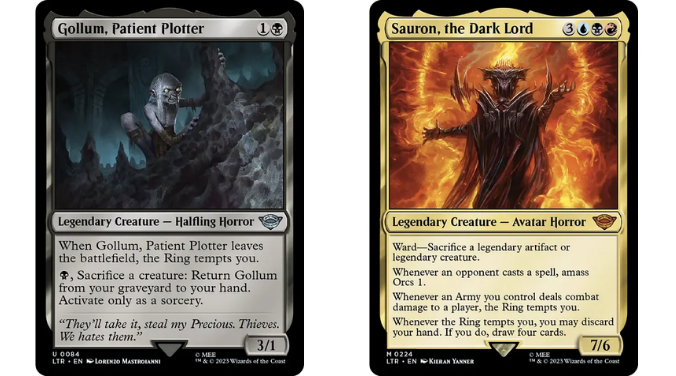
In practice the only exciting part of all this is making creatures hard to block, since you could potentially use it to just force through a high-damage attack. Except that when you look closely, neither of those abilities really matter for such attacks!
Skulk is useless on high-power creatures, and the third ability only matters if the blocking creature(s) would normally survive damage. Neither stops your opponent chumping with their smallest creature (or multi-blocking and trading with you) and neither gives you a way to push direct damage to the defending player.
CAN IT BE FIXED?
Given the inherent limitations of combat triggers and the way cards with TRTY triggers were actually balanced, I think perhaps the design team should have stuck with some of their more powerful playtest versions of the Ring-bearer abilities. For instance, the skulk from the first ability could have been replaced by shadow and been just as flavorful, making Ring-bearers of any size borderline unblockable.
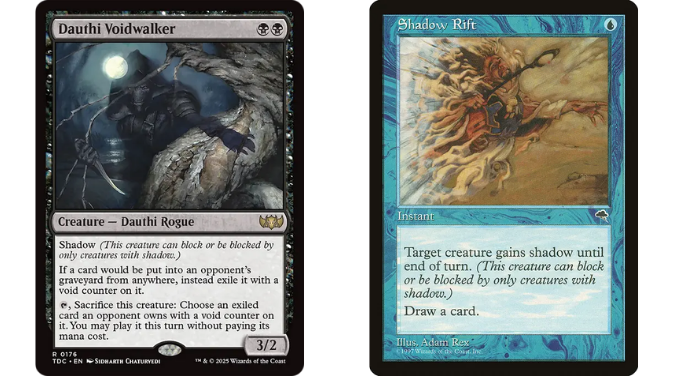
That said, it is nice that skulk gives players a reason to prioritize low-powered Ring-bearers (like hobbits), so what about the other abilities? First, I would swap the position of the draw-discard trigger with the life-loss one. that way the long-term card advantage ability kicks in during long games, and the extra damage (which matters more in short games) comes online sooner.
I’d also tweak how that life loss trigger works to make it more valuable (especially on early turns). Instead of immediately losing three life, I would have it give the defender a Doom counter. Then I would just add text to the Ring emblem that says “At the beginning of your end step, each opponent loses one life for each Doom counter on them.” This would make Ring-bearer attacks feel momentous even if the damage in an average-length games ended up about the same.
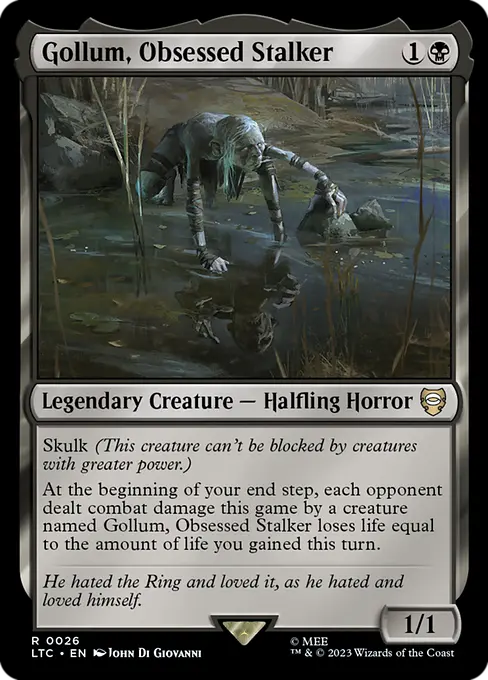
PROBLEM THREE: FLAVOR FAIL
Seemingly the most significant change made to TRTY during playtesting was cutting out any kind of negative consequences for being Tempted or making a creature your Ring-bearer.
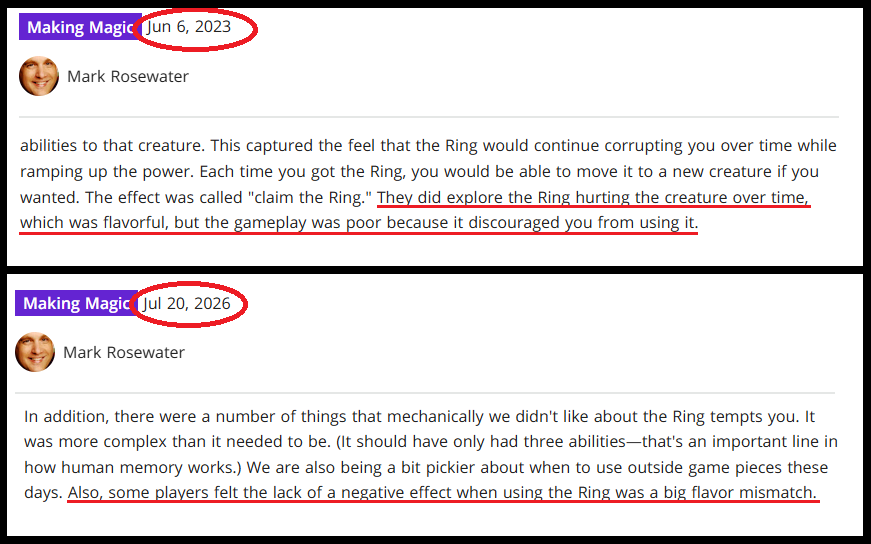
Perhaps it’s unfair to judge this choice now with the benefit of three years hindsight. But I suspect the decision to make TRTY all-positive in spite of the lore would have been contentious even within the design team.
Players were already confused by this a month before Tales of Middle-earth released. When asked whether there was ever discussion about changing the mechanic name to something less ominous, Rosewater insisted “we changed it to the Ring tempts you to be MORE flavorful”. But where in Tolkien’s mythos – or any myth – does the temptation of absolute power come without eventual consequence?

CAN IT BE FIXED?
If I wanted to bring back TRTY in The Hobbit or a future LOTR set, I would actually increase the number of abilities on the emblem by one or two, and have the power of those later unlocks scale up significantly. But then I would also add a final, disastrous unlock: either “target opponent controls you until the end of your next turn” or simply “you lose the game”. While severe, either of these penalties feel pretty lore-accurate for representing the consequences of becoming fully corrupted by Sauron’s influence.
Of course that is only half the change, because most players are unlikely to trigger something that loses them the game even if it is a “canon event”! I would also need to add new cards and effects which cause the Ring to tempt your opponent instead of you. This is obviously a niche effect, so imagine a card like Sheoldred’s Edict with “Each opponent is tempted” as one of the modes, or “target player is tempted” as the secondary effect on a cantrip like Thought Scour.
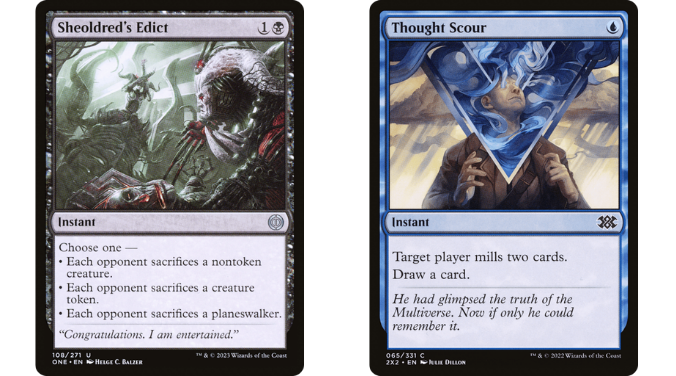
This turns TRTY into more of a risk-reward mechanic where you can trigger it aggressively to make a very powerful ring-bearer, but that sets you up for an opponent to punish you with just a single opponent-targeting temptation!
IT NEED NOT HAVE HAPPENED IN OUR TIME
I don’t think that the team who worked on Tales of Middle-earth were bad at their jobs. But I do think that this was an example of Universes Beyond source material being tricky to satisfactorily adapt into Magic – of designers feeling the need to make something epic and unique and flavorful and powerful and universally playable all at once.
With too many conflicting priorities and no clear sense of how to resolve those tensions, TRTY was doomed. Which makes it rather funny to me that the designers DID manage to create an elegant, fitting representation of the all-powerful and deleterious Ring literally in the same set!
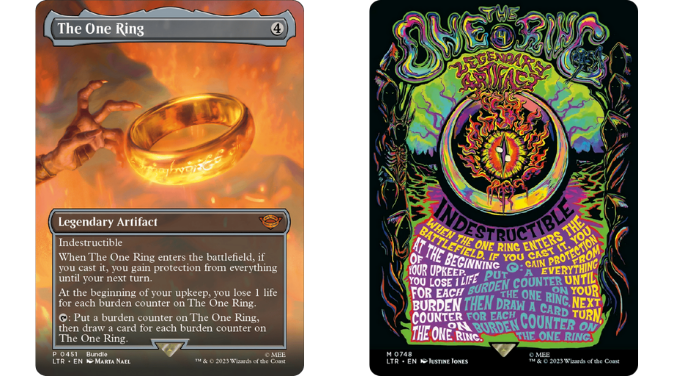
Format-warping though the card may be, it neatly hits on all the key lore aspects that define The One Ring in Tolkien’s lore while being a relatively simple and functional game piece. It has the raw power, the famous invisibility trick, the growing toll on the user, and the item’s near-indestructibility. It goes in tons of different decks (ok, perhaps too many) and it feels pretty great to use.
Could Wizards revive TRTY one day, perhaps in a souped-up form; the same way Initiative turbocharged dungeons? Yes, and I think it would only take a few small changes, as we’ve discussed. But I think Wizards have already learned the right lesson from this experience. Don’t try to cram all the flavor and identity of a set into one bespoke mechanic – and try to make sure that the important rules text is on actual Magic cards.

Tom’s fate was sealed in 7th grade when his friend lent him a pile of commons to play Magic. He quickly picked up Boros and Orzhov decks in Ravnica block and has remained a staunch white magician ever since. A fan of all Constructed formats, he enjoys studying the history of the tournament meta. He specializes in midrange decks, especially Death & Taxes and Martyr Proc. One day, he swears he will win an MCQ with Evershrike. Ask him how at @AWanderingBard, or watch him stream Magic at twitch.tv/TheWanderingBard.