

I find myself saying this a lot, but the defining trait which elevates Magic above other card games is the sheer scale of its history and card pool. In a genre about exploring the range of gameplay possibilities and customizing decklists, simply having way more unique cards available is its own selling point.
Of course, not all the these cards are meant to be completely unique game pieces. A lot of the time and effort of Magic’s designers has been spent on trying to tweak and improve on the game’s core effects. Combat tricks, burn spells, cantrips, reanimation, discard and counterspells and mana rocks and sweepers… these have been the fundamental building blocks of gameplay since Limited Edition Alpha in 1993.
But stable as they are in their general function, nearly everything else about those foundation stones has shifted over time. Whether in service of balance or just changing tastes of its players, Magic has survived through constant evolution – and there’s no better way to see that than compare the Alpha incarnations of these effects against their latter-day descendants.
BURN SPELLS

If you have to pick just one, Lightning Bolt is simply THE Magic card of all time. That’s a consensus pick, not just mine; the original burn spell won a grand voting bracket of literally every Magic card a few years ago, beating out other potential mascots like Black Lotus and Birds of Paradise.
The art, flavor, flexibility, and raw power all contribute to Bolt’s universal and enduring appeal. But its singular status isn’t just a result of popularity. Bolt (and other burn spells) are also the first-principles measuring stick of Magic game balance. How much damage you can do with a one-mana red instant sets the exchange rate for how much your mana needs to buy you on other cards, especially creatures with less than four toughness!

Bolt may not be as obviously overpowered as its cycle-mates Dark Ritual or Ancestral Recall, but it has always been at the ceiling of what’s acceptable. So most of the “evolutions” of this card type have had to either be sidegrades, figuring out what kinds of utility text would make sense on the most streamlined spell in Magic. There have also been many downgrades of Lightning Bolt, designed for formats where the OG burn spell was too oppressive.
Over time, the average toughness of creatures has steadily risen while starting life totals remain the same. This makes balancing modern burn spells tricky: three damage for one red is still too good if you’re burning face, but it looks like the bare minimum for trading with creatures! Thus we get Skred, Flame Slash, Abrade, Redcap Melee, and Unholy Heat – narrower in application, but potent enough to at least do that one job well.
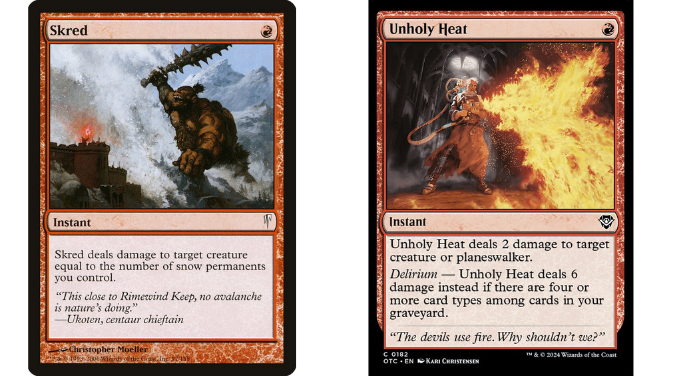
I think we do lose something by the vanishing flexibility of dividing Lightning Bolt into Boltwave and Torch the Tower. But it’s also hard to imagine any way to elegantly meet the mismatched expectations of creature and face burn on a single card. If we can find one, that will no doubt be the next great Red Deck evolution.
CANTRIPS

For such an integral part of Magic today, cantrips as we know them were not really part of its original design at all! The closest effect in Alpha is Ancestral Recall – which pretty much explains why traditional cantrips were not a thing. If your design team believes that you should be able to draw three cards for a single mana, then why would anyone have a need for cards like Predict, Preordain, Sleight of Hand or Serum Visions?

Of course everyone very quickly realized that A.Call was far from A-OK, and its subsequent evolutions (devolutions?) became less powerful but more nuanced. Brainstorm still draws half a hand at once, but tests player skill in numerous ways: the mind games of “hiding” cards from discard spells, sequencing tricks with shuffle effects, and avoiding getting “Brainstorm-locked” made blue decks feel cerebral and rewarding to master.
Appreciating the impact of this “tech” led to more sorcery-speed cantrips, in an attempt to print more high-control cantrips while limiting their ceiling for abuse. Even so, it became clear that drawing more than a single card off one mana was too explosive, even if it was at sorcery speed and actually left you down cards in hand.

Instead, modern cantrips tend to let you control your draws through scrying, surveilling, and similar mechanics. You’re effectively paying one mana to upgrade your draw step so you’re more likely to draw cards you need. In a game where luck of the draw so often dictates our possibilities, who wouldn’t like to take a bit of that agency back?
DISCARD

There might not be a more drastic example of the wild west that was Alpha than its selection of discard spells. Balance, Wheel of Fortune and Mind Twist are game-shattering spells at insanely cheap rates; Disrupting Scepter is fairly designed but completely terrible. The goldilocks of the lot, Hypnotic Specter, became an infamous threat and was oppressive enough to be phased out of print by 1996, before making a comeback 10 years later to find it had been mostly power-crept out of relevance!
But the evolution of hand-attack spells hasn’t really been about getting more or less powerful. It’s been figuring out how to make them more fun. Mind Twist, “Hippy”, even early evolutions like 1994’s Hymn to Tourach; all of these spells force the target to discard “at random”. That’s definitely more threatening than letting the target choose what they lose, but the lack of agency allowed for either player makes for unsatisfying results.
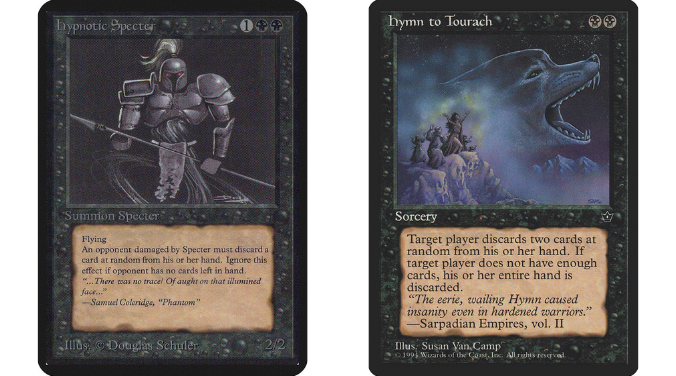
(Your author, Hymns Georg, who plays Bx midrange in every eternal format and cackles maniacally while making opponents randomize the decimation of their own hands, is an outlier and should not be counted).
The printing of Coercion in Visions was the discard equivalent of fish crawling onto land; less than two years later we got Duress, a card which has remained the baseline discard spell for the ensuing 27 years. Duress itself has shown no need to evolve, but its younger cousins like Unmask, Cabal Therapy, Thoughtseize, Inquisition of Kozilek, Grief and Dreams of Steel and Oil have cemented this “targeted discard” style as the apex of the form.

COUNTERSPELLS

The most intriguing part of Alpha’s counterspell suite to modern eyes isn’t the power level or even the relatively unchanged wording. It’s the fact that such stack interaction was, at the time, much more loosely distributed across the color pie. The idea of cards like Lifeforce or Deathgrip existing, even as enemy color hosers, would quickly vanish and leave countermagic as the game’s most color-restricted effect. This is a real shame in my opinion, but that’s the timeline we live in, and it’s one where blue would hold the reins of counterspell evolution for three decades thereafter.
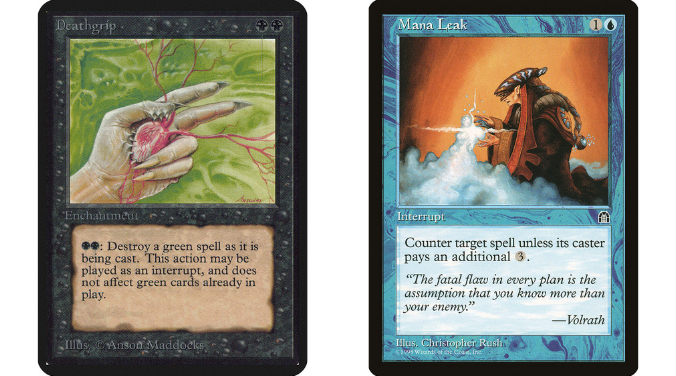
Being so binary makes counterspells tough to iterate on as a designer. The target spell is either countered or not; the result of “half-countering” something is impossible to calculate given the infinite range of effects that spell might have. As a result, most evolutions have focused on the cost exchange being offered; changing the cost of the counterspell, or offering the opponent the chance to trade some other resource to let their spell resolve instead.
This latter kind can be seen as a solid improvement, giving design teams more room to tweak the power level for different costs or formats and allowing both blue mages and their opponents to skillfully play around their additional costs. Eventually even more design space was unlocked by finding ways to evolve the actual results of counterspells.

Cards like Memory Lapse, Spelljack, Hinder, Remand, Spell Queller and Aven Interrupter all complicate the consequences beyond just your spell not resolving. Some of them are more punishing, some of them are less, but all were interesting and relevant in their metagame. To me, this shows the importance of that extra “lever” for designers to use when balancing counterspells; being able to tweak the power level AND the cost is the path to fresh and interesting new iterations.
COMBAT TRICKS

If you go by how long a card remains unchanged as part of Magic’s Standard card pool, then Giant Growth is probably the best-balanced design in all of Alpha. Where the remaining boons all proved to be a little off in the mana-to-power department, and many of the set’s other cards and mechanics would seem completely antiquated even a couple of years later, giving creatures +3/+3 at instant speed remained relevant and effective for literal decades.
As we’ve seen though, these evolutionary trees continue to branch out even when the central trunk remains unchanged. There are a lot more ways to buff creatures than just +3/+3, and they are not limited to one or two colors. While green has always remained fairly faithful to the “raw stats + maybe trample” formula, blue has developed tricks to evade blockers, white has a range of more defensive and protective spells, while red and black focus on boosting power and damage without much care for whether their creature survives a trade.
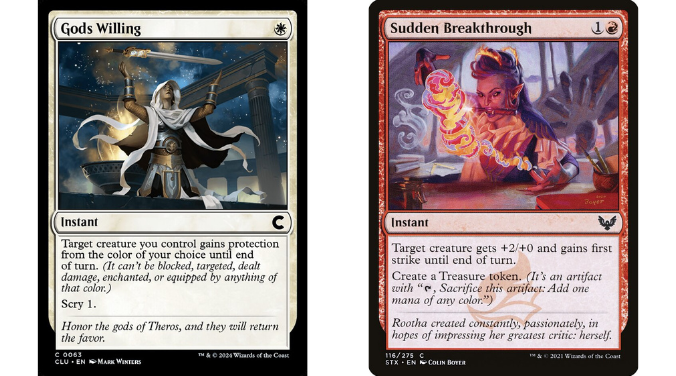
We have seen the lineup of commonly-used trick effects in each color shift a lot, and the general direction has been to granting keywords over raw stats. But maybe the biggest development is the separation between aggressive and protective tricks, which is also largely a division along color lines. Red and green specialize in tricks that boost combat value and might even be cast at sorcery speed, while white and blue priorities saving creatures from deadly situations.
Intriguingly, black has shifted more into the defensive camp over time, going from examples like Hatred to the now-signature Feign Death school of effects, or even the trade-focused deathtouch-granting combat trick.

Tricks which mainly pump raw power and toughness have become less emphasized as the base statlines of creatures get larger, making damage “cheaper” to come by overall. They still find their niche though, whenever players must reckon with force-multiplying effects like double-strike or infect. So long as there are mechanics to maximize the value of bonus stats like this, then Giant Growth may truly be with us forever.
WHEN’S LIMITED EDITION OMEGA?

If reading this article was truly your first contact with Magic since the early 90’s, you might read into it a rather negative tone. After all, nearly every kind of card effect seems to have gotten considerably weaker over time, leaving those Alpha versions like lost treasures from a precursor civilization. What could be fun about playing a nerfed version of the original card game?
But for those who have actually had some experience of these different evolutionary eras, the overall trend is in fact hugely positive. Just because Brainstorm is less powerful than Ancestral Recall, or Duress pales next to Hymn or Mind Twist, does not make those cards a less satisfying experience to play with on either side.
If you’re looking for the enjoyment and skill that come with playing Magic, the overall direction of the evolution is consistent and positive: an ethos which will hopefully guide the game’s development for at least another 30 years.

Tom’s fate was sealed in 7th grade when his friend lent him a pile of commons to play Magic. He quickly picked up Boros and Orzhov decks in Ravnica block and has remained a staunch white magician ever since. A fan of all Constructed formats, he enjoys studying the history of the tournament meta. He specializes in midrange decks, especially Death & Taxes and Martyr Proc. One day, he swears he will win an MCQ with Evershrike. Ask him how at @AWanderingBard, or watch him stream Magic at twitch.tv/TheWanderingBard.