
Lorwyn Eclipsed is out and looking to be an absolute treat. I had a great time last weekend at the prerelease, enjoying some Two-Headed Giant with my mates and feeling the new mechanics in action for the first time.
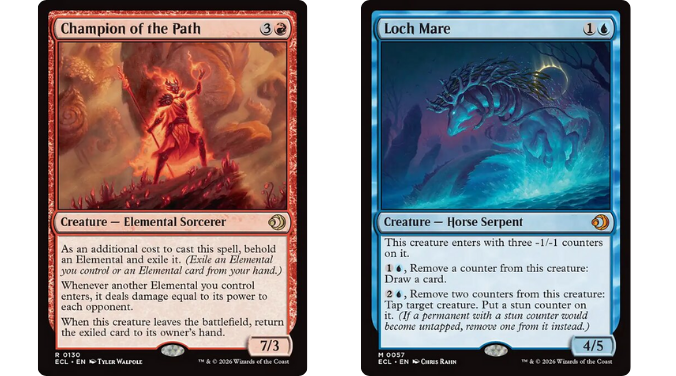
The other big benefit of playing prereleases is coming home with a double-armful of commons and uncommons to sort through. We almost never get truly bad cards anymore, so any new set is going to have a lot of niche playable non-rares – and a few genuine bangers for the collection.
MAKING A GOOD SECOND IMPRESSION
So, which cards are standing out to me after one weekend of Lorwyn Eclipsed? I’ll begin by giving an honorable mention to the selection of common reprints.

Whether it’s because Wizards don’t want Commander players doubling up on similar effects, or just feeling they got it right the first time, there’s a few OG Lorwyn hits that have snuck back onto the card sheet. Crib Swap and Nameless Inversion are my standouts: flavorful and efficient removal spells which are cheap enough to run in some competitive decks while opening up the unique synergies specific to Kindred spells.
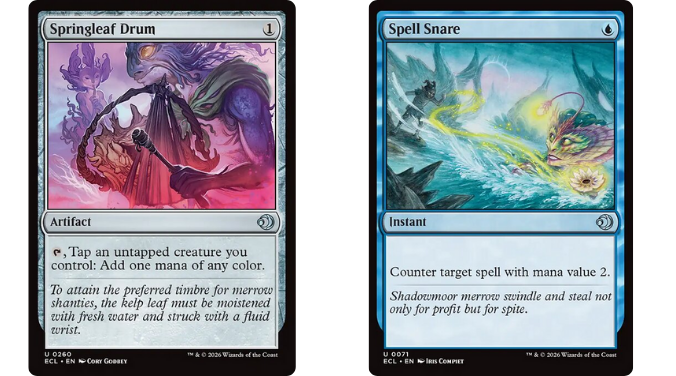
Springleaf Drum is an even more potent Lorwyn alumnus, a one-mana accelerant (and color fixer!) for both creature-heavy and artifact-heavy decks due to immediately refunding its own mana cost. Having Drum in Standard to enable cards like Pinnacle Emissary is absolutely one of the juiciest developments to come out of this set. The re-introduction of Blossoming Defense and especially Spell Snare could also affect the Standard metagame – never underestimate an interactive spell which always “trades up” on mana with the card it counters.
TURN ON THE BLIGHTS

Burdened Stoneback is one of many creatures this set which appear vastly under-costed for their printed stats, but enter the battlefield burdened down by -1/-1 counters which must be removed to achieve that potential. The nice thing about this Giant Warrior is that it can get back to full size almost immediately without any help, and even gets a great bonus for doing so!
It can’t become indestructible in response to removal (as can the equally-exciting Iron-Shield Elf). But activating it pre-combat to swing as a 3/3 or 4/4 indestructible will leave opponents with very hard blocking decisions.
It’s easy enough to re-burden the Stoneback if necessary using any of the new blight-related spells from this set. Though while we’re here, I should point out that the cost allows you to remove ANY kind of counter, which might be key to a whole other realm of shenanigans.

Reaping Willow has the same open-ended relationship to counter removal and is probably a straight-up better card in decks which can afford the color-heavy casting cost. Paying four for a 1/4 lifelink sounds horrendous, but in practice you’re paying six for a 3/6 lifelink PLUS reanimating a small-to-medium creature, which is much more reasonable.
Again, the key is being able to put counters back onto the Willow to turn it into a proper graveyard value engine. But finding the effects to do that isn’t so hard – perhaps you can even reanimate them!
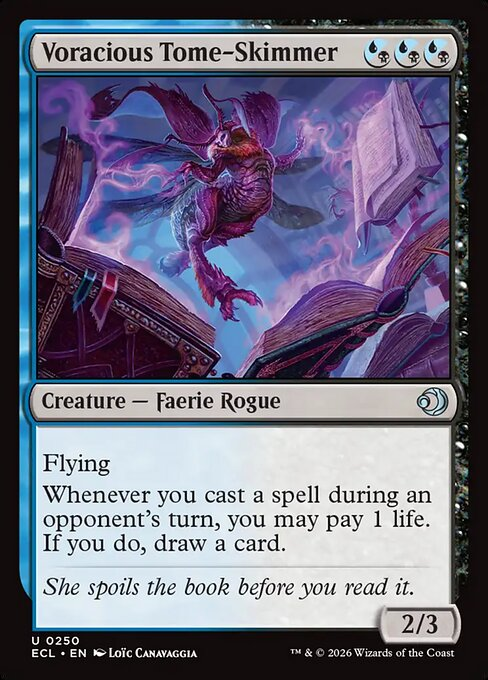
Voracious Tome-Skimmer doesn’t have the most groundbreaking text box in the set. But like jazz music, the cool part is all the design notes it doesn’t hit. Usually this sort of trigger would be limited to drawing one card a turn, or ask you to pay additional mana to draw, but at the negligible cost of 1 life you can absolutely be getting back multiple cards per turn.
The Skimmer isn’t skimping on stats either, providing a totally reasonable flying body for three mana which will at least survive the odd Shock.
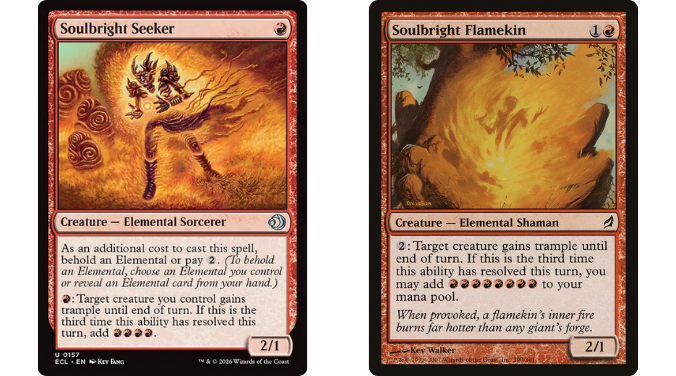
Besides being another lovely homage to a card from the original Lorwyn set, Soulbright Seeker is a pretty amazing one-drop for any deck that can behold elementals. A 2/1 body with upside is the new gold standard for this cost, and for Seeker the upside is layered.
Firstly, the elemental creature type is a big deal and conveys many benefits in the right deck. Secondly, it gives big-bodied aggro decks like red-green a low-cost trample enabler. Last but not least-ly, it also ramps you – converting three red mana into four red mana.
Also in the realm of reasonable red spells is Kulrath Zealot. Magic players have all become real connoisseurs of basic landcyclers in the past few years, as a fresh cycle of mana-fixing big dudes gets printed almost every set. But I don’t remember seeing one where the creature side was such an actually reasonable card!

Kulrath Zealot can lay the smack down with its 6/5 stats, AND it cantrips you with its impulse draw trigger. That’s quite the lategame bonus for a card you’re primarily expecting to smooth draws and fix colors earlier on! I can even see a world where this card is used in similar ways to Troll of Khazad-Dum as a fixer and reanimation target. Obviously it’s not quite as good at double the cycling cost, but since Troll has since been banned in multiple formats, maybe that means the Zealot is exactly good enough.
CHANGE IS A GOOD THING
Changeling is one of those keywords that’s like a cheat code for making random commons and uncommons Constructed-relevant. If you’re trying to theme a deck around one of Magic’s more obscure creature types, there’s decent odds that any reasonable new changeling card will instantly be among the best Brushwaggs, Nomads or Monkeys available!

My pick of the bunch is probably Omni-Changeling, which combines the convoke ability and a highly desirable text box for any creature deck. Another benefit of changelings is their potential to combine typal support effects in unexpected ways. Being able to effectively staple the changeling text onto any creature you control almost makes it hard to NOT stumble across a combo!
For one very easy example, you could use Omni-Changeling to create a clone of Felidar Guardian that also triggers Necroduality, allowing you to flicker the Omni-Changeling (and a second card of your choice) infinite times while creating infinite copied cat-zombie-changelings.
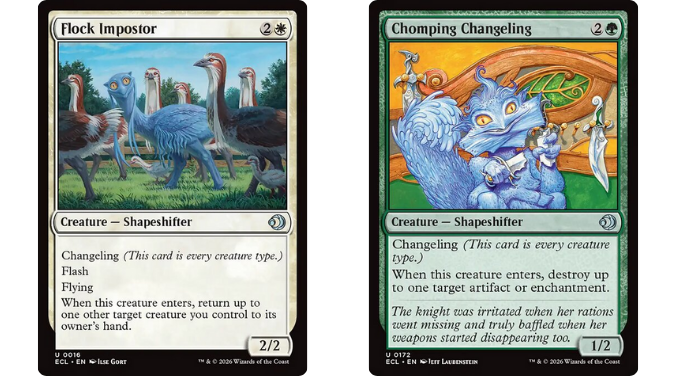
Slightly lower on the “unreasonable power” scale we have Sizzling Changeling, Changeling Wayfinder, Chomping Changeling and Flock Imposter. These are all reasonably-costed utility effects that many typal decks will have available for the first time.

Firdoch Core is a rare non-creature example of the same principle: not a particularly efficient mana rock, but one which may feel more playable to typal decks since it counts as a hit for Gathering Stone (another great Lorwyn Eclipsed uncommon) and similar effects.

Even some of the common changelings here will be exciting to players of certain niche decks. If you’re one of those pilots, you’ll already know whether a new on-type creature with flash or lifelink is a gamechanger for you – and in the cases where it is, I hope you’re over the moon about it!
ONE MAN’S CHAFF IS ANOTHER MAN’S TREASURE
It’s always hard narrowing down the whole field of cards in a new set for articles like this. There’s no objective, quantifiable way to measure juiciness or x-factor, and part of the beauty of Magic is how different players will have totally different takes on a card depending on which decks and formats they prefer.

As a chronic dabbler in all sorts of weird playstyles, I’ll say that what excites me most is novelty: having cards which do something genuinely unique from all the thousands of cards that have come before. Those oddballs are the ones which have a great chance to go from “trivia question answer” to “metagame staple” with just a slight change in conditions. It’s been delightful (and appropriate) to see a set as flavorful as Lorwyn Eclipsed offer up so much of that captivating weirdness.

Tom’s fate was sealed in 7th grade when his friend lent him a pile of commons to play Magic. He quickly picked up Boros and Orzhov decks in Ravnica block and has remained a staunch white magician ever since. A fan of all Constructed formats, he enjoys studying the history of the tournament meta. He specializes in midrange decks, especially Death & Taxes and Martyr Proc. One day, he swears he will win an MCQ with Evershrike. Ask him how at @AWanderingBard, or watch him stream Magic at twitch.tv/TheWanderingBard.