

Does Magic ever get more exciting than spoiler season for a “return to” set? Not for my money. I’ve been fortunate enough to cover several “returns” on this blog over the years: Theros: Beyond Death, Ravnica Allegiance, Wilds of Eldraine, most recently Tarkir: Dragonstorm. But other than when we finally went back to (cyberpunk) Kamigawa for Neon Dynasty, none of those announcements surprised and intrigued me like Lorwyn Eclipsed has!
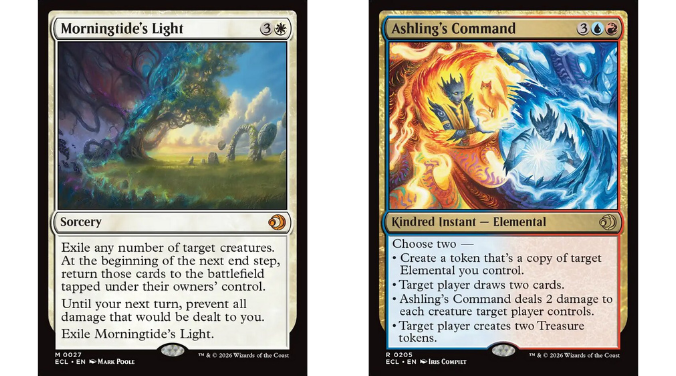
So far we’ve only had a slight taste of what’s to come in this long-awaited revisit, but it’s enough to make clear that Wizards are not overhauling the plane and its aesthetic the way they did with Kamigawa. All signs point to this being a celebration and adaptation of Lorwyn’s original ideas and identity for the Magic of today.
Which ideas are likely to survive that translation? Which cards and mechanical themes seem ripe for an update? Set your wayback machines for 2007, and let’s find out!
A REALM ACCURSED
Our first (and only) visit to Lorwyn happened 18 years ago, at a weird transition point between eras of Magic design. Lorwyn block introduced us to the first ever planeswalker cards, the kindred card type, and a host of influential cards and mechanics. But in retrospect it has sometimes been branded a disappointment. An unbalanced Faeries deck flattened the competitive metagame and the setting itself polled poorly with fans, perhaps because it did not include human characters.

Though Lorwyn block did have some sense of mechanical identity, the theme of “typal matters” is far from unique among Magic sets. Wizards has clearly chosen newer settings like Innistrad, Ixalan and Bloomburrow to carry on that role instead. The saga of Lorwyn and its darker aspect Shadowmoor had been neatly wrapped up by the original four sets. When Throne of Eldraine arrived and started reprising many of the same faery-tale tropes and symbols, it really seemed like the death knell for any hope of a Lorwyn revival. And yet, here we are!
The setting material published for Lorwyn Eclipsed doubles down on the inhuman quirks of its fae races, to better distinguish it from the Arthurian knights and storybook magic of Eldraine. The duality of light and dark is its other defining feature: with Lorwyn and Shadowmoor now in awkward co-existence, both aspects can now be explored within a single set (or single card!) for the first time.
FAE-MILIAR FACES
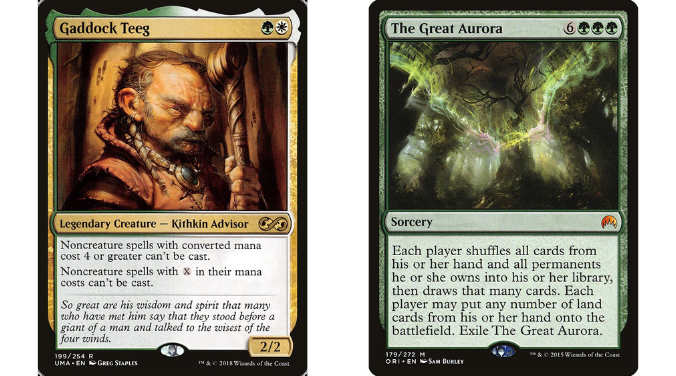
Oona, Queen of the Fae. Rhys the Redeemed and Maralen of the Mornsong. Ashling, the Pilgrim of the flamekin elementals. The Vendilion Clique. Windbrisk Heights, Spinerock Knoll. Auntie Wort, Brion Stoutarm… for a time before Commander design was just an after thought, these sets sure had a lot of legends!
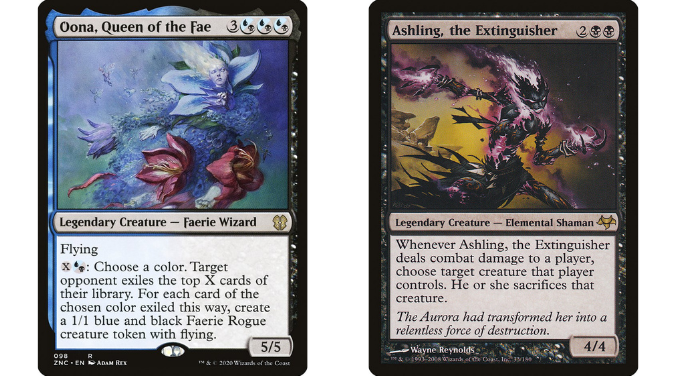
There may be a few decades of time gap in the lore between Eventide and Lorwyn Eclipsed, but some of those memorable names have already been spoiled as making a personal re-appearance. In particular they seem perfect candidates to explore the dual-nature concept, and the cards we’ve seen so far can willingly flip between their Lorwyn and Shadowmoor sides to underline that.

For instance, Ashling’s new card has her “rekindled” on the front side, showing that she’s regained her natural flame after her old Shadowmoor form was reduced to a nihilistic Cinder. But she can also pay to flip back into her NEW Shadowmoor form. For it seems that now when she crosses an aurora borderline, Ashling instead becomes one of the cold-flamed Rimebound!
The new Sygg, Wanderwine Wisdom, also shows off this mechanic. However, the Shadowmoor side of the card does not show Sygg in his twisted, UB aspect – he has an amulet which lets him cross between the light and dark worlds unaffected.

It’s safe to assume these returning legends will form part of a cycle – or even a super-cycle, as the card for twin gods Eirdu and Isilu also follows this template. The kithkin hero Brigid of Kinsbaile seems like the standout choice in white, with her reverse side either green or blue. She was one of the few creatures to avoid transformation throughout the original Lorwyn story, so it might be interesting to get a glimpse of her as one of the creepy, blank-eyed Shadowmoor kithkin!
The elves Rhys and Maralen are almost certain to receive new cards too, although it’s not clear how they’d fit into the cycle. Maralen is the new queen of all fae and among the most powerful beings on the plane, having deposed her creator Oona in Eventide. Meanwhile Rhys is sworn to serve as Maralen’s eternal keeper; not to protect her from threats, but to slay Maralen if Oona tries using her as a conduit to return.

If neither of those two take up the green-black slot in this cycle, enough hints have been dropped that we might see the Sapling of Colfenor reappear despite her apparent destruction at the climax of the last block. The potential red-black entry is the most mysterious of all. With Ashling’s color identity shifting over to U/R, there aren’t really any significant characters from OG Lorwyn to use here.
Either this would make a good chance to introduce a new named boggart goblin, or perhaps a visitor through the Omenpaths like Rowan Kenrith could fill this slot. I can certainly think of a lot of Magic characters who it would be fun to see on a plane which physically makes your internal contradictions and conflicts manifest…
FOLLOW THE RULES
It’s awesome to see Lorwyn Eclipsed proudly pay homage to the lore and characters of its past. But one of the cool things about Magic is how the flavor and feel of a setting is conveyed through game design; the actual cards and mechanics. It only makes sense that if you’re making an effort to evoke the spirit of an earlier set, you would try to re-use the same mechanical themes or intentionally design cards which put a modern spin on old favorites.

That’s exactly what we can see in these Lorwyn Eclipsed previews. Evoke (the mechanic) is native to Lorwyn and was associated with the plane’s exotic elemental incarnations. Cards like Mulldrifter, Shriekmaw, Ingot Chewer, Cloudthresher and Reveillark were so impactful and memorable they shifted our expectations of creature designs. More recent evoke cards have been equally format-defining, cementing this as one of the most exciting and memorable mechanics in the game.

Sure enough, we can already see evidence of another rare evoke cycle headlining Lorwyn Eclipsed, with Deceit and Emptiness matching the conceptual naming scheme of the plane’s greater elementals. If you look closely these are actually paying homage to three Lorwyn block mechanics at once! They combine hybrid mana costs and evoke with the “dual conditional enters triggers” of the hedge-mage cycle in a really cool way, allowing you to choose one effect when evoked but both if cast for their normal cost.

I also find it interesting that Deceit and Emptiness belong to color pairs which don’t match the five shocklands present in the set, whereas the transforming Sygg and Ashling do match. Does that imply that each cycle will only cover half the available combinations?
Printing a full range of evoke elementals across the rarity and color spectrums would be a fun way to distinguish this return to Lorwyn from the kind of dabbling one might see in Modern Horizons. But there’s a lot less space in this single set than in the four sets of the original Lorwyn block, so we might see a “quality over quantity” approach after all.
GOING AGAINST TYPE
Another cornerstone of Lorwyn’s original identity – at least until it became Shadowmoor – was typal mechanics. The first set of the block was defined by its support for its main types: faeries, goblins, elves, elementals, merfolk, treefolk, kithkin and giants. Then Morningtide added a wrinkle with support for the (often overlapping) “job” types: shaman, warrior, soldier, archer, wizard, rogue, druid, and cleric.

Mechanics like kindred, changeling, prowl, reinforce, and kinship made this typal emphasis inextricable from the overall identity of the plane, and it might be weird to have a Lorwyn set with no overt synergy between different elf or kithkin cards. But we do have an example of how to pull off such a return, in 2023’s Lost Caverns of Ixalan.
The original Ixalan was as heavily typal as Lorwyn or Onslaught before it. But Lost Caverns was able to feature a similar mix of vampire, pirate, dinosaur and merfolk cards while drastically scaling back the explicitly typal synergies. Instead, those creature types were united by associating them with more open-ended themes, like explore for merfolk or sacrifice for the vampires. I would expect a very similar approach to the iconic tribes of Lorwyn in Eclipsed – if only to give the design team more space and freedom to explore new ideas.
LOOKING INTO THE ECLIPSE
If you’re a long-time invested player like me then these return sets are practically a parade of sly winks and nods – loving in-jokes to reward your tenure and tickle your nostalgia. Copying the homework of all-time staples like Bitterblossom and Mutavault also had another benefit: it gives you a lot of confidence that the card you’re making will have the potential to make serious plays!
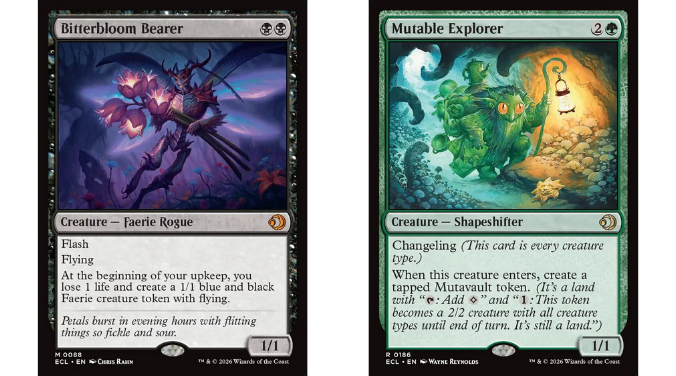
I would expect plenty more of those one-off references on top of the larger cycles discussed earlier. We may not get as many changelings or evoke cards as the first set, since there’s a finite amount of design space for such powerful mechanics. But so long as the ones we get are playable, then they should be enough to etch the image of Lorwyn firmly in the minds of a new Magic generation.
Tom’s fate was sealed in 7th grade when his friend lent him a pile of commons to play Magic. He quickly picked up Boros and Orzhov decks in Ravnica block and has remained a staunch white magician ever since. A fan of all Constructed formats, he enjoys studying the history of the tournament meta. He specializes in midrange decks, especially Death & Taxes and Martyr Proc. One day, he swears he will win an MCQ with Evershrike. Ask him how at @AWanderingBard, or watch him stream Magic at twitch.tv/TheWanderingBard.