

Secrets of Strixhaven is an intriguing prospect for Commander players, especially the preconstructed decks.
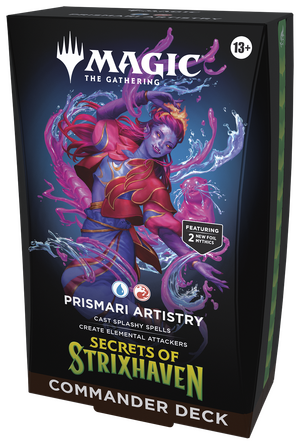
Secrets of Strixhaven is our second visit to the academic plane of Arcavios, which trains young spellcasters from across the multiverse. It’s the fastest Magic has ever returned to a new plane, with the original Strixhaven: School of Mages debuting just five years ago. Like Secrets, that set also had an accompanying release of Commander precons themed around the five Strixhaven colleges.
That means Prismari Artistry and the other new decks releasing with Secrets of Strixhaven are the first time we’ve seen Commander precons which are sequels to existing decks! Which original themes and mechanics from the first Prismari deck will be expanded on here? Or will we see the colleges take a new creative direction?
MEET THE COMMANDERS
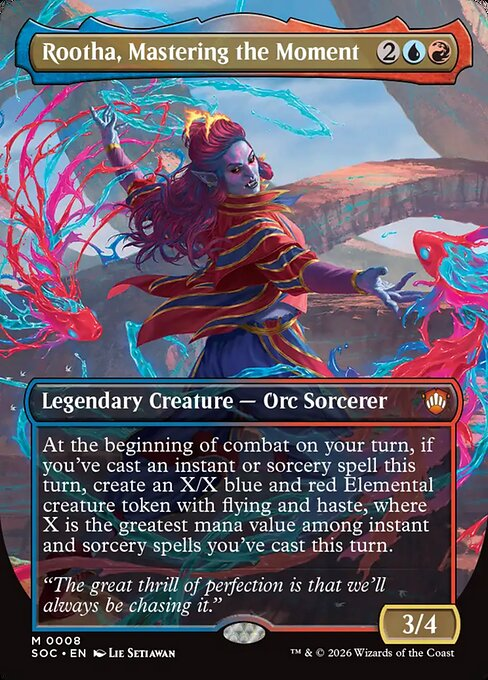
The “default commander” for Prismari Artistry is Rootha, Mastering the Moment. Having appeared in Strixhaven: School of Mages as a fresh-faced Prismari student, Rootha is now a distinguished tutor and mentor to the incoming class.
Her stats, cost and abilities have all been bumped up to reflect this status, and her artwork shows the growth as well. It’s just a small decision in the overall design of these precons, but I really love getting to see these established characters further along in their story instead of completely new legendaries leading the deck.
Rootha only has the one ability, which matches the new Opus mechanic you’ll see on Prismari cards from Secrets of Strixhaven. Opus effects fit the classic blue-red theme of caring when you cast instant and sorcery spells. But because Prismari is all about spectacle and ambition, your rewards from Opus will scale with the mana value of the spell – the bigger the better.
It’s a neat way to differentiate Prismari decks from typical UR spellslinger builds, because the usual incentives push deckbuilders towards casting the cheapest, smallest spells and being highly resource efficient. In extreme cases you’re basically only playing card draw and rituals, hoping to either storm off or create an infinite loop. We’re not really going to be doing that here: Rootha only cares about your one most expensive spell each turn, and she wants you to cast it before combat too!
In return you’ll receive a hefty X/X elemental token with both flying AND haste, which should give you a decent chance to land some direct attacks on your opponents. It’s almost like every spell you cast is now Blaze or Ball Lightning – except Rootha’s tokens don’t expire at the end of turn!
The strategic flexibility of being able to attack or defend, to save up bodies until they’ll be effective as a mass attack or to chump block if you happen to make a little baby elemental one turn; this is the strongest aspect of Rootha as a commander. It’s a good enough value engine to make me at least consider blending spellslinger cards with elemental or token-generation themes when I’m brewing – and that to me is the hallmark of an interesting commander design.
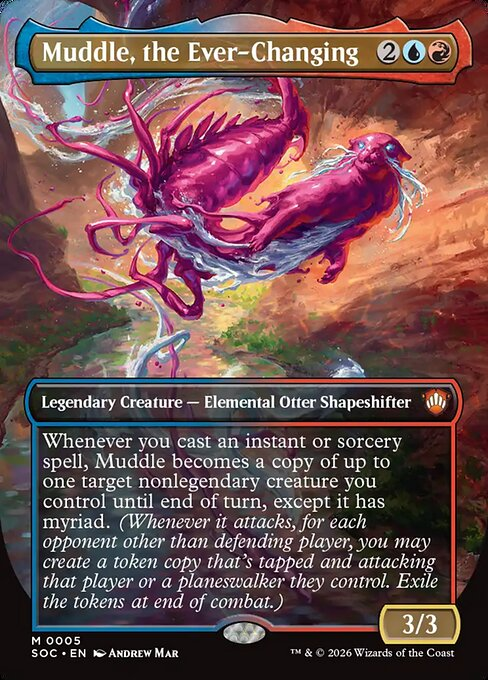
The second new full-art legendary creature who could potentially command Prismari Artistry is Muddle, the Ever-Changing. It’s another highly unique and creative twist on “UR spellslinger payoff” that even manages to be completely distinct from Rootha. Needless to say, if you’re an Izzet-loving mage but you’re looking for something which won’t just play the same cards and lines as your existing decks, this precon has some great options for you to check out!
Unlike Rootha, Muddle can benefit significantly from cheap and numerous spell-casting triggers. But the reward on offer isn’t just some linear value like treasures or card draw. Each instant or sorcery you cast allows Muddle to temporarily copy another creature.
There’s a lot of potential in being able to switch between copying different creatures in the same turn: ask any Scion of the Ur-Dragon players. But what I like is how this design will force you to work to set up those real game-ending combo situations, while opening up more fair utility. Having a hexproof creature on your side of the battlefield means Muddle can treat any instant as Mizzium Skin, for instance.
Getting to add Myriad to the copied text is just the cherry on top of an already tasty dessert; the part that makes up your mind to say “oh, I’ve got to have that”. So long as we’re mainly building around instants (which you probably were anyway), there will be a brief window where we go from having one copy of an effect like Storm-Kiln Artist or Beamsplitter Mage, to having FIVE.
That incredible potential means that Muddle is your choice if you’re looking to play a more combo-chasing, big-turn-taking build of Prismari Artistry: nothing says “big turn” like a free 500% multiplier to your best value engine! Meanwhile Rootha remains the more defiantly Prismari-flavored choice of commander, best to lead the deck if you want big, splashy sorceries (or token beatdown) to be the focus of your game.
NEW CARD REVIEW
Even if I’m excited about playing the precon as-built, it’s always important that these reviews consider the perspective of players who don’t need a whole new deck – but who could definitely be in the market for some powerful new spells if the synergy is right!
Colorstorm Stallion
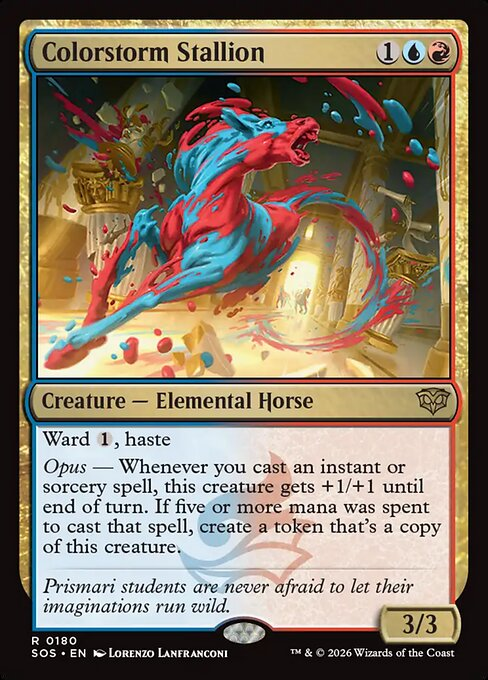
In a precon with natural tension between “big spell” and “efficient spell” themes, I like how Colorstorm Stallion kind of asks you to do both: first big spells to multiply the tokens, then a slew of smaller casts for a big prowess swing!
It’s also a very interesting target for Muddle’s copy trigger. If you cast a five-mana instant while attacking, you’ll get a permanent Colorstorm Stallion token for each temporary copy of Muddle. Better yet, those tokens will ALSO have myriad, setting up a terrifying attack for next turn.

Renegade Bull
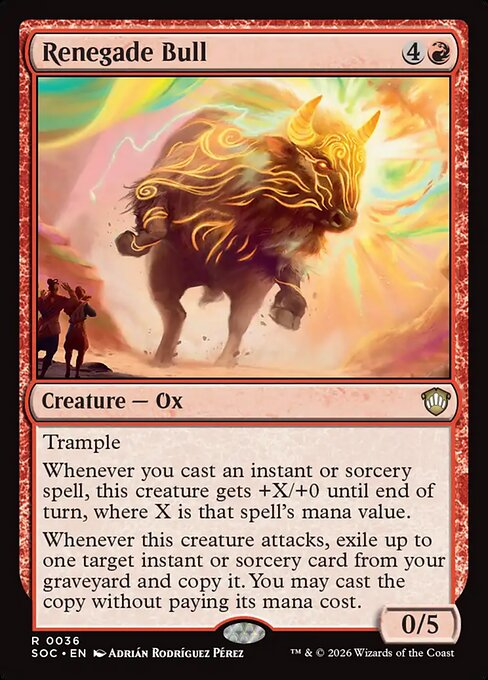
If you haven’t tried to brew around casting specific mana values of spells before, this is a good time to mention that “freecasting” a spell with cards like Renegade Bull still counts for the “mana value five or more” triggers in this deck. The mana value of the spell is what’s printed in the top-right corner, regardless of what you paid for it – the only exception being X-cost spells, where the mana value does change based on the current value of X.
Back to the Bull at hand. This card is another cool design which can benefit you regardless of how much your spells cost, even if big spells do a little more to maximize the value of its freecasting. Five mana is getting up there a bit for a non-haste creature which starts at zero power, but red has a few sorcery-based ways to ramp or cheat big things into play ahead of curve which might help out.
Leitmotif Composer
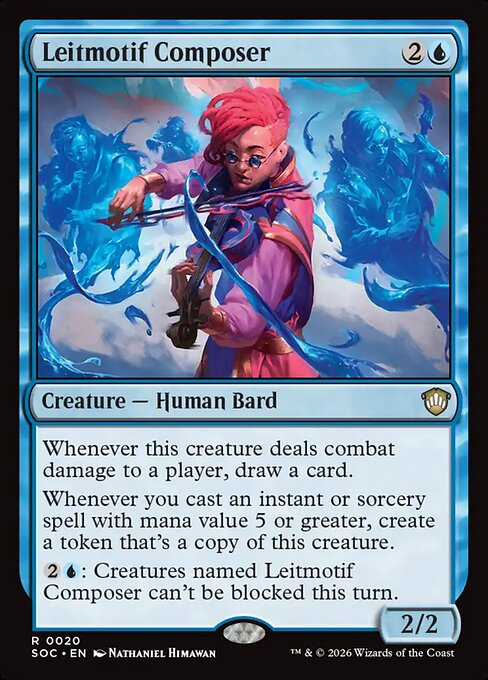
As someone whose professional and online presence is heavily bard-associated, I welcome this slick new representative to our ranks! Rules text aside, I’d like to shout-out the flavor connection in the card name here: just like a leitmotif in an opera or movie soundtrack, this creature keeps reappearing and has more and more impact each time!
Unlike the Bull and Stallion, our Composer doesn’t really offer a reward for casting spells below that five-mana mark, making it a more high-risk or high-commitment inclusion. Paying three to become unblockable is just not attractive when there’s only one Leitmotif Composer on the field. But if your deck has other ways to copy Composer more easily (*cough* Muddle *cough*), that might sweeten your view on this multiplying maestro.
Inspired Skypainter
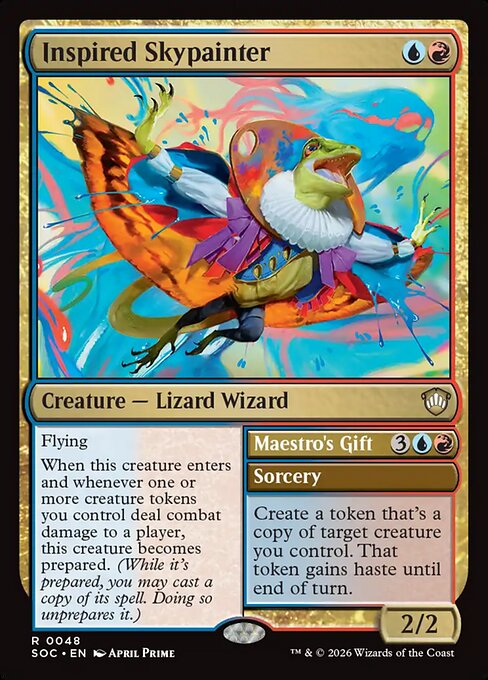
The new prepare mechanic is maybe my favorite thing about Secrets of Strixhaven, and I think Prismari Artistry is making the best use of it out of all the precons. Having a five-cost spell to cast every turn without completely ruining your mana curve requires a bit of help, and Inspired Skypainter is just the lizard wizard for the job.
With this reliably castable two-cost creature, we can potentially allow any number of big-spell triggers down the road, since this precon should be built to “reload” its prepared status every time you attack. It means you don’t need as many big clunky spells in your deck which are only situationally useful draws, and that’s a blessing. This same praise applies to Dirgur Focusmage, the other prepare creature in the precon, making them both invaluable support for this tricky theme.
Furygale Flocking
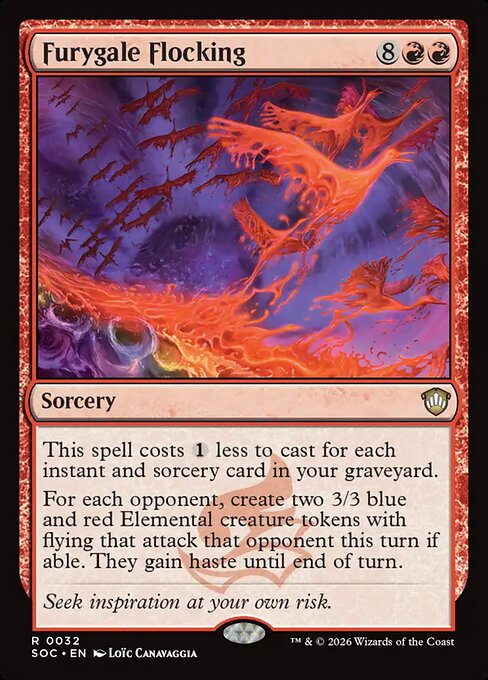
The actual effect produced by this spell is not going to decisively impact a game of Commander at virtually any power bracket. That means I’m primarily evaluating Furygale Flocking as an enabler for our “big spell” synergies: how much can we benefit from a spell that counts as “mana value ten” but actually costs two?
I think that spells which consistently cost a lot less than their printed mana value are certainly a good fit for our deck, especially if we want our commander to feel impactful on games. But I think we can generally find cheaper, more utilitarian effects to fill that niche, since the ten-mana breakpoint doesn’t do anything unless we run Zaffai, Thunder Conductor.
The other thing to consider is how we’re using our graveyard overall. Delve and other effects that use the graveyard for fuel are very common in UR spellslinger, especially if you’re trying to find big self-discounting spells. Furygale Flocking gets some merit for not actually depopulating the graveyard itself, but it’s still vulnerable to having its reason for being invalidated just because you played another, better spell the turn before.
$50 UPGRADE GUIDE
The Prismari Artistry deck has a much stronger combat focus than I’d expected. Whichever commander you choose, aggressive creature tokens are going to be a major axis of synergy: either the ones created with Rootha’s trigger, or myriad copies from attacking with Muddle.
I do find the potential combos and tricky plays Muddle enables to be really exciting. But to fully unlock that power would require sweeping changes to the decklist, including swapping most of the sorceries to instants so we can generate more cast triggers mid-combat while myriad tokens are around. So for this initial $50 upgrade, I’ve decided to build around Rootha as the commander and keep the established themes of the stock list intact.
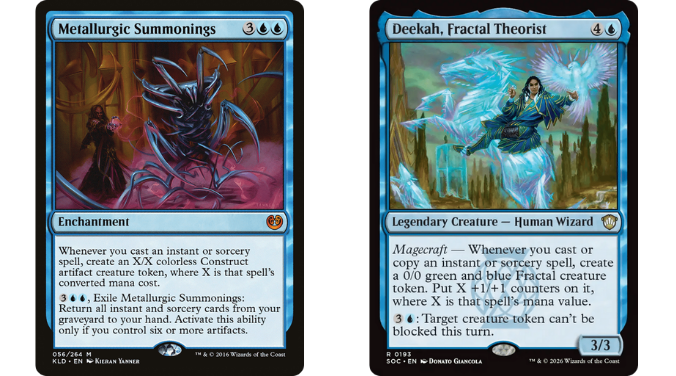
That means choosing the most efficient ways possible to generate cast triggers with mana value five or greater, and looking for even more payoff cards that reward us for doing so. Ideally, those rewards help us quickly build a lethal army of creature tokens so we can rely on combat damage as a win condition.
I think the stock list also does a good job of closing the circle on these themes with cards like Curiosity Crafter, which transform our attacking tokens into another form of resource engine… which can then more efficiently produce tokens, and so forth. It’s not good to go overboard on this kind of “second-order synergy”, since they’re only valuable once we already have a few tokens created, but sprinkling in the very best ones will really help put our deck scale over the course of a game.

First, let’s take a look at the deck to see how many (if any) more obviously weak or out-of-place cards there are for us to cut for space:
- Abrade
- Brazen Borrower
- Chain Reaction
- Galazeth Prismari
- Goldspan Dragon
- Harmonic Prodigy
- Leitmotif Composer
- Mirrorwing Dragon
- Plargg and Nassari
- Prismari Charm
- Reality Shift
- Resculpt
- Rite of Replication
- Rootha, Mercurial Artist
- Solemn Simulacrum
- Twinflame
- Throes of Chaos
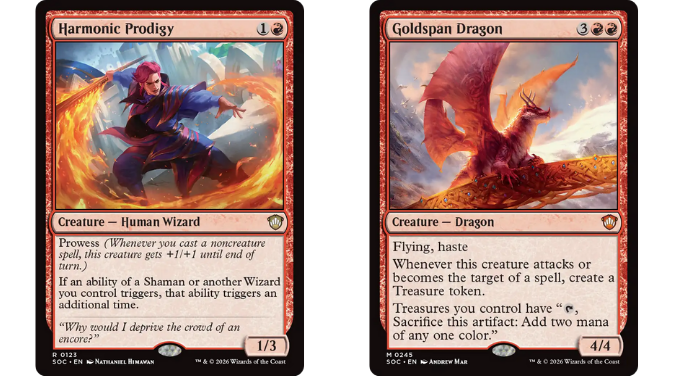
Some of these cuts are going to be fairly controversial – trust me, it feels weird to be taking something as strong as Goldspan Dragon *out* of a precon! But we don’t actually have that many treasure synergies or targeted spells to make this five-mana creature not feel clunky in our spellslinger deck.
Harmonic Prodigy gets the chop for similar reasons. It can’t even double Rootha’s trigger (which is the most important one) since she has the sorcerer type. I think it’s more consistent to just play clones if I want to double the value of our other creatures. I’ve also trimmed a lot of the cheap removal that comes in the base deck, to try and fit in more expensive-but-discountable cards and other things that will advance our gameplan. There’s Commander strategy articles on this blog which discuss how single-target removal is often awkward in multiplayer games; for now, I’ll just say that in lower power brackets (where this $50 upgrade is going to live) I usually only want a sprinkle of these effects (and I’d rather they hit noncreature permanents).
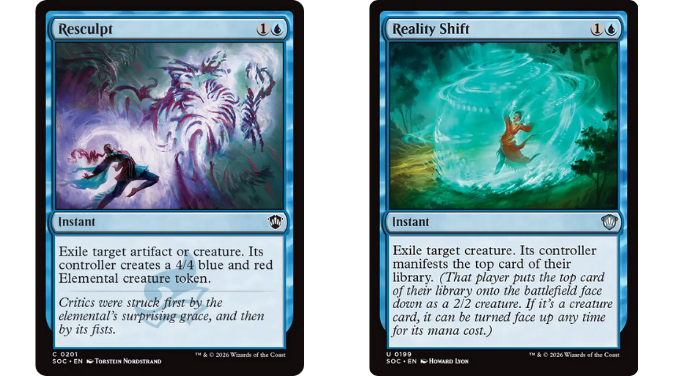
Adding cards to this deck made me more aware of the $50 budget than ever before. Usually all the money is tied up in one or two outlier cards with the rest of what I want being relatively free. But this deck really wants high mana-value spells that can be cast for free (or at least very cheap), and almost all of those cards are above the $5 mark. There’s also cards like Temporal Mastery which run up against power bracket restrictions.
In the end I chose to invest in two mythic rares from Secrets of Strixhaven, with the new Paradigm keyword being absolutely ideal for Rootha’s needs, as well as Commander all-star Fury of the Horde.
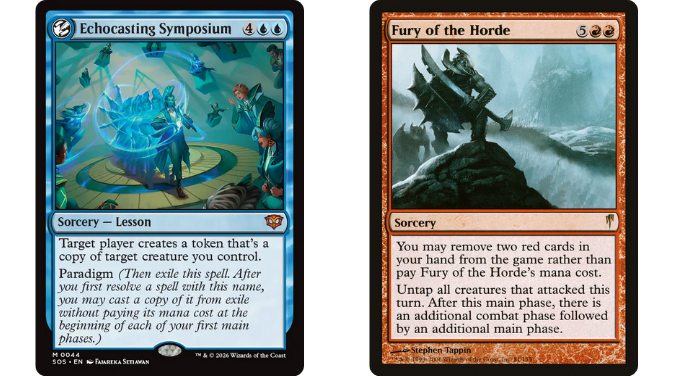
It’s a little awkward to wait until second main to cast Fury, since Rootha wants us to cast spells pre-combat, but creating a second combat (and thus a second Elemental trigger) immediately makes up for it. Since our deck is using combat both for damage and value generation, extra combats end up having a really high potential return even if they don’t end the game on the spot. Check out my “war economy” article for a full explainer on how extra combats are increasingly the best thing red does in Commander.
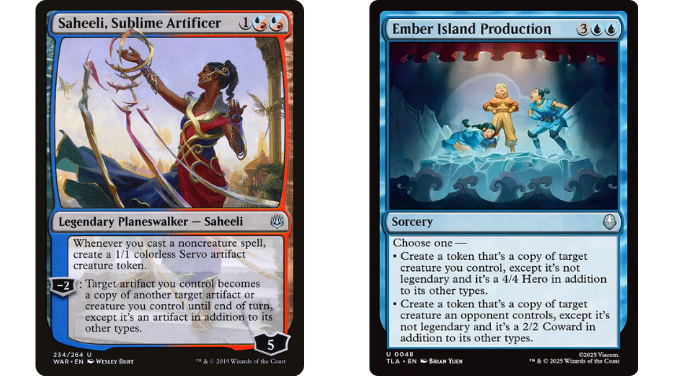
Most of the other additions are just extra token creators or spells which have good utility and a built-in way to discount them. I think the ability to multiply some of our value engines by creating tokens for them is already a great way for our deck to scale. Ember Island Production even lets us do this for Rootha and other legendary creatures! For those with a bit more money to throw around, spells like Irenicus’s Vile Duplication and Quantum Misalignment can help you lean into this “getting extra legends” angle.
Check out the full upgraded decklist on Moxfield here.
ROOTHA-LESS AGGRESSION
This precon deck is a really cool addition to the lineup: I love how it slightly resculpts the expectations of UR spellslinger into a flashy, big-mana-casting token beatdown plan.
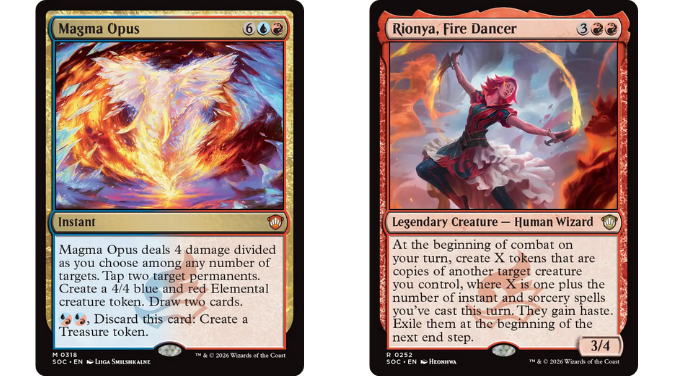
Muddle is an equally exciting prospect, especially for those who want to push their power level a bit higher (something UR is very good at) and this is one time I wish I had the time and column space to explore both precon commanders in more detail.
But I’ll leave it up to you readers to optimize the otter. Let me know how you’re going with any build of Prismari Artistry through Card Kingdom’s social media, or in the Moxfield comments. See you next week as we turn our attention back to the sensational Secrets of Strixhaven main set!

Tom’s fate was sealed in 7th grade when his friend lent him a pile of commons to play Magic. He quickly picked up Boros and Orzhov decks in Ravnica block and has remained a staunch white magician ever since. A fan of all Constructed formats, he enjoys studying the history of the tournament meta. He specializes in midrange decks, especially Death & Taxes and Martyr Proc. One day, he swears he will win an MCQ with Evershrike. Ask him how at @AWanderingBard, or watch him stream Magic at twitch.tv/TheWanderingBard.