

Welcome ensigns, on a voyage to explore the countless worlds of Star Trek Draft!
It’s remarkable to me that Universes Beyond sets still manage to accommodate the design needs of Limited play. Limited formats constrain the ratios of different colors, costs and rarities in the set. It makes it more complicated to have high numbers of legendary creatures or multicolored spells. Draft sets also need to include a variety of mechanical themes, ideally ones which overlap and give players a chance to improvise in the space between archetypes.
The Star Trek designers seem to have latched onto that last part as a way to weld together these two competing goals. They’ve pulled out all the stops to invent new draft themes that specifically reflect the factions and plot beats of Star Trek.
You don’t just draft a deck with Picard and Spock and Janeway in it. You draft a Federation deck, one that fights with the kind of precision and caution you would expect. It’s an awesome idea that ensures a memorable Limited format. Read on for a detailed explanation of how to navigate drafting, deckbuilding and playing all the major archetypes!
SHAPE OF THE FORMAT
The gameplay of this format is defined by its smaller creature stats, which seems to be the first piece of influence from the source material. Compared to other sci-fi franchises, Star Trek is rather light on towering monsters and planet-killer weapons. Most armed conflict is between humans (or humanoid aliens), with very mortal limits on how much damage individuals can dish out or withstand. Plenty of fighters can be felled with a single overhead chop or nerve-grip!
Accordingly, you won’t find many creature cards in your booster packs with high starting power and toughness. In fact, Star Trek has more one-toughness common creatures than any Draft format of the modern era. This means that most creature combats will lead to death on both sides, and even three- and four-drops will often trade down against two-mana blockers.

Since it’s not usually worth attacking into enemy creatures, many games naturally end up in a stand-off between two growing armies. It’s the classic board-stall dynamic, which some readers may have experienced in sets like Lorwyn Eclipsed, Lost Caverns of Ixalan or Midnight Hunt.
When drafting and deckbuilding for these formats, it’s crucial that you always know how your deck is meant to find wins from these stalled positions, and prioritize the cards you need to do that.
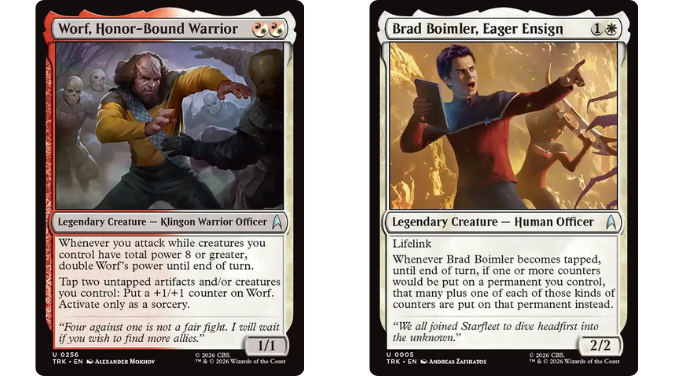
For instance, the red-white archetype has many cards which trigger effects when you attack while controlling eight total power of creatures. During a boardstall you can easily meet this threshold, which then offers you a massive power spike if you’re the one to bravely break the peace and enter the red zone.
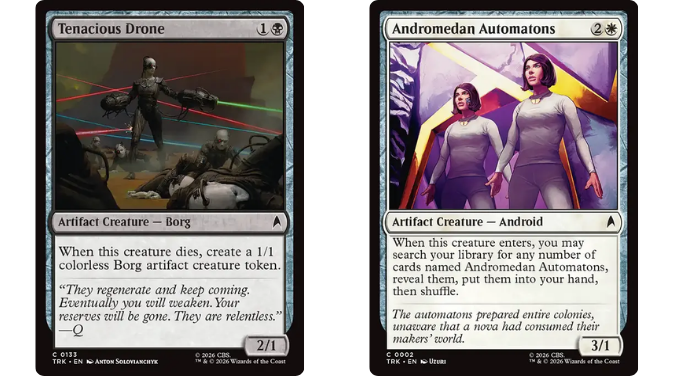
Not every deck needs to be aiming for slow-and-steady though. Blocking creatures die just as easily as attacking ones, so you can put on a lot of early pressure with just waves of expendable 2/1s. The targeted removal also doesn’t feel great to point at these lightweight attackers, since you’re usually trading down on mana to do so.
Most opponents will eventually stabilize against aggro unless you can significantly buff up your own stats along the way. But softening them up initially makes it much easier to find lethal damage in the ensuing standoff. If you’re not trying to force early finishes, then it’s important to keep your eye out for possible value engines which can keep up with (or ideally outscale) opponents doing the same.
Many of the best engines rely on new mechanics like “Federation” or “Strange new worlds” which specifically scale with the number of different cards on your board. The other kind are built around different triggering events, like landfall, lifegain, or cards leaving your graveyard. We’ll cover all of these options in more detail later on, as each mechanic has at least one deck archetype built around it.
COLOR THEORY
Another notable trait of Star Trek is how many land cards the set has: 32 unique nonbasics in all! That number needs to be high to support the “Strange new worlds” theme, but it also makes booster packs is a smorgasbord of color-fixing.
You can find all 10 shocklands, a full cycle of common dual-color Planets which ETB tapped, and Unexplored Territory as another common land that helps find your colors. This galactic bounty naturally makes me much more ambitious about grabbing off-color bombs during the draft, since you can usually find lands to play them even if it’s already Pack Three.
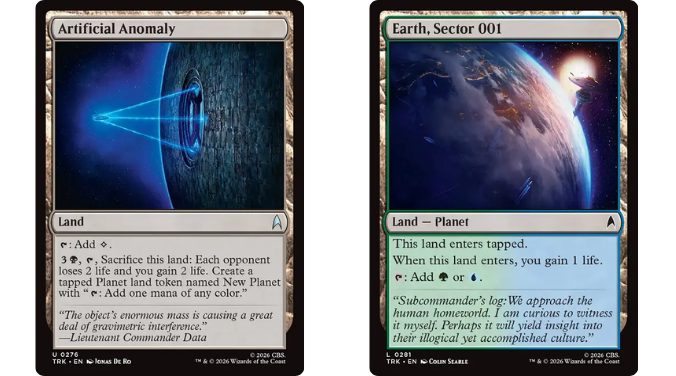
Green’s obligatory land-searching spells are able to find your two-color Planets as well as basic lands, and almost every other mana accelerant is a rainbow mana source. Even the colorless-producing cycle of “Anomaly” utility lands replace themselves with a New Planet token when activated, which technically makes them a third cycle of color-fixing lands! But you barely notice that feature even in non-green decks, since between Warp Core, Class-F Shuttlecraft and landcyclers they have more than enough fixing already. I suppose Star Trek does usually depict a vision of post-scarcity society…
It seems like such futuristic mana technology would naturally lead everyone to draft five-color decks, but I haven’t really seen that borne out in my games so far. I think this is due to the role of synergy in the set, and how even the bomb creatures have their power built into their abilities rather than stats and keywords. You might have the ability to cast a late pick Seven of Nine in your green-white deck with no issues, but she’s only really worth it if you also have enough ways to trigger her.

That’s not to say you can’t splash these cards, since the designers did ensure the key mechanics of Star Trek have significant cross-color overlap. Lots of green and white cards trigger dilemmas: Command Decision, Test of Conviction, Federation Field Medic, and Dominion Assault Force to name a few. But the need to lay a foundation for these bombs with your in-color picks makes it much harder to opportunistically splash them in.
ARCHETYPE BREAKDOWNS
WU: Spacecraft Tempo
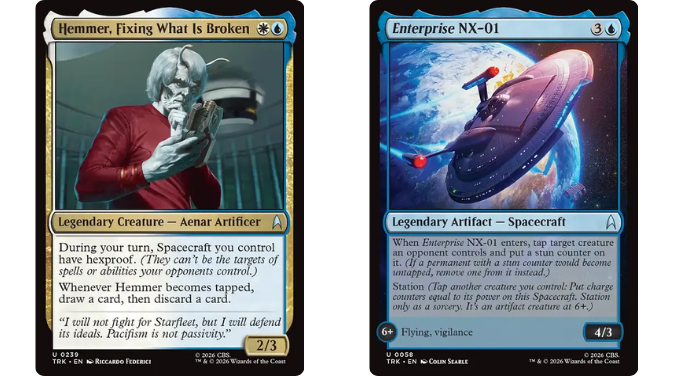
Spacecraft are in all five colors this set, but the majority you’ll see in boosters are UW. These are also the colors with the best spacecraft synergies. You have creatures that care about becoming tapped (which is much safer to do by stationing spacecraft than attacking directly), and some that untap themselves or other creatures to speed up the stationing process. Others work with spacecraft because they care about placing counters on permanents, or casting noncreature spells.
The most important thing I can say about UW is that you need to play it aggressively. Most of your interaction is “temporary removal”: effects which tap, stun or bounce opposing creatures to hand. Use these wisely to paralyze enemy blockers so you can deal as much combat damage as possible before the board fills up. Note that your spacecraft don’t really have much of a role in this early phase – unless you just need to cast one so Starfleet Spanner Jockey can attack this turn!
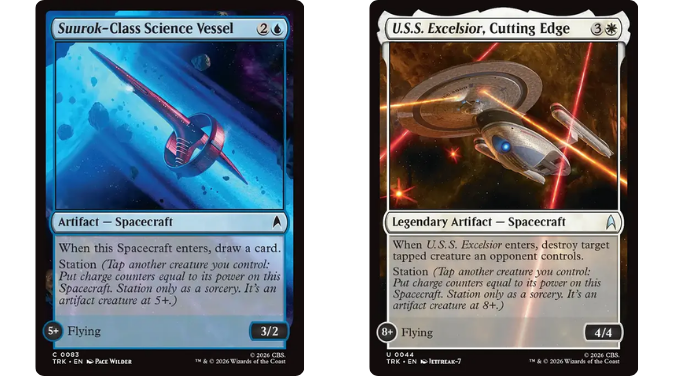
But once the ground route becomes too clogged and hazardous, that’s where your spacecraft come in clutch. Your tap and bounce effects gain fresh relevance when you only need to clear out the opponent’s flying blockers. Aggressively tapping your creatures to station isn’t scary when you have a life lead, since they still need to keep their creatures back to block your potential ground attack. Abuse this dominant position to finish them off with flyers (or something you made unblockable with Combadge or Lore, Positronic Provocateur).
WB: Artifact Creature (Borg) Aggro
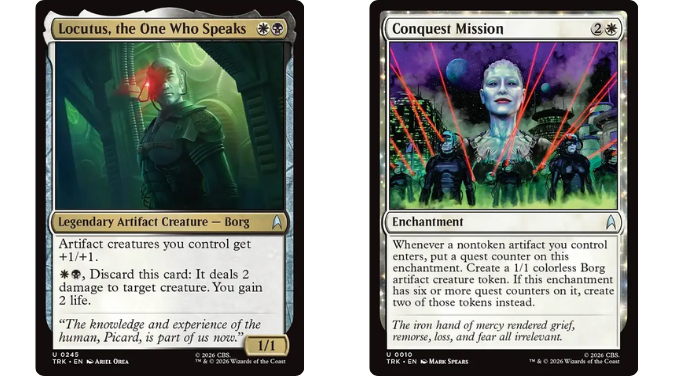
WB Borg is a classic creature-typal deck: something of a curveball for this set, but very thematic for the Collective. It plays cheap, expendable bodies which often strengthen each other with passive effects, creating a threat greater than the sum of its parts. The drawback is that you need to draft and build your deck from a specific subset of cards – in this case, artifact creatures. There’s 19 such cards in these colors at common and uncommon, which should be enough to fill most of your creature slots if your draft lane is uncontested.
In game, you can ideally curve out in such a way that the enters and static abilities of your Borg repeatedly knock opponents off balance and deny them any chance for good blocks. Buff your own creatures with Assault Drone and Locutus, create expendable bodies with Assembly Specialist and Conquest Mission, and negate their blockers with Vexing Drone and Organic Avulsion Unit.
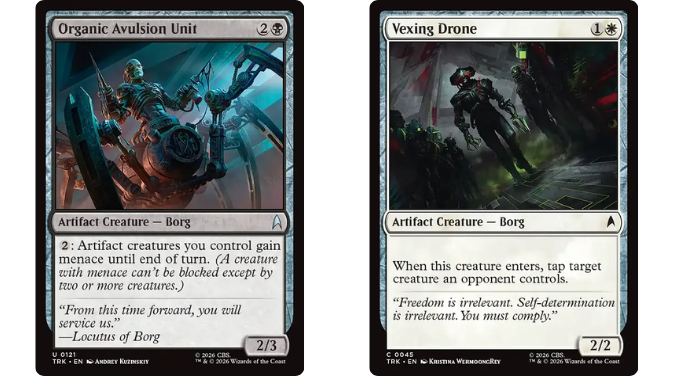
If you’re not able to draft a critical mass of these creatures and your ground attack is running out of steam before you can win games, spacecraft make the best secondary wincon. That’s true of most decks this set, but your “artifact creature” bonuses make them especially deadly here. Sadly, the other set mechanics aren’t well supported within the Borg card suite, although Vengeance Mission works well as another hard-to-block damage source.
UB: Dilemma Control

The key mechanic in UB is “face a dilemma”, which means resolving a spell or ability which asks you to choose modes. Only cards which offer a choice of modes count – something like Pavel Chekov may have the word “choose” in its rules text, but it is not considered a dilemma.
You’ll find there are a ton of dilemma cards in blue and black, and almost all of them are good on their own! Mostly we’re talking about modal interactive spells, plus a few creature ETBs and “mythic common” Tal Shiar Operative. The payoff cards you trigger with dilemmas may look pretty ordinary, but this isn’t like most Draft archetypes that ask you to build around a single card type or mechanic. You’re getting paid extra to just cast Good Spells, and that’s the true strength of this UB deck.

The dilemma payoff to underwhelm me is Tell Me What You See, which almost always ends up being a two-mana cantrip. I think it gets a lot better in a low-curve deck that has mana to spare and is consistently pressuring the opponent’s life total, where my UB decks are usually on the defensive with a relatively full grip.
With enough dilemmas and payoffs you don’t need any other win condition, as your value train should eventually grind them down. But keeping opponents hanging around is always a bit of a risk, so it’s still worth grabbing some bombs or flyers to help finish things off – especially ones which help generate dilemmas like V’Ger, the Intruder.
WR: “8 Total Power” Aggro
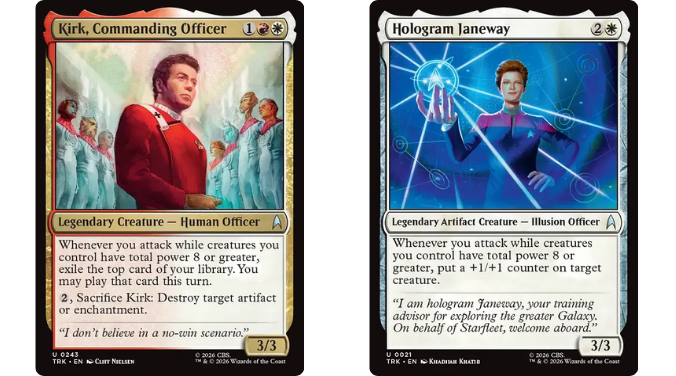
The pride of Starfleet’s officer school is here, tempering the courage of red with white’s teamwork and tactical nous. Their key mechanic is creatures which trigger “whenever you attack while creatures you control have total power 8 or greater”.
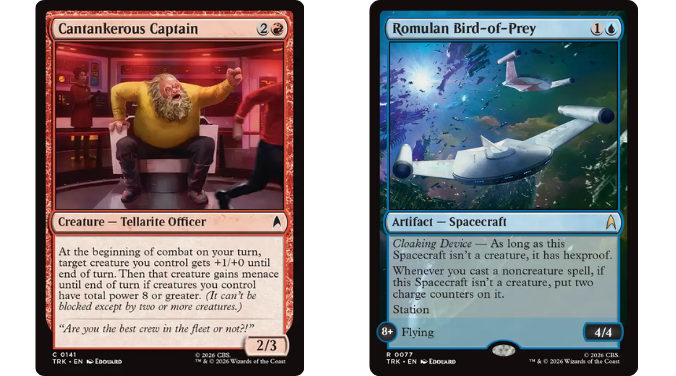
That’s some very specific wording, which gives the WR player a lot of flexibility in how they approach their combat step. You don’t need to actually attack with eight total power, or even with the creatures that have these abilities. So long as you have enough total power on board, and at least one attacker is declared, all of these abilities in play will trigger. When your opponent has a well-established board you’ll want to play this “single attacker” style, stacking all the buffs from your triggers onto your chosen champion. Worf, Honor-Bound Warrior is the ideal choice since his is the most selfish trigger, but the benefit here is that you’re forcing the defender to trade multiple cards for even your weakest possible attacker.
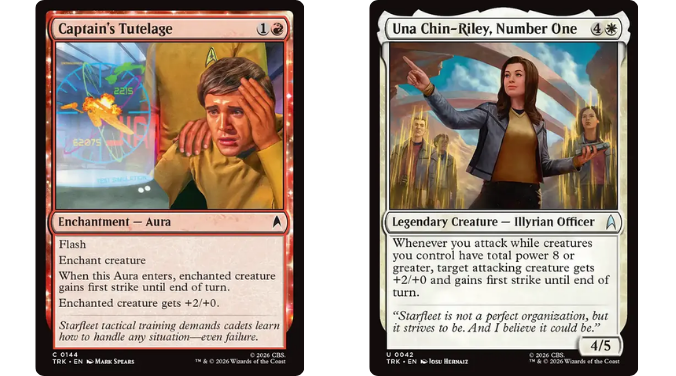
You also get to keep back your own wall of blockers to discourage counterattack – though keep in mind, if they call your bluff and force a trade you could lose some of those crucial triggers or even dip below the 8-total-power threshold. If you can’t reliably reach eight power you’ll be leaving a lot of value on the table, so even your non-creature cards should ideally contribute to that count in some way (like combat tricks or spacecraft). For similar reasons, you should avoid trading creatures early game and lean on efficient removal (like Set Phasers To…) to outrace aggressive opponents where possible.
UR: Non-Creature Spell Tempo
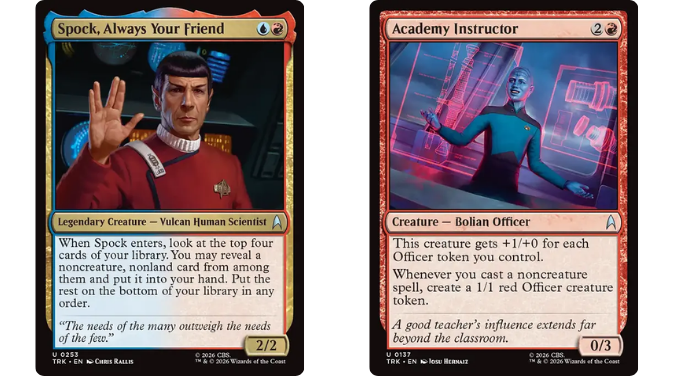
It may have the famously mild Dr. Spock as its figurehead uncommon, but UR is tied for the most all-in aggressive deck in Star Trek Draft. This is classic spell-slinger tempo: you want to open with aggressive creatures and then spend the rest of the game interacting with everything your opponent plays so they never get off their back foot.
Ideally, your cheap threats have mechanics which let them beat equivalent costed creatures in combat without any help. The natural first strike on Beckett Mariner or the steady stat growth of Data, New Life and Jett Reno are high-tier examples, but even Planetary Patrol and Starfleet Spanner Jockey consistently attack as 3/3s. When your creature starts with the advantage, the defender is forced to commit resources just to even the odds, which you can then easily punish with your own interaction.
Your cheap creature removal is incredibly strong in these colors: Marooned and Planetary Bombardment at one mana, then Khaaaaaaaaaaaannn!, Energize, Type-2 Phaser and Transporter Malfunction at two and Plasma Cascade to finish things off. The fact both Plasma Cascade and Transporter Malfunction can target players gives you one of the easier answers to “how will I win after they stabilize”, assuming you’re able to draft them.
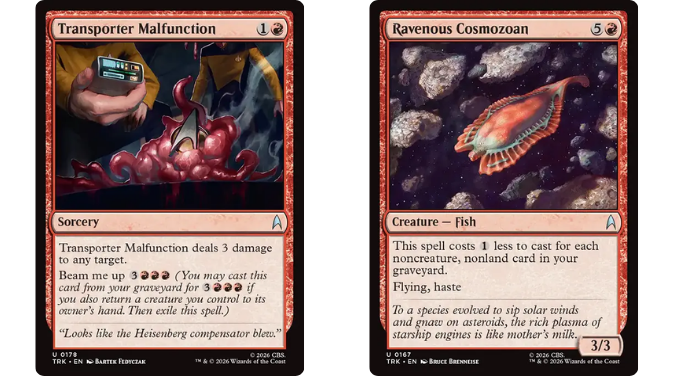
In the best drafts you probably want to cap your curve at four mana; this is where you’ll find some suitable tempo finishers like Enterprise NX-01, Cetacean Ops and Ravenous Cosmozoan (once you factor in the inherent discount). La’An Noonien-Singh, Security or Gray and Adira, Forever Joined can also be good in this slot if your draft is a good fit for them (i.e. good ETBs for Gray and Adira).
WG: +1/+1 Counter Aggro

Despite a smattering of references to doctors and gaining life, WG ends up being a straightforward +1/+1 counter beatdown deck. Green’s good baseline stats plus white’s buffs mean you’re one of just a few decks in this draft format which can attack without offering easy trades. The snowball potential is obvious, and with the right mix of offensive and defensive tricks you can blow out any attempted removal spell or multi-block that might slow your roll.
The biggest threat to this deck is simply draw variance, and an overall lack of draw power if you ever lose that leading position. You’re not without tools in that department, but There’s Coffee in that Nebula and Hologram Stalker are highly contested. Phlox, Unorthodox Doctor and Jake Sisko, War Correspondent are more likely to be passed to you, but each requires additional support and time to pay off, while being vulnerable to creature removal.

I’ll briefly address the lifegain sub-theme while we’re here. Despite there being a lot of incidental lifegain in these colors, the only cards which reward you for it are Neelix and Sickbay. Sickbay is quite strong, even first-pickable, and doesn’t actually need any additional lifegain to be good in most decks. I wouldn’t go out of my way to try and enable Neelix, but he’s still usable if you’re already going to play the lifegain spells.
UG: Strange New Worlds Ramp
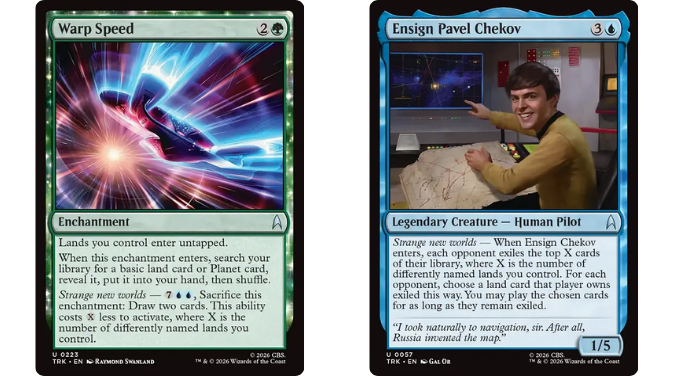
This archetype showcases another new Star Trek mechanic, “Strange new worlds”. This ability makes your cards scale with the number of differently named lands you control, dovetailing nicely with RG’s landfall theme.
You’re not automatically locked into playing Temur though, especially compared to some other recent sets where those three colors seem joined at the hip. Both Bant and Sultai feel better aligned with the kind of unhurried, reactive game UG wants to play. In practice, it should probably just come down to which tertiary color offers the best cards in each draft. If you find yourself struggling to choose, just be four- or five-colors – remember, this set has an amazing amount of color fixing available.
UG can be plenty strong without other colors too, even in the early game. You get some excellent defensive statlines on the likes of D’vana Tendi and (my new favorite Trek character) Starfleet Spanner Jockey. Enough Spanner Jockeys will stop nearly any aggro deck dead in its tracks! Slowing the game down is really the hard part, as your cards naturally increase in strength with your land count and any number of splashable bombs can help carry your lategame.

My favorite wincon for UG is actually Ensign Pavel Chekov, whose “ramp” ETB also permanently exiles a significant chunk of their library. Even one activation should be enough to get your opponents sweating, since the pressure is now on them to find lethal while you can play full defense. But once you start beaming Mr. Chekov up to hand, or recurring him from the graveyard, then your opponents will learn to truly loathe his smug little grin.
BG: Graveyard Recursion Midrange

Necromancy and the undead aren’t really a big part of Star Trek lore, so our GB graveyard deck is instead themed around xenoarcheology and studying the past – a very cool choice if you ask me! There’s a lot of graveyard-to-hand recursion effects to make up for the lack of direct reanimation, and they still feel very valuable in a set where you can easily drag games long.
Additionally, you get a few strong payoff uncommons that trigger when a card leaves your graveyard for any reason. These make your recursion spells even more valuable but will also reward any Beam Me Up casts or incidental graveyard-exiling from Sylvia Tilly or Dominion Assault Force. It’s enough to bump the humble Cybernetic Specialist up a few draft tiers, as it provides the most convenient way to ensure a card leaves your graveyard every turn.
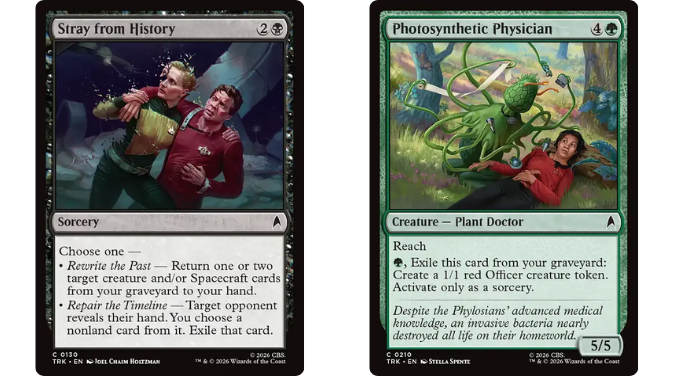
While this “excavation” value engine can be very strong when you get all the pieces, I would advise you not make it your first or only priority when drafting GB. If you’re building around recursion effects, having great threats to bring back like Mugato or Syndicate Liquidators is more valuable than triggering some extra draws from Vash. Remember, most colors in Star Trek Limited don’t even get creatures this big, and forcing them to trade with your six-drops over and over will prevent them from accumulating the counters and other buffs they use to even the odds.
But it’s comfy to know that if I don’t pull awesome rare threats, even unremarkable commons like Photosynthetic Physician and Dominion Assault Force can be elevated by leaning into the synergy-engine half of this archetype.
BR: Klingon Sacrifice Aggro
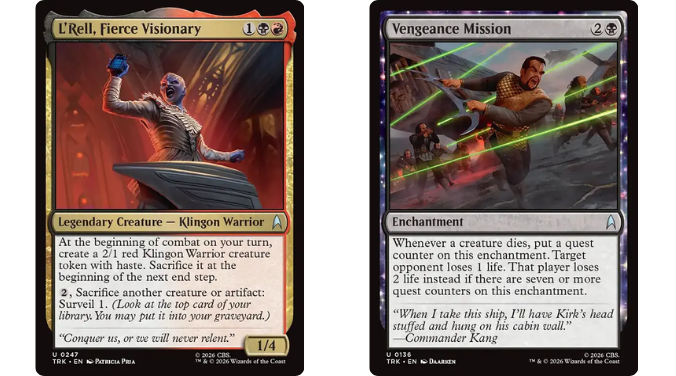
The Klingon way of war is not for the faint of heart, or for anyone overly concerned with what happens to their own creatures. But though your warriors may die in droves, your opponents will also perish – and they don’t even get to go to alien valhalla afterwards!
RB aggro is the nihilistic counterpoint to creature decks like WR and WG. Rather than investing in a boardstate and attacking only with a clear advantage, RB embraces the inherent lethality of Star Trek combat and profits with a variety of on-death triggers. Battle-Scarred Survivalist is a solid two-drop in this archetype, but bigger payoffs like Sarcophagus, Ship of the Dead and especially Vengeance Mission are the real direction-setters for this archetype.
The other half of RB’s strategic identity comes from token generators, specifically L’Rel, Fierce Visionary. In addition to guaranteeing you trigger both “on attack” and “on death” abilities every turn, having L’Rell herself sit back as a sturdy 1/4 blocker really constrains opponents who might otherwise try and race you to 20 damage.
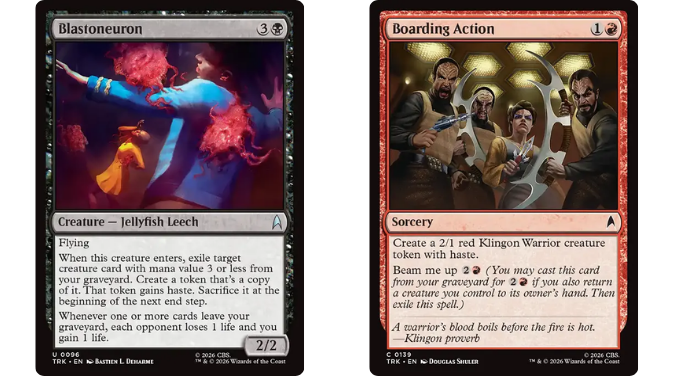
But the main benefit of temporary Klingon tokens is the opportunity to sacrifice them (or beam them up) post-combat. Dahar Master, Targ Wrangler, even Boarding Action are all effective ways to maximize your value here. Automated Warfare System gets you a whole card, although it denies you the chance to really swing with the token. Meanwhile combat tricks (particularly A Good Day to Die) and other buffs are great for ambushing opponents who think their larger creatures can safely wall out your temporary 2/1s.
RG: Landfall Midrange
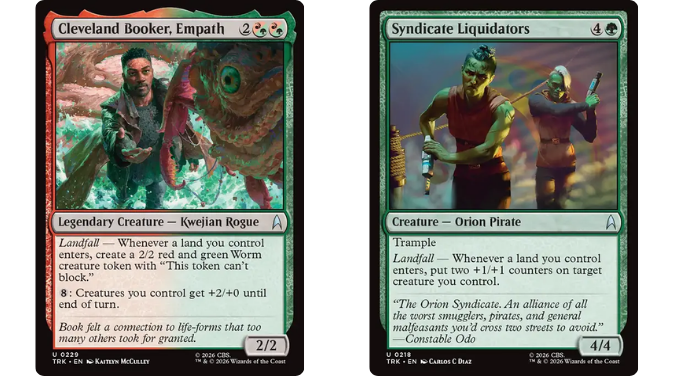
It seems like most sets have at least one color pair that doesn’t quite come together with a coherent theme, and for Star Trek that’s definitely red-green. That doesn’t mean you can’t draft a strong deck in these colors. But without specific synergies to build around, you’ll mostly want to pick red and green cards based on their individual strength. If you keep picking enough of them, you’ll play a base RG deck!
Landfall is the intended key mechanic here, but for me the true superpower of green creatures is simply being Big. Having bigger creatures lets you take the aggressive stance in the matchup, which is beneficial even if you’re not dealing a lot of damage to their life points. A lot of your cards get significantly worse on defense, so being offensive and setting the tempo early in games helps cover any weak turns where you stop to cast a ramp spell and double-landfall, or sink mana into cracking Jake Sisko’s clues.
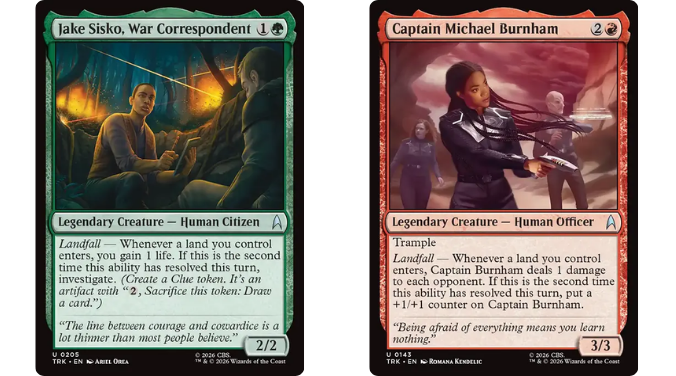
Even Cleveland Booker, a pretty decent landfall payoff overall, starts life as 2/2 for four. You don’t want to block with him, and the Worm tokens he makes can’t block either. This makes casting Cleveland very risky unless you’re already dominating combat. Take the small advantages and stat boosts landfall gives you, use them to set the pace early, burn removal on anything that might trade with your big bodies, and you’ll create enough space to utilize your slower landfall effects.
ALL GOOD THINGS…
I’ll be the first to admit that I have very little firsthand experience of Star Trek, but from what I know of the series and its image in pop culture, it feels like the designers did a very impressive thing with this set. Everything from the statlines of the creatures to the playstyles and mechanics chosen for each archetype fits together to make this format feel like its own little world within Magic’s greater milieu.
It gives Star Trek an identity within the card game beyond just having Klingon and Borg as creature types, a really complete treatment at all levels of design. Because the set has such a consistent vision, I can enjoy it even with relatively little perspective on the media it’s referencing. Drafting Star Trek was so much fun it made me go and look up some of the episodes and characters online to see how the card designs reflected the lore!
If that’s not a recommendation for a Universes Beyond set, I don’t know what is. May your draft runs live long and prosper, and enjoy this rich Limited experience.
BONUS POSTSCRIPT
Thanks for reading all the way to the end! Here are my top common and uncommon picks from each color for the start of a draft, when you’re not yet sure about your direction:
WHITE: 70,000 Light-Years from Home, Hologram Janeway, Malfunctioning Holodeck, Pet Sehlat, Vexing Drone
BLUE: Marooned, Data, New Life, Starfleet Spanner Jockey, Those Old Scientists, Cloak and Phaser
BLACK: Test of Loyalty, Resistance is Futile, He’s Dead Jim, Gabriel Lorca, Mirror Menace, Tal Shiar Operative
RED: Khaaaaaaaaaaaannn!, Transporter Malfunction, Planetary Bombardment, Academy Instructor, Boarding Action
GREEN: Mugato, Syndicate Liquidators, Hologram Stalker, Dominion Supervisor, Common Goal
OTHER: Sickbay, Seven of Nine, L’Rell, Fierce Visionary, Worf, Honor-Bound Warrior, Phlox, Unorthodox Doctor

Tom’s fate was sealed in 7th grade when his friend lent him a pile of commons to play Magic. He quickly picked up Boros and Orzhov decks in Ravnica block and has remained a staunch white magician ever since. A fan of all Constructed formats, he enjoys studying the history of the tournament meta. He specializes in midrange decks, especially Death & Taxes and Martyr Proc. One day, he swears he will win an MCQ with Evershrike. Ask him how at @AWanderingBard, or watch him stream Magic at twitch.tv/TheWanderingBard.