
As a wise muppet once opined: it’s not easy being green – and that goes for more than just frogs. The Teenage Mutant Ninja Turtles set has not had an easy debut into Standard, appearing just as the format is reaching historic peaks with the size and power of its card pool.

That’s a high barrier to entry. But it turns out ninjas are awfully good at climbing walls! After an initial period of exploration, we’re starting to see cards from TMNT show up in bodacious mutations of top Standard decklists – and even a few all-new archetypes.
VANGUARD INFILTRATORS
If we’re picking out standard-bearers for the TMNT Standard push, there are some cards which seem to have reached “stock inclusion” status fastest and with the broadest consensus. These cards were seeing play almost as soon as the set released, and have been steadily cementing their place with successful records ever since – while other cards might just be starting to assemble a body of work over the past weekend.

Our first and most successful example is Leatherhead, Swamp Stalker. This cantankerous croc has been sighted in most of the major green archetypes, including current top dog Mono-Green Landfall. While Leatherhead doesn’t have any direct synergy with lands herself, the abilities she does have all help to address important areas of need in the current metagame.
Standard is home to an increasing number of game-changing artifacts and enchantments, such as Monument to Endurance or Sapling Nursery. Leatherhead gives aggressive green decks a card which can counter these threats without taking any time off the main plan of beating opponents down. You can even make her ability reusable with a few +1/+1 counters from cards like Bristly Bill or Earthbender Ascension, which is tremendous value added to an already great deal.
That ability to remove opposing win conditions through combat is often the difference between winning and losing, which is why Leatherhead seems to have taken over from alternative cards like Webstrike Elite or Pawpatch Formation. In fact, Leatherhead has proven to be more than just a “replacement level” attacker for the landfall decks, thanks to her particular synergy with Mightform Harmonizer.

The scariest aspect of Harmonizer is its ability to one-shot kill out of almost nowhere; you warp it in, generate multiple Landfall triggers either with extra land drops from Icetill Explorer or “fetchlands” like Fabled Passage, and then put all those buffs onto whatever other creature you have lying around able to attack. Leatherhead with a mere three triggers is already a 40/40 trampler, all but guaranteeing lethal damage even through blockers.
If the green player is able to warp in Harmonizer with their fetchlands already on the battlefield, then killing the buff target is often the only way to break the combo up: removal on the Harmonizer can be responded to by cracking more fetchlands to ensure the Landfalls resolve first! But Leatherhead’s hexproof-ness completely covers that weakness, giving the Harmonizer combo a slightly slower but much more reliable kill against controlling opponents.

Cool but Rude is the opposite kind of success story: one which is powerful in such a narrow way that every pundit and player immediately knows which deck it’s going into. Discard-focused decks were already racking up wins by building around Monument to Endurance, and Cool but Rude has gifted that archetype with another excellent value engine
In most cases it’s not been a competition between artifact and enchantment, as most players have just found room for both and enjoyed more consistent access to their wincons. But there are some differences which can prompt alternative takes on the archetype if you focus exclusively on Cool but Rude. Most notably, its damaging ability can trigger multiple times in the same turn, allowing “all-in” kills where you dump your whole hand to kill players a turn or two faster than the Monument could.

This is turn has led to an uptick in discard outlets like Bloodthorn Flail and Iron-Shield Elf which can facilitate this kind of repeated activation when necessary. There’s enough synergy with other cards like Moonshadow (which can also benefit from multiple discards per turn) for this offshoot of the discard archetype to be recognized as its own deck: usually BR instead of UR and going for a more traditional creature aggro plan with discard tricks for extra speed. Some of them have even turned to Casey Jones, Vigilante as a curve-topper, giving them a way to reload with more discard fodder to fuel a killing blow.
Switching to red-black has also positioned these decks to make use of another early standout from TMNT – or should I say, two standouts?

Tokka & Rahzar, Terrible Twos is another card that only really shows its power when viewed in the context of the current format. There just so happen to be a huge number of cost-reducing mechanics in Standard right now: Gran-Gran in Izzet Lessons, all the creatures in Spellementals, Momo in mono-white, Sapling Nursery, anything with Evoke or Warp or Sneak… this ability hits a TON of things once you start to look for it, and a Lightning Bolt of damage per card adds up very fast!
In most cases the opponent can’t even really play around it; discounting mechanics like Gran-Gran or Affinity are not optional, and you can’t just choose to pay more than the modified cost, so Tokka & Rahzar are an existential threat for some of Standard’s best decks.
All of that and a 3/2 menace body for just two mana, uncounterably, is simply a fantastic deal. The hybrid mana cost is a legitimate concern for aggro decks who can’t afford to not curve out, but any list which is primarily in red or black is rapidly making room for a few of these guys in their 75.
CYBER HUMAN NINJA ‘WALKER
It’s one thing to have a couple of outlier rares push their way into existing Standard decks. But what if you were hoping to register something more emphatically TMNT-flavored, that actually uses the legendary turtle bros and signature mechanics like Sneak?

Optimizing a deck around the cards and mechanics from one set when other competitive decks are drawing the absolute best spells from all seventeen Standard sets is, unfortunately, a very tough ask. But not impossible – if we can find and modify an existing high-tier deck that builds around similar effects!
The current form of UB Tempo (also called Dimir Midrange) has existed since Duskmourn: House of Horror, which provided its defining threats in Enduring Curiosity and Kaito, Bane of Nightmares. Kaito in particular is a format-warping threat, tricky to remove while providing both clock and card draw; UB is heavily incentivized to play cheap evasive creatures to increase the odds of deploying him on turn three via ninjutsu.

Keen eyes may have noticed that this is the exact play pattern that the Sneak-y ninja from TMNT use. Or that Kaito is actually a very powerful ninja typal enabler, if you choose to focus on his often-overlooked +1 loyalty ability.
Can you radically transform Standard Dimir into a TMNT ninja deck and still be competitive? One brave ninja warrior decided to test it out last weekend, and was only a win or two away from qualifying to the Pro Tour with this brew!
Besides the mandatory four Kaito and a handful of interaction, the list is all-in on radical ninja power from TMNT. Dream Beavers and Prehistoric Pet are your one-drop evasive attackers (along with Wilds of Eldraine’s Faerie Dreamthief). If they manage to attack unblocked on turn two, you can unload a variety of Sneak payoffs – from Dark Leo & Shredder, to Leonardo, Cutting Edge, or Splinter, Hamato Yoshi. The latter two only cost one mana to Sneak, letting you redeploy your one-drop immediately to set up another Sneak (or Kaito) on turn three.

But the true secret weapon of the deck is The Last Ronin’s Technique, which boasts impressive synergy with almost everything else here. Splinter’s ability and Kaito emblems both add big chunks of bonus damage to what is effectively a two-mana spell. Casting it alongside an attacking Dark Leo & Shredder all but guarantees you’ll control five ninjas when that card’s ability resolves.
In the worst case, adding three attacking bodies for one card is also a decent way to brute force Sneak opportunities if your opponent has flying blockers – even if some ninja must die in the attempt, their brethren will sneak through to ensure a turn-three Kaito!
SPIRITS OF THE UNDERGROUND
If you know where to look, there’s hints of even more TMNT cards being tried out in promising situations all over the place, even if they may not have seen big results or widespread adoption yet. Also taking a high place at RC Sydney was a 4-Color Artifacts deck starring Krang, Master Mind, where most of the key pieces are also from the new set.

Ravenous Robots, Does Machines, Improvised Arsenal, Sewer-veillance Cam and The Ooze are a huge chunk of this deck, with the only non-TMNT pieces being Lady Octopus, Springleaf Drum and Pinnacle Emissary. the addition of Ravenous Robots as another efficient copy of the Pinnacle Emissary effect attracted hype from Modern players as soon as the card was spoiled, which suggests the shell will definitely be good enough for Standard with a bit of fine-tuning.
I’m delighted to see MTGO grinders have added Go Ninja Go to their Jeskai lists after finding a hilarious interaction with Shiko, Paragon of the Way. Shiko is the most common finisher for these decks, using its ETB to free-cast anything from Stock Up or Consult the Star Charts to Gwen Stacy (since the rules allow Shiko to cast her on the Ghost-Spider side).

But if you cast Shiko with one or more copies of Go Ninja Go in graveyard, you can milk even more value by targeting the TMNT sorcery first. By choosing both modes, you get to punch an opposing creature with Shiko AND flicker the spirit dragon to choose a new target for the ETB. The synergy is just as strong if you play Shiko first – Go Ninja Go from hand can flicker Shiko and will be fully resolved in your graveyard by the time you choose targets for the ETB, allowing you to effectively double-cast the removal mode AND still replay a “real” target from your yard for just RW.
Speaking of spirit dragons, the TMNT card with the most diverse appearances across archetypes might be North Wind Avatar. There’s a ton of different URx decks co-existing in Standard right now, and essentially any of them could be tempted by this sideboard-accessing dragon if you enjoy that kind of flexibility. But probably my favorite application of Glyph is the latest iteration on Omniscience combo, as seen from this MTGO league winner.
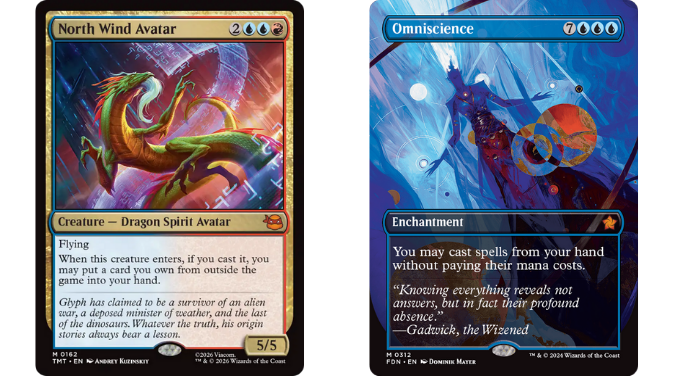
A lot of the tech is re-used from earlier Standard decks, but North Wind Avatar is a perfect centerpiece here. Being a creature lets you tutor it with Formidable Speaker, discard it to Winternight Stories and force it through the stack with Cavern of Souls. Once you’ve deployed Omniscience (ideally by tapping Kona, Rescue Beastie with station or harmonize) the Avatar being wish-on-a-body lets you very easily loop its ETB with that of Marang River Regent to plunder your sideboard for as many cards as you need to close the game.
SLOW BUT STEADY IS THE TURTLE WAY
The depth of Teenage Mutant Ninja Turtles has been slow to reveal itself, but that seems to say more about how complex and competitive the Standard environment is right now than the actual potential of the set.
There’s even more new cards finding purchase in other Constructed formats, like Pauper, which suggest that something like Raphael, Tough Turtle can be playable in the right conditions. I’d imagine we’ll get to revisit this next tier of TMNT cards after the next Standard rotation, as the format shakes up and players search for effects which can best replace outgoing staples.
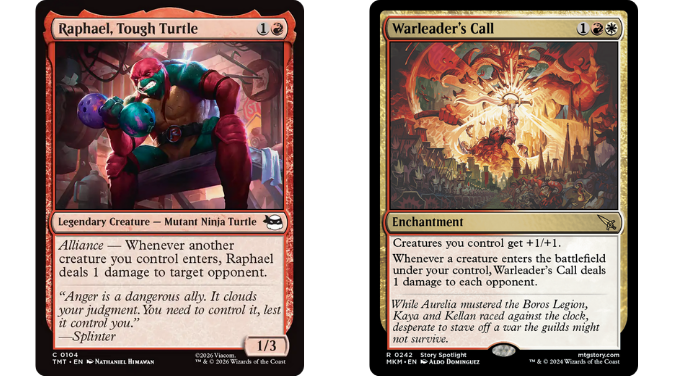
But why wait until then – there’s nothing to say that the cards aren’t good right now. In a Standard that’s bigger and more diverse than ever before, you’d be foolish to think that the only good decks and cards are the ones we’ve already discovered.

Tom’s fate was sealed in 7th grade when his friend lent him a pile of commons to play Magic. He quickly picked up Boros and Orzhov decks in Ravnica block and has remained a staunch white magician ever since. A fan of all Constructed formats, he enjoys studying the history of the tournament meta. He specializes in midrange decks, especially Death & Taxes and Martyr Proc. One day, he swears he will win an MCQ with Evershrike. Ask him how at @AWanderingBard, or watch him stream Magic at twitch.tv/TheWanderingBard.