
Well, it’s officially the new year on the CK Blog (and I suppose everywhere else too). As a veteran writer, I’m making it my new year’s resolution to try and remain topical and hip with Magic’s younger demographics.
I hear all the kids these days talking about “aura farming” – showing off by doing things in stylish, unexpected ways. Auras in Magic do tend to be pretty straightforward and workmanlike cards. But, there’s still some sneaky-good tech you can flash around that most people aren’t familiar with – and today I’m going to show you some cards that are guaranteed to impress your table.
10. “Auras that can go on your opponent’s stuff in an emergency”
I couldn’t think of how to pick just one of these cards to properly represent my point, so the first entry on this list is shared between a whole list of decent-to-great auras. The important thing have in common is the trait I hold most important when evaluating this card type: they have an alternative use case that makes them impactful even when you’re not in a good spot to be buffing your own creatures.
If we think about creature auras using quadrant theory, enchanting your own creatures is something that’s great when you’re in a winning board state, reasonable when you’re at parity, risky during the developing turns of the game and actively bad when you’re behind.
Basically, the less established your board state the less likely you are to have a great target for your auras, and the more it will hurt if your opponent removes that target with an aura on the stack. But, if an aura you normally play to benefit your creatures can also pull double duty as removal for opposing creatures – even if it’s not great removal – then that pushes its scores in those weak quadrants way up!
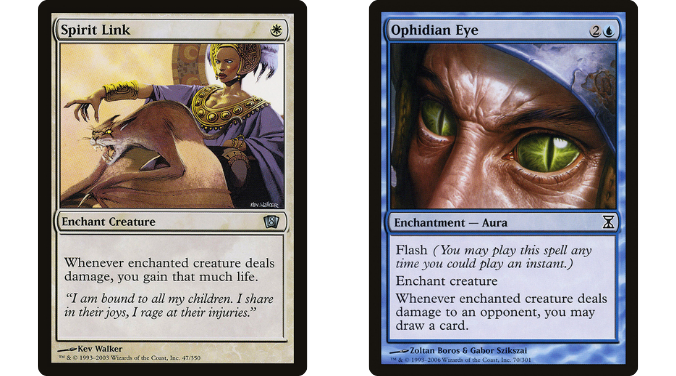
Spirit Link or Vampiric Link give your creatures a form of lifelink which can stack with itself or the actual keyword. But they can also enchant an opponent’s creature, and they’ll still heal YOU whenever it does damage – essentially negating any non-lethal attacks they make and healing you if they’re blocked or attack a different player.

The Vow megacycle is a more obvious if expensive example: they’re straight-up buffs for your creatures, goad effects in multiplayer, or Guard Duty in a 1v1 situation.
There are tons of enchantments like this; particularly older ones, as before a certain point auras would almost never specify “enchant creature YOU control”. Curiosity, Keen Sense and Ophidian Eye all let you draw cards off opponents’ dealing damage.
Phantom Wings and Ghostly Wings include an “ejector seat” clause which can turn them into reasonably-costed bounce spells. Pariah on an opponent’s creature usually turns into Fog + Doom Blade, which is a pretty solid Plan B when you can’t find your own indestructible creature to put it on.

Don’t miss the forest for the trees here – a card with two mediocre effects is still not worth playing. But raising the floor of an effect that’s already got a good ceiling is always important – and it’s always a great flex when you find ways to use a card that your opponents hadn’t even considered!
Wreath of Geists
Step aside, All That Glitters: there’s a new “worst aura to try and block” in town. For the beautifully low price of a single green mana, this aura provides stat buffs which are oh-so-easy to scale up.

You can literally dredge large numbers of cards into your graveyard every turn for zero mana – but even if you don’t want to tap out resources each turn filling your yard, the threat of doing it at instant speed should have every potential attacker thinking twice before tangling with the Wreath.
If your creature does end up in a fight where it’s behind on stats, you can activate any discard, loot or dredge effects – even sacrifice other creatures – to power up the Wreath and win the exchange. Most opponents are not gonna risk that kind of blowout a second time, so you end up getting a huge unblockable threat for just one green mana. Shout out to Geists!
Charisma

The only things that make Charisma remotely fair are its triple-blue casting cost, and the fact that your opponents can (theoretically) get their stuff back.
In practice, blue decks tend to be very good at blocking creature removal, and the generous wording on the aura means you don’t need to risk the enchanted creature in combat to get the benefits. Far better to slap it on a creature which can deal damage as an activated ability, and gain the power to steal any creature at any time like a juiced-up Memnarch.
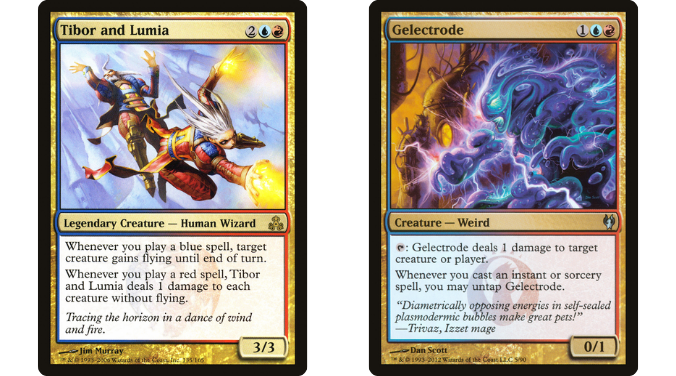
Of course, the ultimate supervillain move is to slap it on a board-wide pinger like Thrashing Wumpus or Tibor and Lumia. Those creatures tend to be expensive or require extra setup to not destroy themselves, but an at-will Insurrection is worth the effort!
But if you’re not trying to turn Charisma into a game-ending threat (or you prefer to still have friends at the end of the night), then just put it on any random first striker. Changing a creature’s controller immediately removes it from combat, so Charisma becomes a form of super-deathtouch which should seriously discourage swinging into your aura-bearer.
Breath of Fury
I love extra combat spells almost as much as I love weird creature auras… so you can imagine how this Ravnica gem is near and dear to my heart.

The potential of this card in any half-decent creature deck is nearly limitless, kill-the-table type of damage. You basically get to sacrifice your smallest creature to get another swing with the entire rest of your army, as many times in a row as you want. The only thing holding you back is that you need to actually connect and damage a player with the thing you put the aura on each time to secure another go-around.
If only red had access to some number of cards which said “creatures can’t block this turn”, or if the Commander format had a history of developing tech to efficiently defend creatures from spot removal… would that make Breath of Fury a premiere game-ending spell?

Only the bravest red players among us will find out, I suppose.
Dual Casting

It’s always awesome when auras make a creature better at something unrelated to combat. Getting to double the effects of expensive and X-cost spells for just a one-mana kicker is already some amazing fair value, especially when you can opportunistically copy Faithless Looting and other smaller spells in between the big stuff.
But allowing spells to be copied for the low price of one mana plus tapping inevitably leads to thoughts of combo, especially given how many cheap instants and sorceries can untap your creature.
Cast a spell which untaps your Dual Caster and a mana source, like Hidden Strings, and you can keep copying forever. If you enchant a Storm-Kiln Artist, then you can go infinite with a one-mana spell that untaps one creature. Don’t even get me started with the possibilities if you enchant a creature that can untap itself during the loop, like Pili-Pala or Battered Golem.
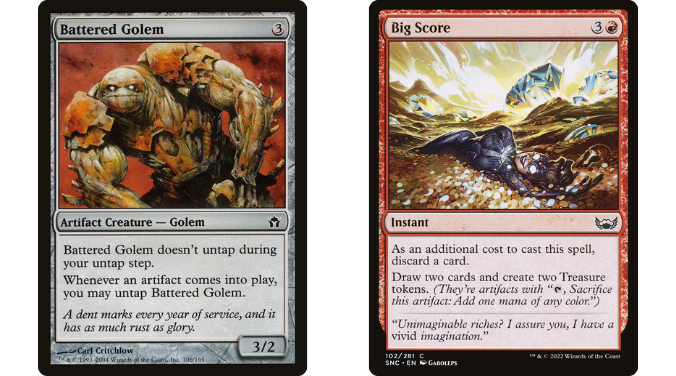
The worst part: even though Dual Casting is a tap ability, you can usually put the aura on a creature which was already in play – so assuming the spell you want to copy is an instant, you can go from innocuous boardstate to comboing off in the same turn for just four or five mana.
Pattern of Rebirth

Getting to search for any creature card in your deck and immediately put it onto the battlefield for free, no strings attached, is one of the most powerful things you can possibly do in Magic.
So isn’t is a bit shocking how relatively low-profile Pattern of Rebirth is today? Four mana plus a sac outlet, and the world is basically yours. Other than the potential for a blowout should the target creature be removed with your aura still on the stack, but that’s no different from the sacrifice cost on Natural Order – and Pattern doesn’t even force you to work with green creatures!
It’s not the most powerful thing to do out of context, but one of the coolest lines in an aura-focused deck is for Pattern to tutor up Storm Herald or Bruna, Light of Alabaster. From top-decking a single four-mana aura, you might suddenly conjure up a massive giga-threat with all your enchantments on it… then when it dies, do all that again! Then the third time, you tutor up a Karmic Guide to reanimate the Bruna… you can pretty much keep this up as long as you think it’s funny.
Metamorphic Alteration
Copying creatures using an aura is different to the more traditional, creature-based form of Clone. But those points of difference can be advantageous when used correctly!

Making something a copy after it comes into play means you can’t benefit from copied ETB triggers, but you also skip over any detrimental triggers. There’s a growing subset of creatures who balance out a lower-than-usual cost by entering play “asleep” with a bunch of stun counters on them: copy them with Alteration, and you can turn your 1/1 into a full-power Arixmethes or The Watcher in the Water.
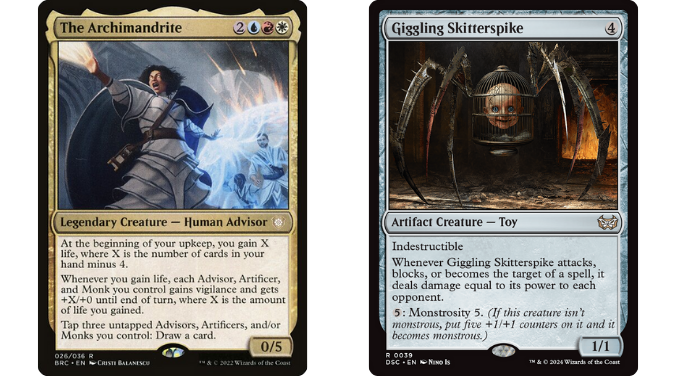
You can also strategically time your Alteration to “stack” the abilities of two different creatures. For instance, in an Archimandrite deck you could gain a bunch of life in your upkeep and first main phase to add a big +X/+0 buff to your commander, then use Alteration to turn it into Giggling Skitterspike. The rules for layers are notoriously tricky, but in almost all cases you apply the copy effect BEFORE other stat changes, meaning lingering buffs from triggers will boost its new power too!
If all that sounds too niche, remember you can play Metamorphic Alteration on opposing creatures to make them worse, copying a 1/1 token or whatever else is lying around. Always being able to upgrade or downgrade the most important creature on the battlefield for just 1U makes this card far more consistent than it might seem.
Laccolith Rig

A long-time favorite of mine, and an amazing card if you like to test your opponents’ reading comprehension… or dominating combat maths!
You can enchant your opponent’s massive creature, and suddenly you can totally stonewall it with a 1/1 token or 0/1 Argothian Enchantress. Trample and effects that say “damage can’t be prevented” won’t help them get through, and abilities which trigger on combat damage get denied. Even better, you can then use the absorbed damage to nuke any creature on the battlefield – even the enchanted attacker.
It’s especially brutal if you can flash this in as a combat trick, since most players won’t dare to attack when this is on their creature. Of course, you can enchant your own creature and use the same threat of removal to discourage opponents from blocking and triggering the Rig.
In multiplayer games, the Rig becomes a politics-powered removal cannon! Say I want to kill Player A’s commander: I attack Player B with my Rigged creature and ask them to block so I can redirect the damage to A’s creature. B’s blocker won’t even take damage, and even in a low-trust situation they only have to risk their worst creature. So they usually play along, and help contribute to the greatness of The Rig.
One with the Kami
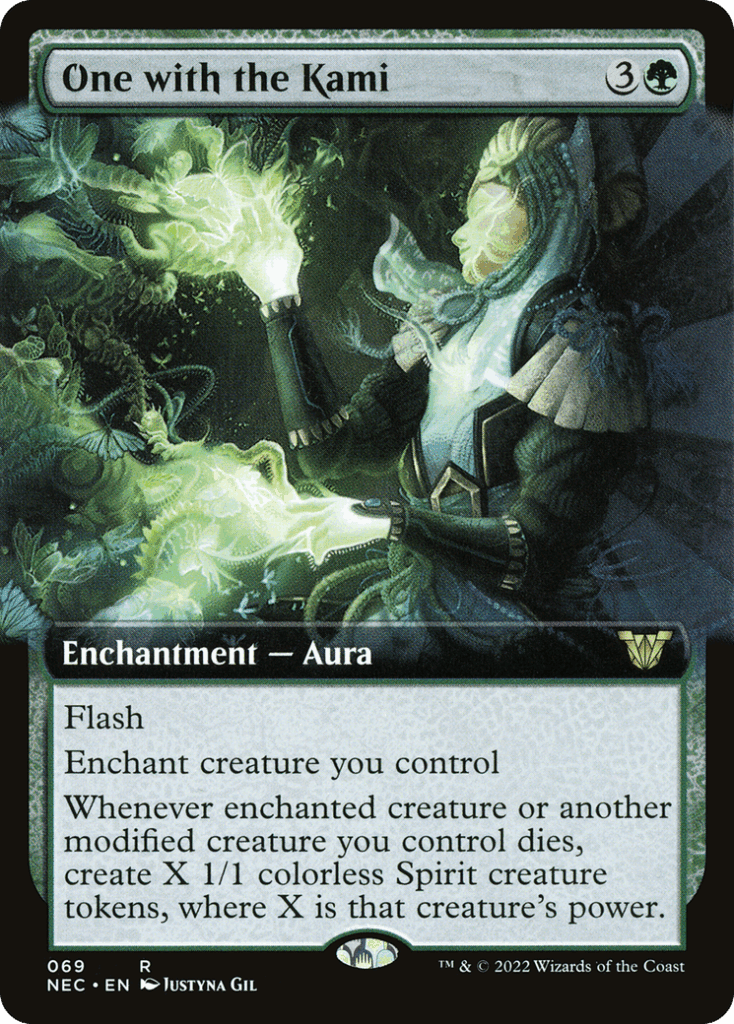
Pointing at random expensive cards to ask “is this Splinter Twin” has been passe for years… but I think this actually is pretty close to the green Twin. As a four-mana aura, it’s good that you can technically use it in a fair way, slapping it onto something as a response opponents removing a different creature (or wiping the board).
However, the most obvious use case for One with the Kami is as part of a game-winning combo. The other parts you need are simply a zero-cost sacrifice outlet and some effect that can place a +1/+1 counter on creatures as they enter the battlefield: Grumgully, Path of Discovery, Juniper Order Ranger, or Rhythm of the Wild for example.
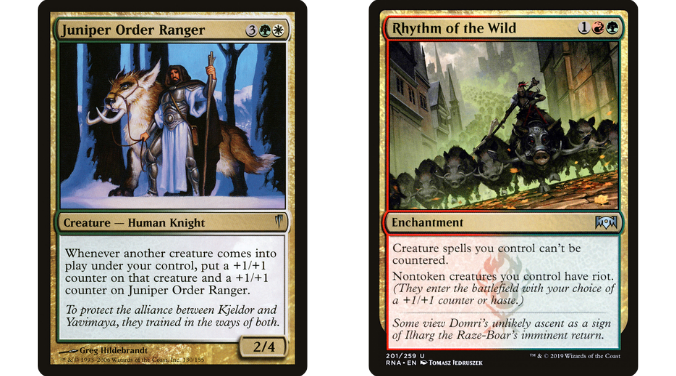
With those in place you can flash in One with the Kami onto your favorite creature, and then sacrifice one of the others. Assuming that sacrifice was modified, you’ll make at least one Spirit token, which can then be sacrificed to make two more Spirits thanks to the +1/+1 counter it enters with.
The only difference from actual Splinter Twin is that your infinite token army won’t have haste. But they’re also not temporary – so if you flash in One with the Kami and make the Spirits on the endstep before your turn, you should still be able to attack and win without giving any opponents a chance to untap. Brutal!
Swift Reconfiguration
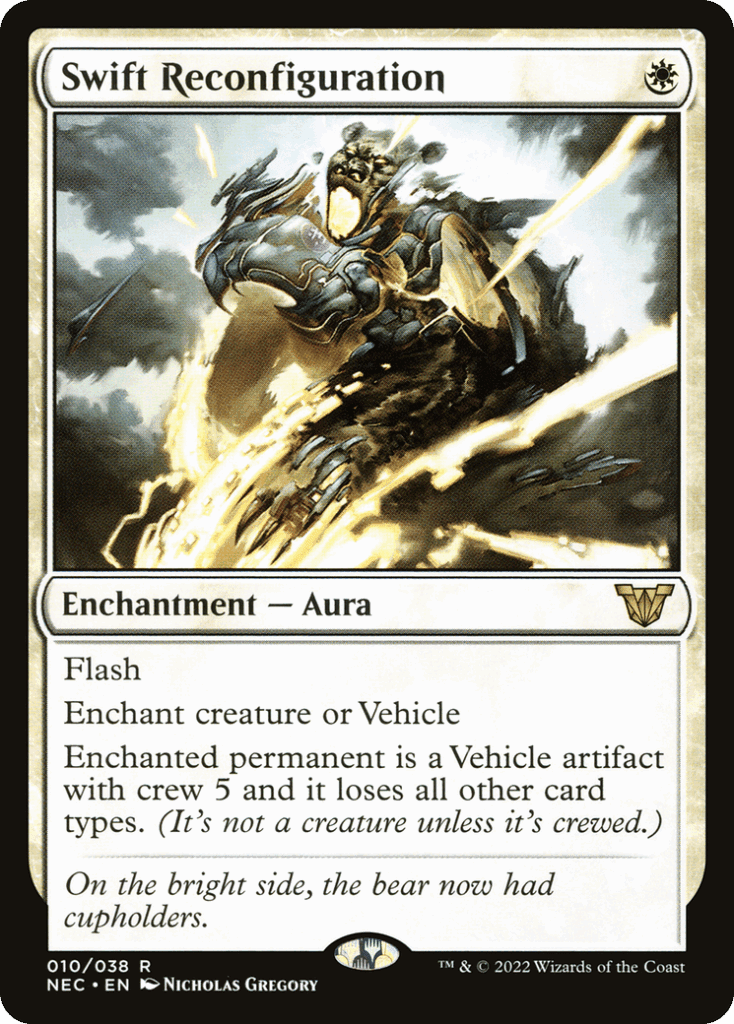
Besides its slightly confused artwork and unnerving concept, this one ticks all the boxes.
Easy to cast? It’s an instant-speed one-drop.
High impact? It can save a utility creature from basically all removal (even board wipes), and also enables two-card combos with targets like Devoted Druid.
Flexible? It can pull double duty as one-mana instant Pacifism if you’re under pressure and need that kind of removal. (In case you haven’t seen it in action, turning an attacking creature into a vehicle removes it from combat, even if there are enough other creatures to immediately crew it again).
Turning creatures into vehicles also removes summoning sickness and the risk of dying from damage or low toughness, while retaining all other rules text. This is especially powerful with creatures whose abilities damage themselves as a cost, which is how the Devoted Druid combo functions. Just remember not to actually crew your Druid-mobile at any point, lest it instantly collapse under the weight of its trillion -1/-1 counters.
You really can’t ask for much more, and Swift Reconfiguration has proven useful for me in even the most high-powered Constructed formats.
SHOCK AND AURA
So, do you agree that these are some cool, exciting aura cards?

They’re definitely not the most competitively viable ones (though I consider game-winning potential to be a necessary ingredient in making cards or decks “feel good”). But I don’t think you need me to tell you that Rancor and Sheltered by Ghosts and Ethereal Armor are strong cards to put in your deck – and there’s other resources out there if you do need that.
What I think is valuable to share are cards which are less obviously busted on rate. Cards which do take a little extra work or lateral thinking to make good, which thrive on sneaky alternate uses or unusual interactions and combos. Uncovering these hidden gems is a great part of the Magic experience – as is taking them for your own and then unleashing them on your unsuspecting play group.
Have fun enchanting, and I’ll see you next week!

Tom’s fate was sealed in 7th grade when his friend lent him a pile of commons to play Magic. He quickly picked up Boros and Orzhov decks in Ravnica block and has remained a staunch white magician ever since. A fan of all Constructed formats, he enjoys studying the history of the tournament meta. He specializes in midrange decks, especially Death & Taxes and Martyr Proc. One day, he swears he will win an MCQ with Evershrike. Ask him how at @AWanderingBard, or watch him stream Magic at twitch.tv/TheWanderingBard.