
Commander is Magic’s most successful format. For many players, the two might as well be synonymous. There are plenty of people who learn about this game through Commander, exclusively play and discuss Commander, and never once trouble themselves with thoughts of other Limited or Constructed formats!
There’s nothing inherently wrong with that (and certainly from Wizards’ perspective, those people have helped the game flourish remarkably). But being “all in” on just one format does limit your enjoyment of Magic in situations which don’t suit that ruleset.
Luckily, Commander is not a monolith: there are plenty of related and variant formats which afford players a chance to rest or change things up, while still having that Commander feel you know and love.
STAYING IN THE ZONE
Firstly, let’s talk about alternative ways to play Commander. Imagine a Venn diagram where the circles represent the format’s signature rules: Commander itself would be in the exact center (where all the rules apply), and these ways to play would be closely adjacent, with only one or two key differences to set them apart.
Most importantly, their rules for deckbuilding are similar or identical to mainstream Commander. So if you’re an invested Commander player, you should be able to try them out with minimum extra fuss!
DUEL COMMANDER
The “sales pitch” for Duel Commander is extremely simple: have you and a buddy ever wanted to bash Commander decks but there’s nobody else around to form a pod?
Maybe you showed up to your usual Commander night and the other regulars called in sick. Or there’s an uneven number of players, and you don’t feel like making an ungainly six-player game that’ll take all evening. What do you and the other odd-person-out say? Time to D-d-d-d, d-d-duel!
Duel Commander optimizes certain aspects of the rules to make 1v1 games more fair and interesting. There’s nothing about the “normal” Commander rules which prevents you playing 1v1, of course. But there are a lot of cards and strategies which become oppressive when a player can focus all their energies on a single opponent.

The Duel Commander rules are curated by a community of players who have been jamming 1v1 games for almost 20 years, banning some additional cards and changing a few rules to keep the worst of these offenders in line.
Deckbuilding: Almost identical to “normal” Commander. Duel Commander does change the rules for Partners (and similar mechanics). The Duel Commander rules state: “Players may only cast one of their commanders from the Command Zone each game (the first one cast). This choice need not be announced before casting.”
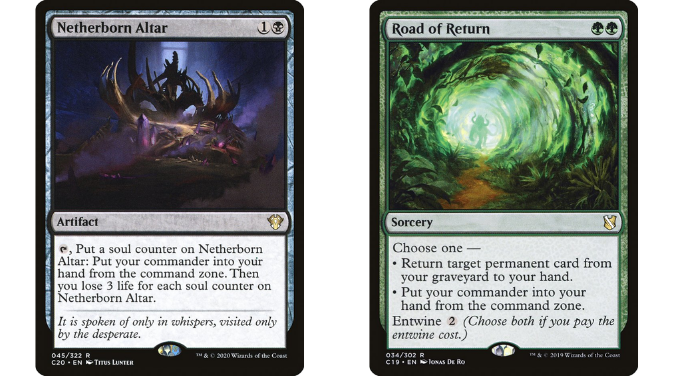
This is a necessary change for balance reasons – and I like it better than just banning every card with partner mechanics – but it could understandably feel a bit harsh to someone who built their deck around using both their commanders in unison. At least it only prohibits casting the second commander from your Command Zone: you can still access them using cards like Command Beacon, Road of Return or Netherborn Altar!
If you’re planning to engage with the Duel Commander community, especially on Magic Online, you should also check out the format’s banlist. It’s sort of a hybrid between the banlists of Legacy and Commander: removing most of the Vintage-tier fast mana and resource-denial cards which allow turn-one kills, but also cards that are simply too good on rate: Treasure Cruise, Uro, Fierce Guardianship and White Plume Adventurer to name a few.
Gameplay: The biggest difference for Commander players to appreciate is that Duel Commander uses a starting life total of 20, not 40. This is standard across most 1v1 formats – that bigger buffer isn’t necessary when you’re not catching strays from multiple extra players in between each of your turns. The lowered starting life also means there’s no special rule for commander damage in Duel Commander games. Lifegain-deck players, rejoice!
If you decide to play in an organised event, it’s worth remembering that Duel Commander matches are played as a best-of-three-games set. While there’s still no sideboarding, you CAN freely change your commander between games so long as it doesn’t make your deck illegal under color identity or singleton rules.
BRAWL
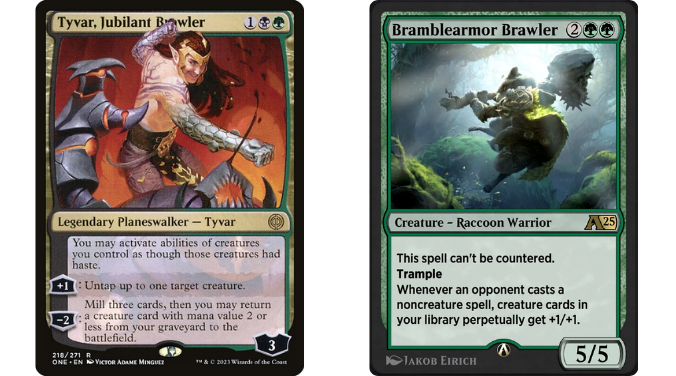
Similar to Duel Commander, Brawl exists as a way to extend Commander’s expressive deckbuilding and gameplay into 1v1 scenarios. But where Duel Commander is primarily played in paper or on Magic Online, Brawl was specifically created to play on the MTG Arena digital platform.
This makes it a 1v1 Commander variant by default as (at time of writing) only two-player games are possible on Arena. Brawl’s card pool is also defined by which cards exist on MTG Arena, including digital-only cards from Alchemy sets.
Some players might remember Brawl using 60-card decks and the Standard-legal card pool. While this was originally true when the format first released, it has since evolved to become more straightforwardly “Commander, but on Arena”.
Deckbuilding:
All Planeswalkers are considered legal commanders in Brawl, on top of all the normal options. The other major difference comes from the Alchemy card pool. If any of the cards in your deck have been “patched” for Alchemy, then you are only allowed to use that patched version in Brawl.
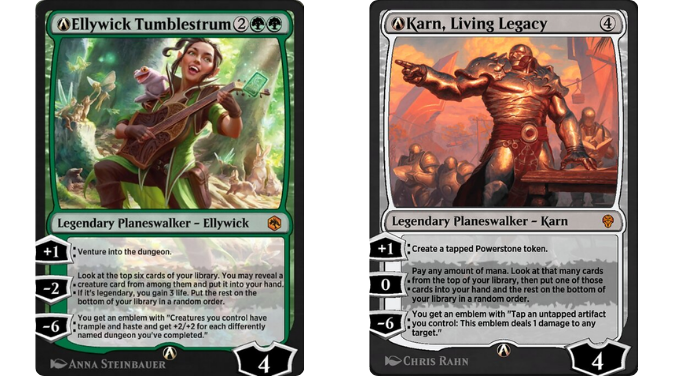
Brawl also has its own relatively short list of banned cards, but since this is automatically enforced by the Arena client there’s no danger of accidentally building an illegal deck.
Gameplay:
Similarly to Duel Commander, Brawl reduces your starting life total for 1v1 gameplay: in this case, you get 25 life. There is no commander damage rule.

TREACHERY
Are you a fan of both Commander AND social deduction games like Werewolf and Blood on the Clocktower? Do you play with the same group often enough to know each other’s favorite decks inside and out, and want a way to shake your games up?
A lot of players can say yes to at least one of those questions, in which case you should definitely take a look at Treachery! This surprisingly underrated format layers a simple “hidden role” game on top of your usual Commander pod, with each player receiving an Identity card face-down before the game.
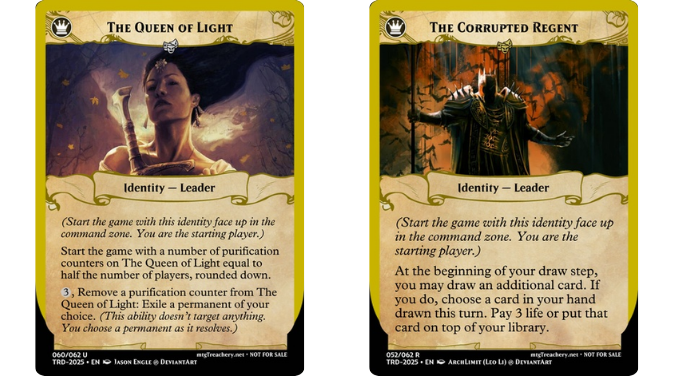
One player will be dealt a Leader identity: they start the game by turning their card face up, and taking the first turn. Everyone else is then locked into a deadly shadow war, with your hidden Identity deciding which side you’re aligned with.
Dealt an Assassin card? You win by eliminating the Leader from the game at all costs. Meanwhile, players with Guardian cards need to keep the Leader alive, and the Leader needs to survive until only they and their loyal Guardians are left standing. There are also Traitors, who have no team allegiance and win by being the last player standing.
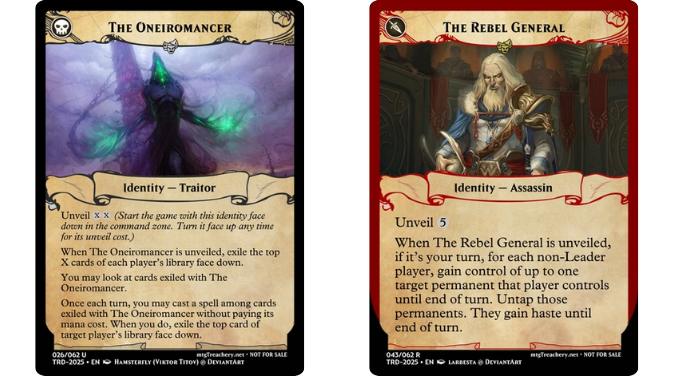
Those are the basic roles, and just using that system can be an exciting change-up the first time you play. But the advanced version features specific sub-classes within each identity, each with a unique “unveil” ability which you activate by flipping them face-up, revealing yourself to the rest of the table.
Is it worth trading secrecy for strength? That’s the question asked by Treachery, and your answer will change frequently depending on how the game is going.
Deckbuilding:
No special rules or changes compared to normal Commander deckbuilding: you add the Identity cards only at the start of each game. The format’s website suggests three cards that should be soft-banned unless your table agrees to use them: Expropriate, Head Games and Trade Secrets.
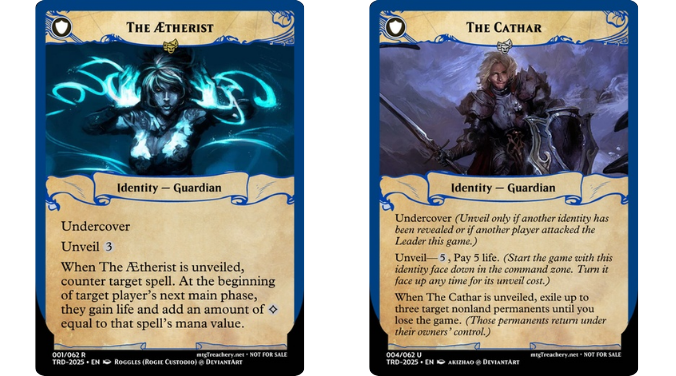
Gameplay:
The addition of Identity cards changes the game significantly, as explained above. The Treachery website has both readable and “complete rules” style explanations of how these extra systems integrate into the familiar game of Magic. There is also a digital reference for all the different Identity cards and their abilities.

TWO-HEADED GIANT
Many players are at least aware of Magic’s “doubles” format from playing in prerelease Sealed events. But did you know you can also use the Two-Headed Giant rules in Constructed formats – including Commander?
Two-Headed Giant games pair players up in teams of two: each team plays as a single entity, sharing a life total, attacking and blocking together, and taking their turns simultaneously. This might sneakily be my favorite way to play Commander: less downtime for each player, less agonizing over who to target and when, and less incentives to play passively compared to free-for-all.

Partnering up also instantly creates a ton of novelty and atmosphere! Like a superhero team-up, it’s a thrill to see what unique teamwork opportunities and combo plays your duo of decks can pull off (which is why I prefer to assign teams randomly instead of building decks specifically for 2HG Commander).
Playing in teams also naturally encourages more communication throughout the game – both between teammates, and between teams. It’s very easy to enjoy some lighthearted banter and smack-talk when the game defines friend and foe, just as it’s nice to pull off cool cooperative gameplay without it being called out as collusion or kingmaking.

Deckbuilding:
Officially Two-Headed Giant teams use Unified Deckbuilding rules, which means that you cannot have the same card appear in both players decklists.
However, I’ve never seen that rule enforced for Commander 2HG. It also presumes that you’re building your deck specifically to play 2HG, and that you know your partner’s deck. If you play 2HG like I do, randomly splitting people up into teams with their usual Commander decks, then Unified Deckbuilding obviously has to be ignored.
Gameplay:
The only change between Two-Headed gameplay at a prerelease and at Commander Night is that teams in Commander 2HG start with a combined 60 life, rather than 40.
It is still important to remember the precise rules around what you share with your “other head”, and what you track individually. The individual players on a team have separate hands, command zones, graveyards and exile zones. They play cards as individuals and cannot pool their resources to pay costs unless a rule says so, like the “join forces” ability.

They count as two distinct players when targeting or resolving effects, which matters for cards like Splinter, Aging Champion as well as ones like Dire Fleet Ravager. This means that you’re always dealing damage (or causing life loss) to the individual players even though they share a life total. However, since teammates can always block for each other regardless of which head was targeted, this tends to only matter when a defender has cards like Palisade Giant, or an attacker has a Hypnotic Specter.
REMEMBER, COMMANDS ARE MODAL
Commander is a lot of fun, but that fun relies heavily on novelty. When I get burned out (or hear other people around me expressing that emotion) it’s usually because I’ve felt too many of my recent games playing out the same way, or I’m losing to the same sorts of cards without much opportunity to interact.
I used to respond to those feelings by building a new deck to play. Unfortunately, over time that has diminishing returns: the new voltron or enchantress deck starts to feel a lot like my last voltron or enchantress deck. But by thrusting that deck into an unfamiliar strategic context, I can still enjoy a fresh Commander gameplay experience with minimal extra effort – and without building any new decks. I thoroughly recommend giving them a try yourself if you’re also feeling burnt out.
I didn’t have time to get into them today, but there’s also plenty of “Commander-adjacent” formats. These typically have more distinct rules, and may require you to tweak or rebuild your decklists. But they give you even MORE different ways to appreciate Commander-style Magic, and for that they will be worth our future attention. See you then!.

Tom’s fate was sealed in 7th grade when his friend lent him a pile of commons to play Magic. He quickly picked up Boros and Orzhov decks in Ravnica block and has remained a staunch white magician ever since. A fan of all Constructed formats, he enjoys studying the history of the tournament meta. He specializes in midrange decks, especially Death & Taxes and Martyr Proc. One day, he swears he will win an MCQ with Evershrike. Ask him how at @AWanderingBard, or watch him stream Magic at twitch.tv/TheWanderingBard.