
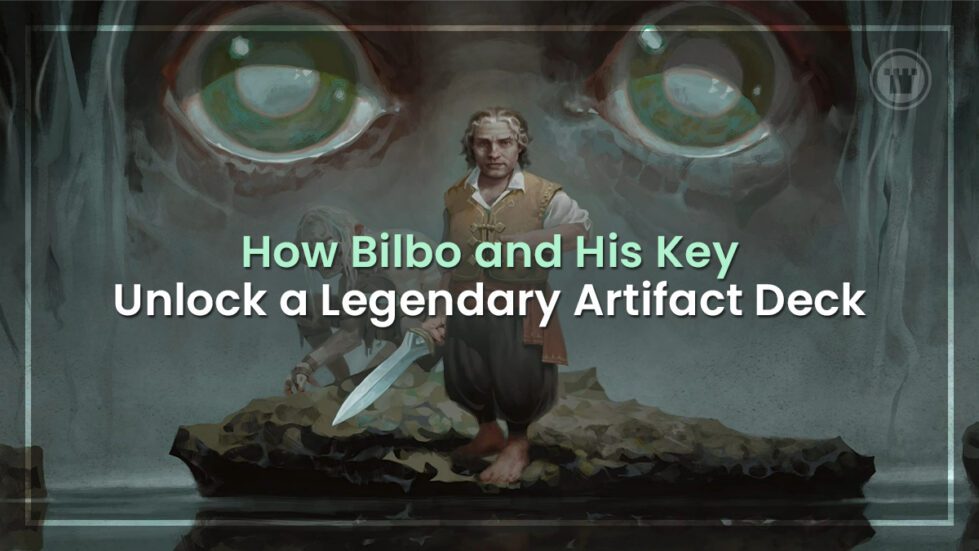
It feels like this whole spoiler season, excitement for The Hobbit has been slightly chilled by the looming shadow of The One Ring. Tolkien may have dreamt up Bilbo’s adventures as a lighthearted children’s story, but once you understand the epic events it presages it’s impossible to read with the same innocent whimsy.
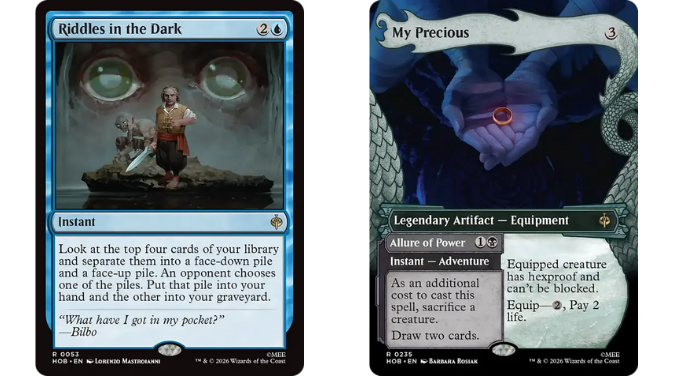
Likewise, if The Hobbit had been Magic’s first visit to Middle-earth, it would have been met with unqualified praise. But in this timeline, we have already been treated to the epochal power of The Lord of the Rings: Tales of Middle-earth!
Designed around the power level of Modern and eternal formats, cards like Orcish Bowmasters and The One Ring have now come to define the crossover of Magic and Middle-earth. It’s great that The Hobbit is reprinting these staples to give players another chance at them – but what about actual new cards from the set itself? Surely there’s at least a few with potential to see play in more than just Standard? (spoiler: yes, and I’m about to spend the rest of this blog pointing them out).
THE KEY IS IN THE IGNITION
One of the biggest criteria cards need to meet when you’re considering eternal formats is how well they synergise with what’s already in the metagame. The card pools in Modern, Legacy, and Commander are too deep to stand out just on raw efficiency, and most decks will only want new cards that will not weaken the overall cohesion of their gameplan.
Our first standout card is a perfect example: an artifact with clear upside in graveyard decks which also provides powerful support to a third theme which pairs naturally alongside them: Legendary matters.
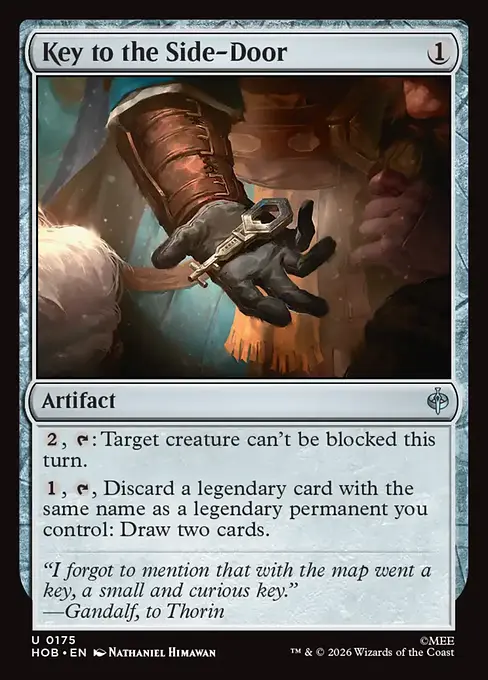
Key to the Side-Door is a mana-efficient, colorless way to sculpt your hand and graveyard over several turns. However, you can only activate it by discarding duplicate copies of legendary permanents you already control. It’s quite a unique requirement – how hard is it to actually meet?
Since Key only specifies “legendary permanent”, the most consistent enabler will be legendary lands. There’s over 60 such lands in the eternal card pool, including enough untapped colored sources to tempt the thought of a mostly- or all-legendary manabase. However, the relative lack of multicolor legendary lands means only one- or two-color decks can fully pursue this plan – and you’ll always be giving up the utility provided by basics, surveil lands, and other popular land choices.
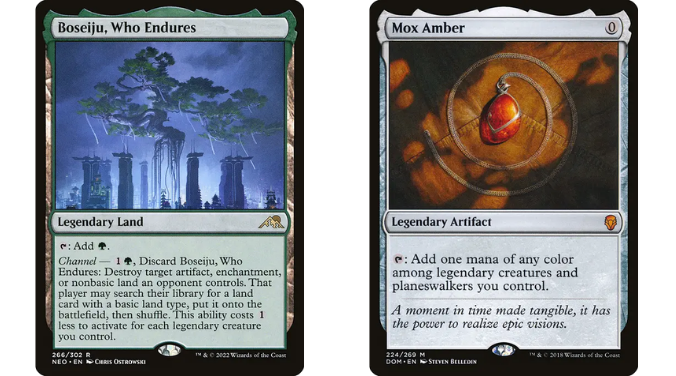
There’s no such downside to legendary mana rocks though! Mox Opal and Mox Amber are well established powerhouses in Modern already. Mox Jasper hasn’t yet been solved in the same way, but can still be cheaply enabled with cards like Mutavault, Slumbering Dragon, Masked Vandal, or Scaled Nurturer.
As good as the Moxen are, we’ll still need to sprinkle in a few actual legendary creatures if we’re trying to leverage Mox Amber. Blue definitely has the standout suite of legendary one-drops, especially when you look at how their effects play with the rest of this package. Emry, Lurker of the Loch is a nasty value engine and enabler of Moxen “loops”, while Tamiyo, Inquisitive Student can easily be flipped by activating Key on your turn. Even off-meta options like Gran-Gran, Lady Octopus and K-9, Mark I seem like great fits.
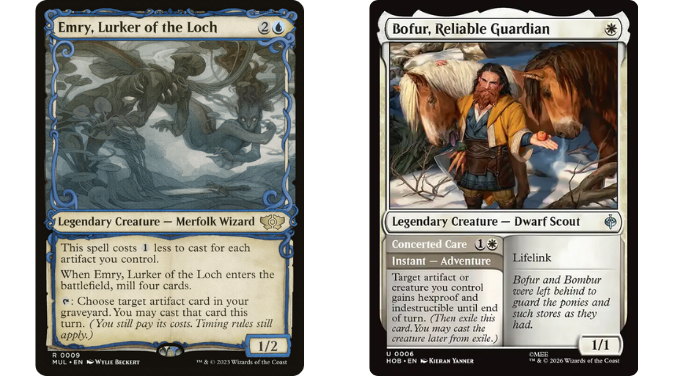
But other colors have good options too. Key is a natural enabler of madness for decks built around Asmoranomardicadaistinaculdacar. Ragavan is still among the best aggressive one-drops and can be made unblockable with Key to guarantee triggers. The newly printed is basically a defensive instant disguised as a creature, meaning we don’t care about drawing multiple copies even if Key isn’t around to loot them away.
Seeing so many of the cheapest legendary permanents also share their colors and mechanical theme makes it seem obvious that Key to the Side Door will find its home in blue (or blue-white) Urza’s Saga decks.
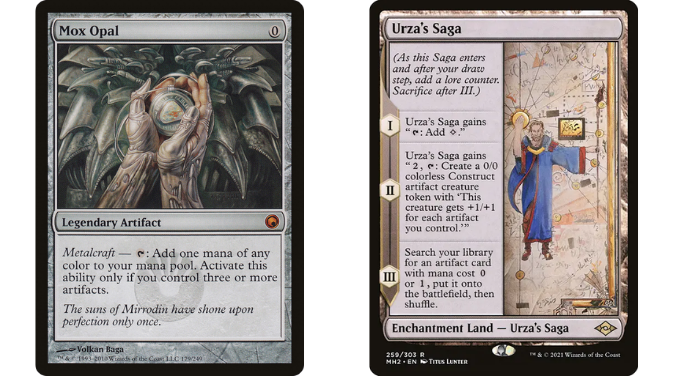
Saga itself can be used to tutor for the Key, or for a second copy of a legendary artifact we’re holding in hand. The chunky construct tokens Saga produces are also among the best targets for Key’s “can’t be blocked” ability – and knowing that Key could always be tutored and immediately used that way off the third chapter will give opponents yet another contingency to try and guard against.
REAL PROTAGONIST AURA
It’s a simple reality of Universes Beyond sets that plot-important characters get the best cards. After all, those are the cards fans most want to play with, and you don’t want people to feel like doing so is shooting themselves in the foot. So, it’s not really a great surprise to find that the early standout card for The Hobbit is its unlikely protagonist, Bilbo Baggins.
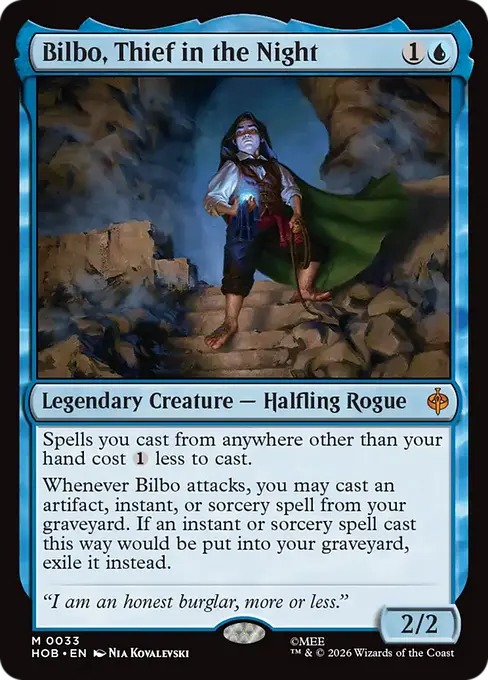
At mythic rare, Thief in the Night is the most potent and efficient representation of Bilbo in the set. With the art seeming to capture him at the threshold of Smaug’s lair, Bilbo’s can brazenly risk his life in combat to net some tremendous rewards – I’d call that a flavor win!
Compared to similar effects like Dreadhorde Arcanist, Bilbo is far less restricted in which spells he can recur. The tradeoff is that you still have to actually pay for the spell in question, although Bilbo will at least give you a discount on it.
This Emry-like ability to recur artifact cards (repeatedly, since those won’t be exiled) combined with this colorless cost discount makes it feel like Bilbo might also slot into the same package of cheap blue legends we’ve earmarked for Key to the Side Door. The unblockability from Key is certainly one of the better ways to ensure Bilbo can survive swinging into blockers, while its looting function helps stock your yard with good spells Bilbo can recur…
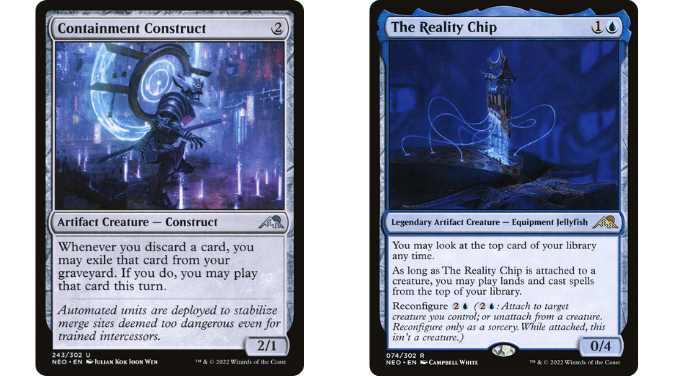
His cost discount is also easy to get extra usage out of in artifact decks: Emry, Experimental Synthesizer, Containment Construct, The Reality Chip and Unstable Amulet all help you cast spells from other zones. Discounting one-cost artifacts into free spells also lets the deck loop Conjurer’s Bauble or Chromatic Sphere for card draw instead waiting for the delayed trigger from Mishra’s Bauble – highly relevant for a deck that’s trying to combo-kill.
Bilbo offers one last sneaky advantage, hidden in the wording of his recursion trigger. Unlike some similar effects, he does not give the card flashback or cast it as part of his trigger. He simply says “you may cast an artifact, instant, or sorcery spell from your graveyard”. The first benefit of this is that your opponent gets no window to react after you announce which card you’re recurring – you choose as part of the ability, so they essentially have to exile your whole graveyard to deny you.
The other upside is that this wording gives you the freedom to utilize alternate casting costs, X-costs, Phyrexian mana costs, and other flexible options on spells you recur with Bilbo’s trigger. The only ones off limits are which specify the timing or zone of the cast (Darksteel Monolith) or where the spell you end up trying to cast is no longer an artifact, instant, or sorcery.
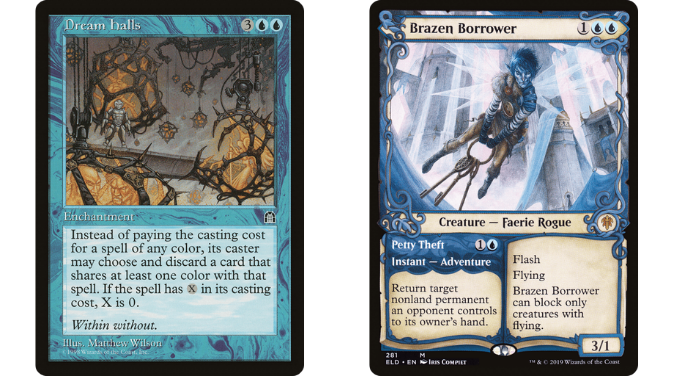
So Bilbo cannot be used to recur Brazen Borrower directly – but he can be used to cast Petty Theft from the yard, and you can then follow up with the creature side (discounted!) as normal. Pretty slick for a reluctant amateur burglar!
COMMAND IMPERATIVE
It’s negligent of me to make this an article about Eternal formats and not address Commander, the most popular and prolific such format. I think Bilbo, Thief in the Night will offer pretty similar potential there as he does anywhere else. Perhaps even more so, since he can be a strong contributor either in the 99 or from the command zone.
But I obviously can’t say the same for Key to the Side Door. It is actually possible to pay its grandeur-like cost in singleton formats; just copy a legendary permanent, get the original card back to hand and then discard it. But the original argument for Key is good utility for a very small investment; requiring such convoluted workarounds rather defeats the purpose.
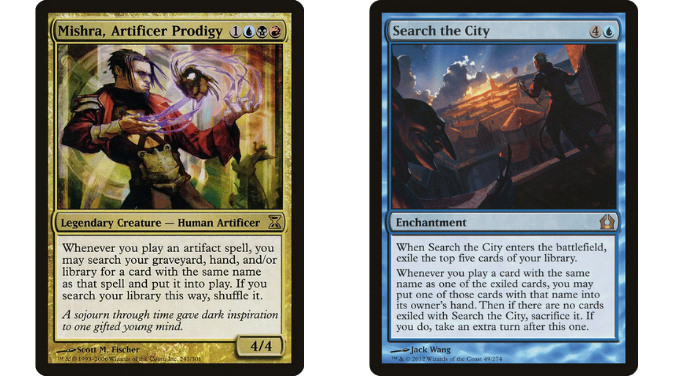
It’s a little surprising to see cards worded like this, in an era where Commander reigns supreme and exerts obvious influence over the design of every Magic product. Yes, there are plenty of other effects that don’t work in singleton, but most of them are older – from an era before Commander was ever acknowledged by Wizards, let alone pandered to.
The fact that we are “allowed” to print a card with this kind of restriction actually feels good to me. Not because I want to wave a toy under the nose of Commander players who can’t have it, but because I think Magic is often better when each format has its own distinct card pool and metagame. The power creep of Modern Horizons has mostly erased the gap between Modern and Legacy. Incorporating Commander-friendly design into every set has us all playing with Commander cards in every format, obliterating any unique charm or character that actual Commander gameplay could once claim.
I don’t really think that Wizards intends Key to the Side Door to be some kind of huge statement or harbinger for change. But I will still hope that it represents a slight reversal of these trends, and that we can see more cards in future which are designed to perfectly fit into their specific Magic format, instead of trying to make them equally good everywhere.

Tom’s fate was sealed in 7th grade when his friend lent him a pile of commons to play Magic. He quickly picked up Boros and Orzhov decks in Ravnica block and has remained a staunch white magician ever since. A fan of all Constructed formats, he enjoys studying the history of the tournament meta. He specializes in midrange decks, especially Death & Taxes and Martyr Proc. One day, he swears he will win an MCQ with Evershrike. Ask him how at @AWanderingBard, or watch him stream Magic at twitch.tv/TheWanderingBard.