
Lorwyn Eclipsed is a Limited format that wears its heart on its sleeve. When a set is built from the ground up around a handful of key creature types, changelings, and other typal synergies, most players don’t need a fancy strategy guide like this one to tell them what’s up. You just jump into this set, choose a type like Elves or Goblins, and then keep picking the best cards in that type and color pair for an easy “on rails” draft deck.
But almost as soon as I started spamming draft runs in preparation for writing this guide, I was rapidly re-evaluating those expectations. The typal synergies are not an easy solution to this format, or even their own color pairs.
A lot of people seem to have had a negative first impression of Lorwyn Eclipsed, and I can’t help but wonder if some of that comes from this clash between typal-set expectations and reality. But now that I’ve adjusted, I’m loving the set and finding plenty of success across all colors and archetypes I tested for this guide. Read on, and I’ll try and explain my findings and help you understand more of how to navigate the nuance of Lorwyn Eclipsed Draft.
SHAPE OF THE FORMAT
This is absolutely a slower, boardstall-heavy Draft environment – moreso even than other recent sets in that style. I’ve rarely felt less punished for waiting until turn three to cast a spell, or for relying on blockers alone to catch up from an early board deficit. Part of that is due to the removal suite – which has a lot of efficient options for killing smaller creatures or attackers, but fewer tools for getting a big dumb defender out of the way.

It’s also a natural (if unintuitive) consequence of being a typal set. Almost every creature card in ECL has the bulk of its power tied up in synergy effects. They rely on strength in numbers, and no body is truly expendable when keeping it alive powers up your key uncommons and rares.
Even the non-typal mechanics like Blight, Convoke and Vivid specifically emphasize keeping “spare” creatures alive by giving them alternative uses. Thinking of trading your two 1/1 tokens for that 4/2 attacker? What if I tell you each of them is contributing an extra color to your vivid effects, and you won’t be able to cast either of the game-changing instants you’re holding up if they die?
Add in a lot of playable lifegain cards, plus the imbalance of removal for small attackers vs. large defenders, and you can understand why aggressive, trade-centric decks rarely work out here.
I suspect that’s the hardest lesson to learn for players trying the format blind, because swarming aggro is exactly what people expect from typal decks like Goblins and Kithkin. But unlike other typal sets (including the original Lorwyn), not all the featured types get an uncommon “lord” effect to bend the combat maths in their favor. In fact, there’s very little access to team-wide pump effects at all outside of certain chase rares.
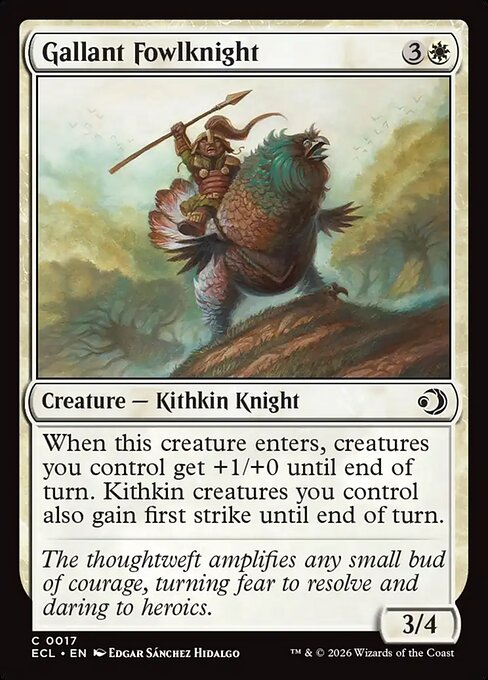
Instead, the combat dynamic is to attack only with your largest creatures, ones you know the opponent cannot block favorably, and force them into uncomfortable decisions.
Maybe that makes the gameplay sound dull or simplistic. But every deck has its own different ways to build up those attackers or otherwise break a boardstall, and the slower games with larger board states give you maximum room to execute creative combos and leverage build-around mechanics that might feel too greedy in other environments.
WHEN EVERYONE’S OVERPOWERED…
Understanding the importance of cards and combos that can “break parity” does help explain the most common complaint I’ve heard about the set: that whoever drafts the “strongest” deck automatically wins and in-game decisions don’t matter.
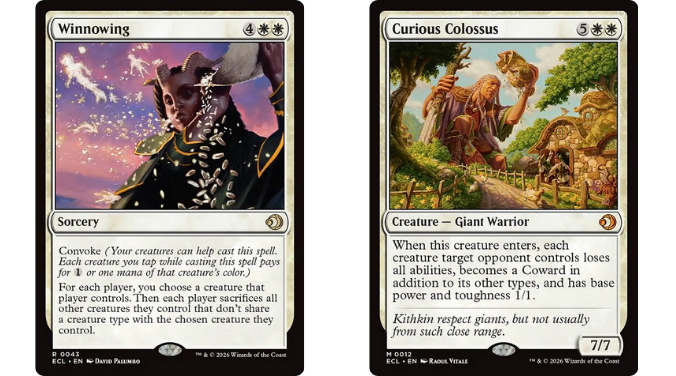
It’s easy to understand how someone could feel overwhelmed by insane rares like Winnowing or Curious Colossus which can suddenly delete an entire board. Or when the merfolk deck has a perfect curve of Gravelgill Scoundrel into multiple Tributary Vaulter and kills you on turn 6 without you ever being able to block.
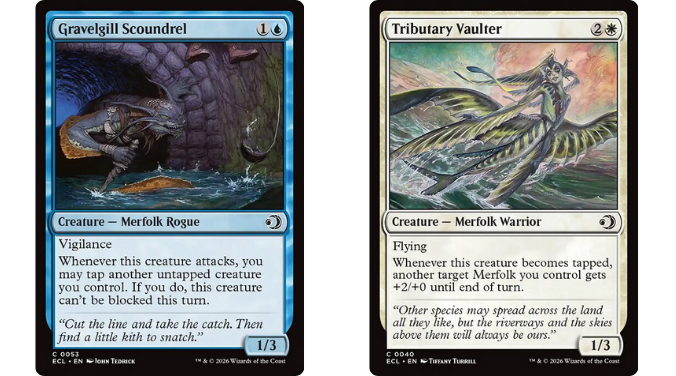
But take a step back, and think about the range those examples cover. On the one hand, a game can be won single-handedly by a really strong rare or mythic. But you can also get completely dominated by someone using only common creatures, if those cards have the right synergy. No offense to players sharing their bad beats, but if both of those extremes can work then it starts to sound less like this is about “draft luck” than it is “draft strategy”.
As the average draft game has gotten shorter and the ratio of rares to commons in a pack has changed, I have absolutely tested formats where it felt like you could get unlucky and go a whole draft without being offered the right tools to win games.
But both my experience and the early aggregated data seem to suggest that’s not the case for Lorwyn Eclipsed. The top-performing cards are pretty evenly distributed across colors, archetypes and rarities – and for those concerned about game-swinging bombs, half of the top ten slots are locked down by the Eclipsed creature cycle.

With so many options, it doesn’t really hold up that good Limited players could consistently be in unwinnable draft positions with no way to assemble a viable deck. But sometimes that viable deck will not be totally “obvious”, or fall easily within the color pair and archetype you were aiming for.
As with other “loosely themed” Draft sets like Lost Caverns of Ixalan or Duskmourn: House of Horror, the key is to have a flexible understanding of how different mechanics and synergies overlap. That way when you’re not so lucky as to get an uncontested draft lane with all the right rares and uncommons for your deck, you’ll still know how to work with what you’re offered – blending in other themes and colors to fill the gaps.
COLOR THEORY
Despite what the vivid mechanic and hybrid mana symbols in this set might imply, I’d set the average/expected number of colors for ECL Draft decks at “two and a bit”. You can usually get away with a light splash of one to three cards from a third color. But going beyond that risks diluting not just your manabase, but potentially the synergy between your spells as well.
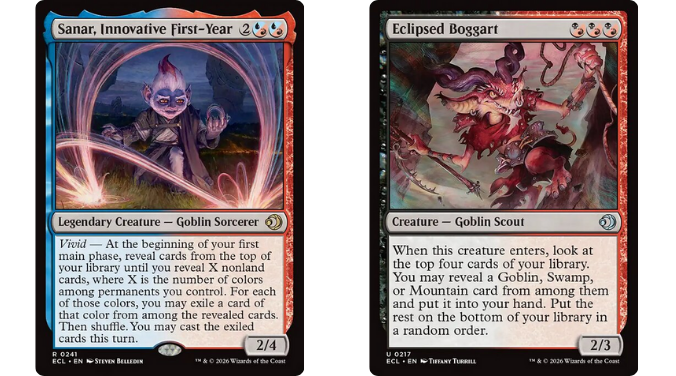
The hybrid mana costs are actually a big reason why you want to splash colors conservatively. Spells like Eclipsed Boggart are much harder to cast on curve if you’re not primarily in those two both colors. The Boggart is also an example of how many in this set cards rely on specific synergies to be worth their cost. So it’s not nearly as rewarding to play them outside of their own color pair, UNLESS you can work in enough matching pieces to still have them hit.
Splashing successfully requires you to work in a couple of color fixing effects, so I like to try and pick those up in the second half of draft packs just so I have more options when its time for deckbuilding. Springleaf Drum is my 17th or 18th land in nearly every deck and has some neat synergies to play with. Evolving Wilds and Eclipsed Realms also go in any deck thanks to their infinitesimal opportunity cost.
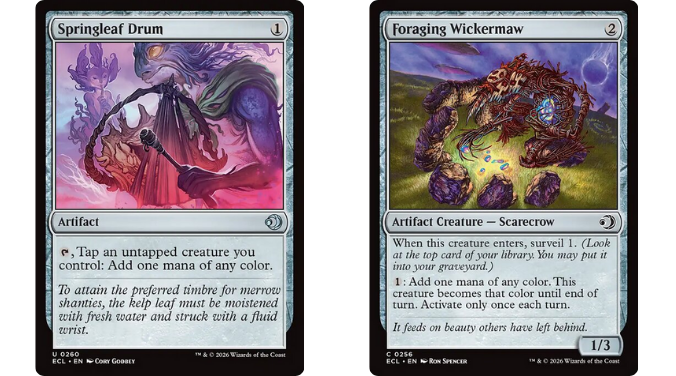
The other colorless options are all a bit too expensive to be “good” picks, so I only run them when they’re necessary to support other card choices (either splash colors or with the vivid and changeling mechanics).
The remaining fixer spells are in green, red and blue: green gets the most and the best, though red does get some overlap with Vibrance, Flamebraider and Noggle Robber. White and black have no fixing at all – only red and blue get access to the classic “big guy with landcycling” card this format. Be wary of this extra challenge if you’re trying to get ambitious with splashables while drafting the white-black deck.
ARCHETYPE BREAKDOWN
Each of the eight “featured creature types” in Lorwyn Eclipsed is associated with their own color pair and draft archetype. Only four of those are actually designed to be typal decks where the creature type is referenced by your card abilities. The other color pairs focus on particular mechanics instead, but their best cards still belong to those signature types (such as faeries in UB) so it’s still relevant to associate them.
I’ve also continued a recent trend of combining UG and RG into one entry, since they are almost always played together as a 3+ color deck. UR remains separate though, as I consider UR elemental typal substantially different to the Temur Vivid deck.
UW: Merfolk Typal Tempo
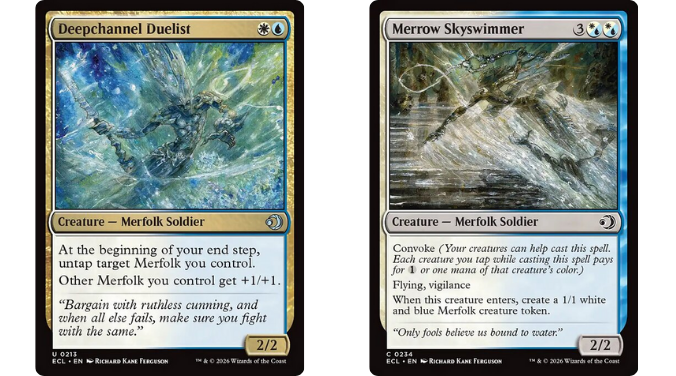
As is often the case when blue gets to be the beatdown deck, UW Merfolk is one of the most consistent, powerful, and versatile decks of the format. They can win both quick and slow games thanks to their “triple dip” value engine. They go wide with cheap merfolk and token generators, which helps them cast more spells using convoke, which then also helps trigger the “when tapped” abilities of your merfolk. That’s a ton to do in one turn, and it’s usually enough to snatch a lead in the life race. Then you just keep attacking evasively and interact with counterspells, bounce and removal so they can’t catch up.
Having “when tapped” as their identity gives merfolk a huge advantage, as they just end up getting paid extra for attacks they were already going to make, without needing to jump through any hoops or pay any costs. It also means most of their effects re-trigger every turn, pulling them ahead in the long game. Make sure to prioritize Gravelgill Scoundrel and the flyers so you can put the opponent on a clock and simplify the game down to protecting that lead.
UB: Faerie Flash Tempo

While they are not a full typal deck, Lorwyn’s infamous fae folk do give this UB deck a strong and potent identity to build around. The trio of Voracious Tome-Skimmer, Unwelcome Sprite and Nightmare Sower reward you for each spell you cast on an opponent’s turn, so put extra priority on flash creatures and instants if you think you might end up in these colors. There’s no limit on how often they can trigger, which can get really funny when you start using Run Away Together to reset your own flash creatures to hand.
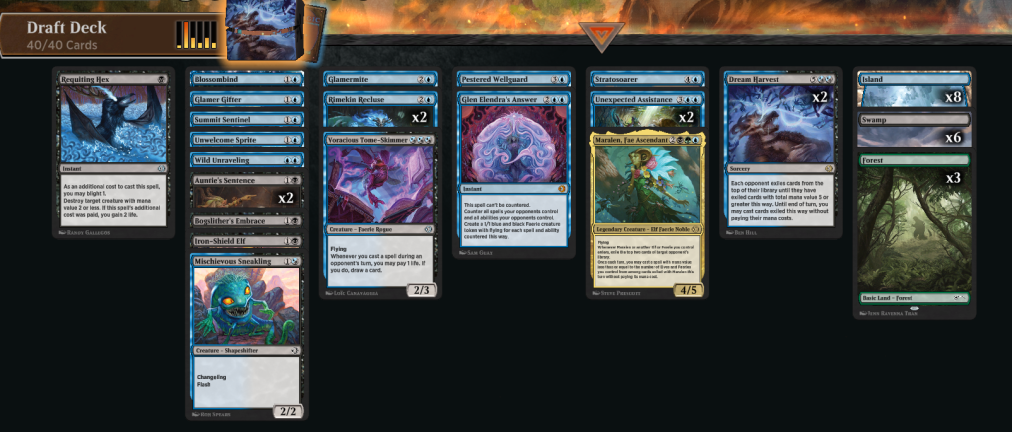
Those enabling faeries are certainly powerful (especially Tome-Skimmer), but you probably won’t get enough copies to reliably grind opponents out in card advantage battles. Instead, I recommend casting a few Glamermites to tap down their best threat each combat, and start chipping away at them to exploit ECL’s lack of small reach blockers. Between the tapping, Glamer Gifter as a combat trick, and the various other bounce spells, you can probably buy the flyers all the time they need to get the job done.
WB: Treefolk Blight Control

Appropriately for treefolk, the key to this deck is patience – just block, hold up removal, gain life, and don’t be in a rush to force trades or try and put pressure back on them by attacking until you’re already certain you have the situation re-stabilized. White in this set has a lot of creatures which remove -1/-1 counters from themselves to perform different effects and black has probably the most reliable and valuable ways to re-blight their own stuff repeatedly – it’s a perfect match.
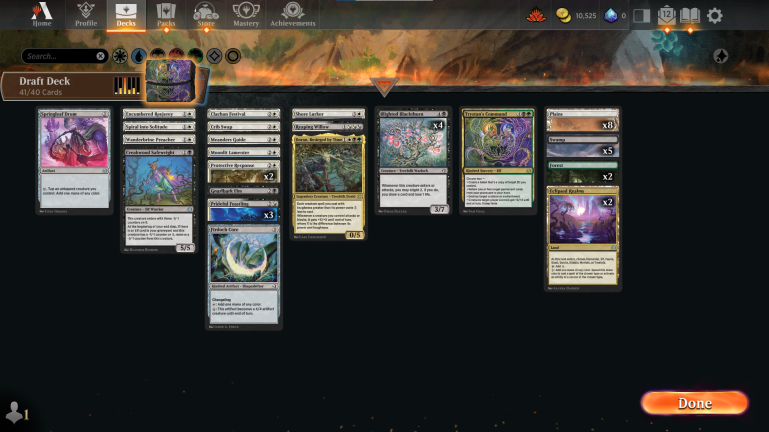
Moonlit Lamenter and Reaping Willow are your key payoffs, drawing cards and reanimating stuff respectively. Using Willow to reanimate a Lamenter is one of the most satisfying plays to make in Lorwyn Eclipsed, and it’s not even that difficult to pull off. When it comes to “reloading” your happy little trees with fresh -1/-1 counters, Blighted Blackthorn is the common you can’t get enough of. Even if you never find a spot to attack, Blackthorn is a 3/7 blocker which cantrips on ETB and also draws another two cards (if it blights Lamenter) or reanimates a three-drop (if you blight Willow). Talk about a mythic common!
WR: Giant Blight Aggro
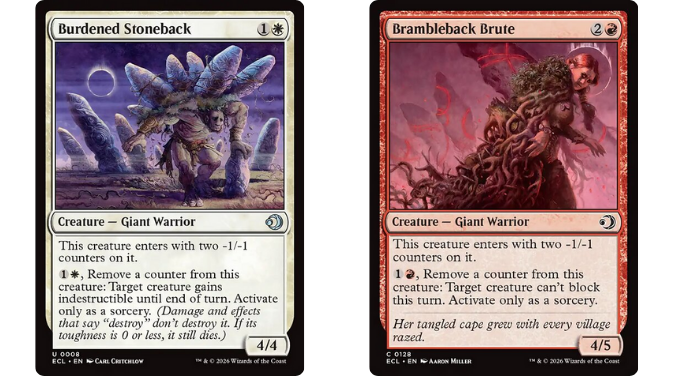
Much like the WB deck, your creatures in RW start small with -1/-1 counters on them, and then remove those counters to pay the cost of their abilities. But instead of looping counters to fuel an endless grinding value engine, you just remove them all ASAP to swing with bigger stats while getting some bonus utility on the side. You can make it even harder to block by buffing your giants with Evershrike’s Gift or Hovel Hurler to help them fly, and with Impolite Entrance or Soulbright Seeker to give them trample.
Since the focus is on efficient beatdown, I wouldn’t focus too much on having ways to constantly “reload” the -1/-1 counters on a Brambleback Brute. But when you have cards like Chaos Spewer or Cinder Strike which can reduce costs or improve effect by blighting, then having these giants as -1/-1 counter sinks can be very profitable.
I should also mention the only giant typal support card in the set: Boldwyr Aggressor. This is a great example of a potential win condition you can speculate on if you’re in red, green, or just expect to play a lot of changelings. Aggressor is better in the vivid deck than here, but she’s still a great curve-topper choice for the deck alongside (and in combination with) Hovel Hurler.
UR: Elemental Big-Spell Midrange

UR Elementals feels like a mechanic-centric deck with a strong typal subtheme. The issue I have is that I can’t always figure out which mechanics I’m meant to be centering! Most of the UR elementals focus on “cast a spell with mana value four or greater” triggers, which means we should be looking at a top-heavy curve and a lot of discountable or alternative costs to help trigger those cards more often without making the deck unplayable.
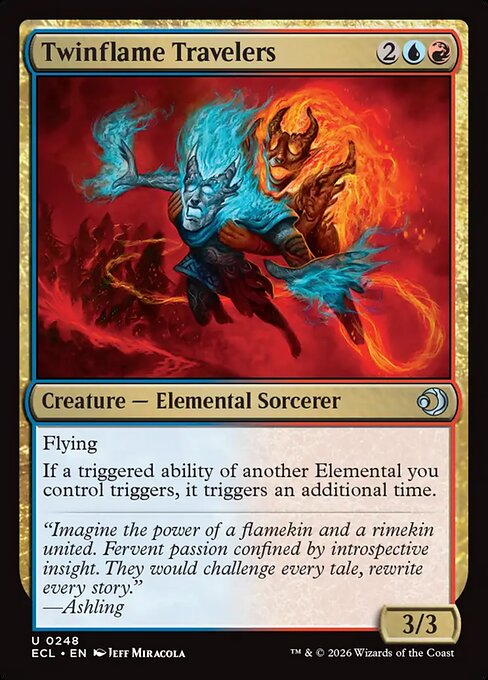
But there’s also Twinflame Travelers – one of the highest rated elemental cards, and one which specifically doubles the value of triggers from other elementals. If you go browsing through the list of elementals with triggers, some of your best options are Shinestriker or Explosive Prodigy. So should you also bend over backwards to try and play some extra colored permanents to up THEIR value? Of course the answer is: it depends!
Playing UR is a good way to quickly practice the flexible mindset required by Lorwyn Eclipsed Draft, because basically every draft becomes the “figure this out” scenario you’re hoping to avoid with other decks. If you get several Boldwyr Aggressors and Explosive Prodigy, you can flex into vivid and pick up other giants/changelings. But other different starts could lead to completely different approaches: aggro around Soulbright Seeker, instant-speed control around splashed Faerie cards, convoke pile alongside merfolk.
RB: Goblin Typal Aggro
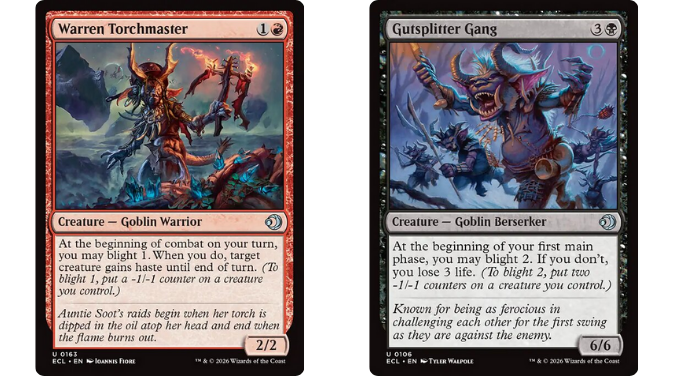
The goblins of Lorwyn Eclipsed are another blight-based creature deck, but they leverage the mechanic quite differently to their WR and WB cousins. Instead of trying to place counters on creatures to fuel their activated abilities, RB uses them to put a twist on the very recognizable “aristocrats” or “sacrifice aggro” playstyle. Effects like Gristle Glutton or Warren Torchmaster are a little minor to be worth sacrificing a whole creature, sure… but what if you could sacrifice half a creature? That’s basically how blighting works in this deck – you either sacrifice a tiny goblin, or you sacrifice a chunk of stats off a more important card, and that’s how you pay the costs on your army.
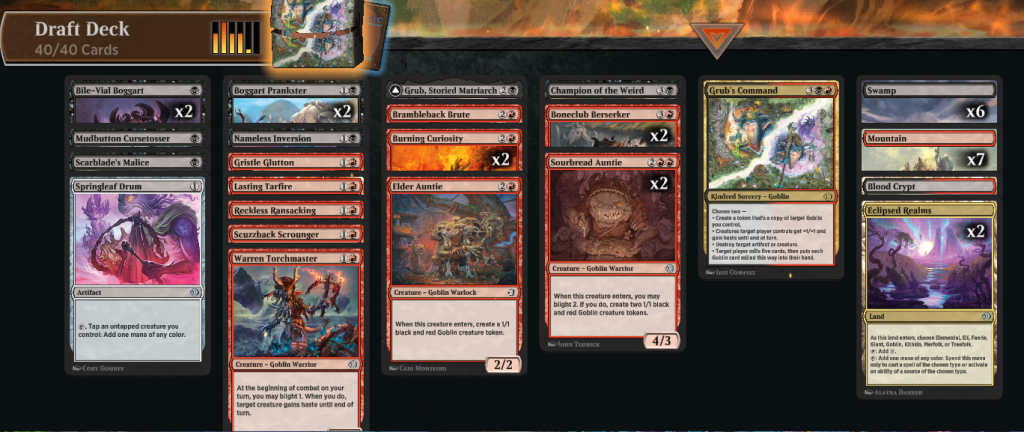
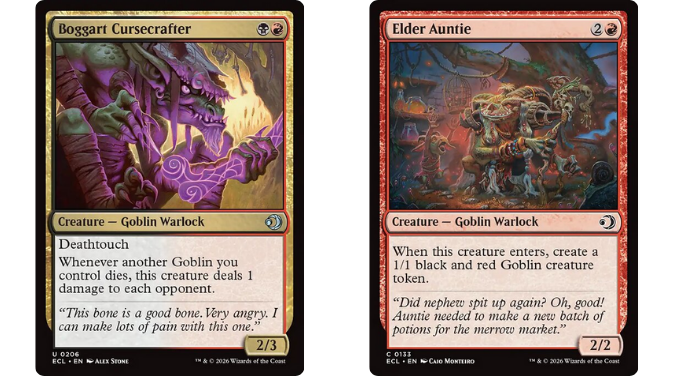
The biggest challenge with goblins isn’t usually getting in – their early game is great, and backed by lots of cheap removal. But how do you close out the game once opponents get big blockers down to stem the bleeding? If you can’t assemble the means to challenge them with a huge Gutsplitter Gang or Boneclub Berserker, you may need to rely on direct damage sources. Fortunately, Boggart Cursecrafter and Boggart Mischief can combine with Lasting Tarfire to really sizzle away the last points of life fast – assuming you get the time to set it up.
WG: Kithkin Typal Aggro
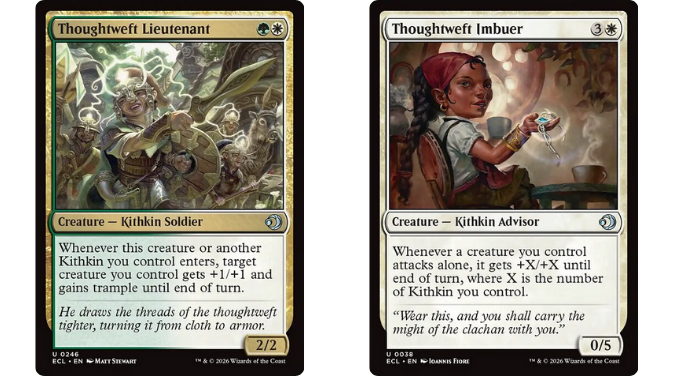
GW Kithkin may not be bad (in fact its statistics are quietly very good) but it is a lot less intuitive to build and play than merfolk or elves. A classic GW go-wide deck at first glance, in practice this deck wants to keep attacking with one huge creature a turn and stonewall the opponent out of the game with the rest. Thoughtweft Imbuer deserves special credit here as one of the most aggressively-taken uncommons in ECL and a super-high-impact card which swings most games where it is drawn.
If I was trying to advise someone who was super-determined to play WG in their first draft, I would honestly say to try and avoid most kithkin typal cards and just pick whatever makes your deck strongest. It just so happens that for this deck that’s often something like Moon-Vigil Adherents (an honorary Kithkin in my book) or Pummeler for Hire.
If you can’t win quickly, then the game will likely stagnate into a board stall. Kithkin lack the direct damage of the goblin decks, so if things go late you’ll be turning to flyers and other evasive damage instead. Kithkeeper may be hideously expensive, but it does convert “wide boad” into “flying damage” in exactly the way you need for such scenarios.
BG: Elf Typal Midrange

The elf deck is neck and neck with UW Merfolk for highest overall card quality and depth of toolkit, to the point that its biggest weakness might be the difficulty of finding an open lane for it. The worst elf creature in this set is still a substantially more useful card than many kithkin, goblins and elementals, meaning you have plenty of options to pick from as you sculpt a tidy, consistent mana curve. Having so many abilities which grant additional stats is perfect for the “swing with my biggest thing” dynamic favored in this set, and the efficient bodies mean you can consistently apply pressure on offense or threaten hard trades on defense.
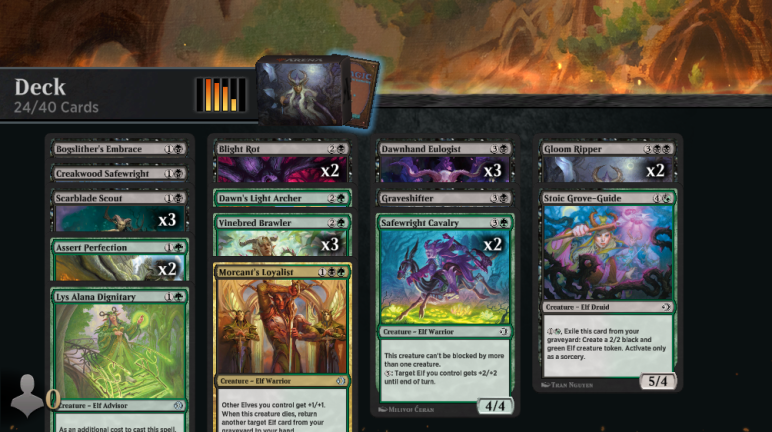
The other specialty of these elves is self-mill, and while there’s only limited access to actual reanimation in ELC you have a ton of ways to recur milled elves to hand: Dawn-Blessed Pennant, Graveshifter, Morcant’s Loyalist, or Unbury. You could also just leave the bodies lie, since having a fully-stocked yard powers up some of your best finishers in Morcant’s Eyes, Moon-Vigil Adherents and Gloom Ripper.
Despite the strong typal flavor, remember that only a handful of cards exclusively synergize with elves, and most of the time you’re building more of a generic GB midrange deck. Don’t deprive yourself of a powerful card like Retched Wretch or Glister Bairn just because it doesn’t fit the deck’s theoretical identity!
URGx: “Five-Color” Vivid
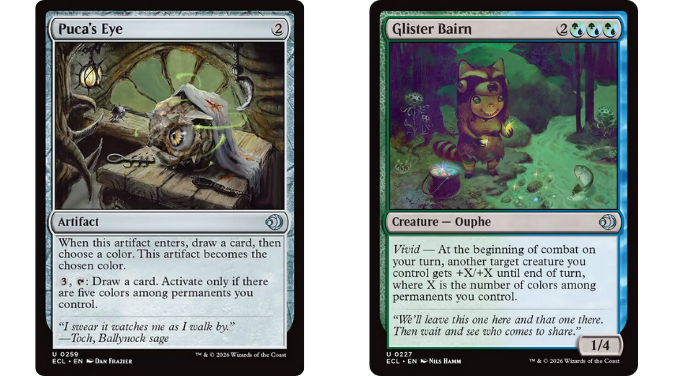
With so much of this set’s fixing concentrated in Temur colors, along with so many of the elemental creatures that benefit from the vivid mechanic, most drafters seem to instinctively identify that the “five-color vivid” deck, if there is one, should start here.
I’m actually of the opinion you don’t need more than 3 colors in your manabase for this archetype, since hybrid mana costs and “choose a color” support cards make it reasonably easy to get to “vivid five” without actually needing a splash. You also don’t need all five colors of permanents in play to make most of the vivid effects good: it’s really just for Puca’s Eye card draw (and to show off that you can).

Because of the common overlap between ramp cards and fixing cards, and because most of the great vivid threats are expensive, we also need to approach this as a type of ramp/”good stuff” deck. Shinestriker, Squawkroaster, Glister Bairn, Wildvine Pummeler and Prismabasher all cost substantial amounts of mana, and you’re gonna need a couple of them in play to really start throwing your weight around, so jumping up to the five-seven mana range early will stop you bleeding out too much before you get a chance to stabilize.
ECLIPSED AND LOVING IT
I was a little nervous hearing the mixed initial feedback for Lorwyn Eclipsed, and it did take four or five draft runs for me to dial in my card evaluation and sense of how fast games can go. But now that I’m caught up, I’m really enjoying the depth and freedom the format has to offer.
The dual nature of half typal, half non-typal archetypes is a great way to capture the lore and mechanical history of the Lorwyn and Shadowmoor blocks. Combining them into the one metagame seems ambitious, but thanks to some canny design choices in how the typal themes are implemented, there’s enough overlap for deckbuilders to mix and match different themes in new ways every draft.
It almost makes me want to see a Lorwyn/Shadowmoor Remastered product to try and carry over a similar format philosophy to the original typal set and see how well it sticks! But that idea can wait – for now I’m in no rush to call time on this visit to Lorwyn anytime soon!
Thanks for reading
BONUS: Top 5 First-Pack Common/Uncommons in Each Color
White: Thoughtweft Imbuer, Protective Response, Moonlit Lamenter, Crib Swap, Pyrrhic Strike
Blue: Voracious Tome-Skimmer, Blossombind, Glamermite, Rimekin Recluse, Glister Bairn
Black: Bogslither’s Embrace, Graveshifter, Iron-Shield Elf, Auntie’s Sentence, Blighted Blackthorn
Red: Cinder Strike, Warren Torchmaster, Boulder Dash, Kulrath Zealot, Sizzling Changeling
Green: Assert Perfection, Dundoolin Weaver, Moon-Vigil Adherents, Mistmeadow Council, Dawn’s Light Archer
Multicolor: Every “Eclipsed” creature!

Tom’s fate was sealed in 7th grade when his friend lent him a pile of commons to play Magic. He quickly picked up Boros and Orzhov decks in Ravnica block and has remained a staunch white magician ever since. A fan of all Constructed formats, he enjoys studying the history of the tournament meta. He specializes in midrange decks, especially Death & Taxes and Martyr Proc. One day, he swears he will win an MCQ with Evershrike. Ask him how at @AWanderingBard, or watch him stream Magic at twitch.tv/TheWanderingBard.