

Some among you may have noticed this already, but Marvel Super Heroes is an awesome-looking set!
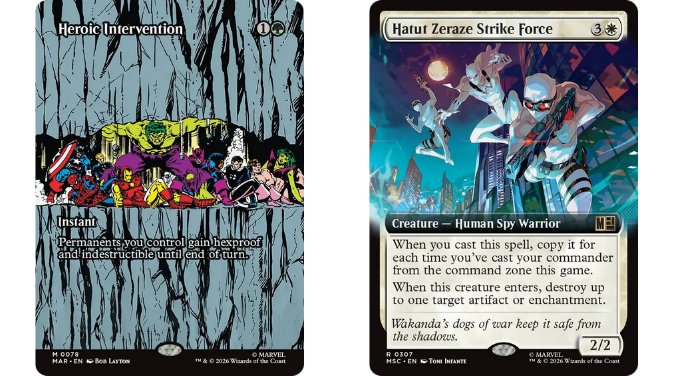
It’s vital for any Universes Beyond set to have card treatments and art styles that evoke the associated IP, and make the cards more exciting for fans to collect. And between the main Standard set, Project Booster Fun add-ins, four Commander precons, a Jumpstart set and more, Marvel Super Heroes certainly has a lot of room to print these crowd-pleasers.
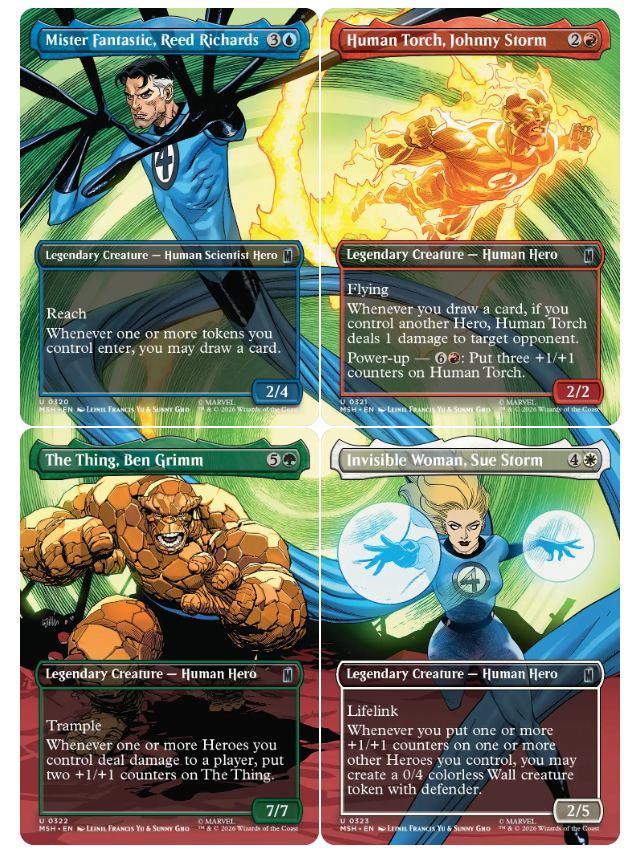
The Thing, Ben Grimm | Invisible Woman, Sue Storm
However, none of these special printings standout quite as much as the “Scene Card” variants. These eye-popping jigsaw pieces look great alone, but really come together when you can assemble the full set to capture a dramatic comic-book showdown.
ARRIVING AT THE SCENE
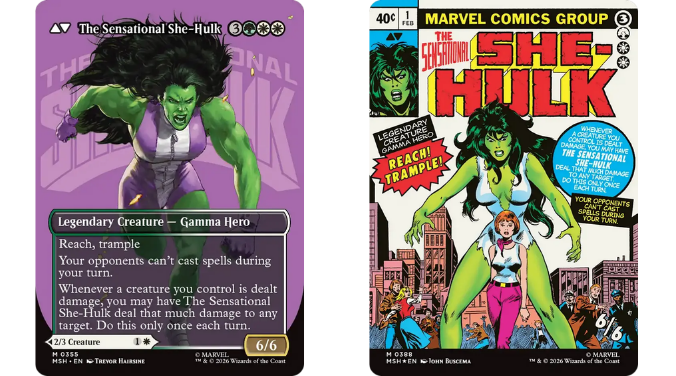
It’s fair to ask makes these scene cards important in a set already overflowing with cool artwork? The easiest answer is variety: it’s another unique-looking treatment for some of the most popular characters in Marvel Super Heroes. Why choose between different iconic depictions of She-Hulk or Captain America when you can just print a different showcase version of the card for each one?
At some point though, just giving fans more stuff to collect feels a bit uninspired. There’s no doubt that Wizards wants these sets to connect with the audience of non-playing collectors who generate strong sales for Pokemon and other IP-based card games. These fans don’t really care how powerful a card is on the tabletop. But is there a way to give cards more utility as collectibles?
It’s a different kind of design challenge from what Magic’s used to, but I think scene cards are a very insightful answer.
What collectors value is having specific goals to chase while collecting the set, and being able to display their cards in ways that look cool. The Nazgûl from The Lord of the Rings: Tales of Middle Earth are a great example of setting up goals for collectors.
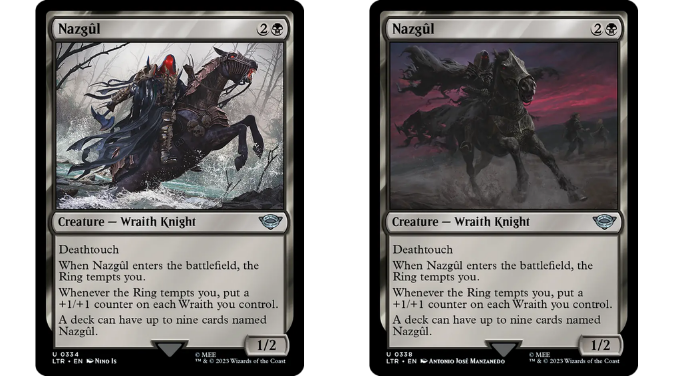
It certainly wasn’t necessary to print nine different artworks for this uncommon. Seven Dwarves only got the one card art despite its similar premise, and Nazgûl isn’t the most exciting or powerful card to play with, even in a themed Commander deck. But as soon as people realized that there was the potential to assemble a “full set” of nine unique Ringwraiths, the different versions became some of the more valuable and sought-after cards in the set!
Wizards seized on a prime opportunity there, but not every Universes Beyond crossover is going to feature a natural opportunity like the Nazgûl or Cid, Timeless Artificer.
Scene cards are the cheat code: a way to elegantly create these goals or opportunities for collectors within any set, using any cards, by the simple expedient of their connected artwork.
SELLING THE CONNECTION
Okay, perhaps it’s wrong to say that Wizards could use ANY set of cards as part of a scene. It’s all in the name. Collectively, the subjects of the cards should be recognizable to fans as a “scene”: either literally recreating one from the original IP, or at least as one which feels like it could happen within the lore.
Marvel Super Heroes definitely understood this part of the assignment when putting together its scene cards. The mechanical design of the set takes pains to honor the connections between specific characters (see last week’s article about deckbuilding with different super-teams). Scene cards satisfy that same fan desire outside of gameplay, creating collector goal for fans of specific comic titles like Fantastic Four or Daredevil.

Elektra, Daughter of the Hand | The Kingpin of Crime
I particularly love how these scenes feature both heroes and villains in a single tableau. The fated pairing of a supervillain and their arch-nemesis hero is always the most interesting relationship in comic books. But it’s hard to portray that enmity through card mechanics because it feels weird these enemies to “work well together” on the battlefield!
Scene cards provide an opportunity to honour these connections which mean so much to the identity of the characters involved. Likewise, being able to single out characters from the same comic creates the chance to pay homage to some of the iconic art styles and even specific art panels from Marvel history.
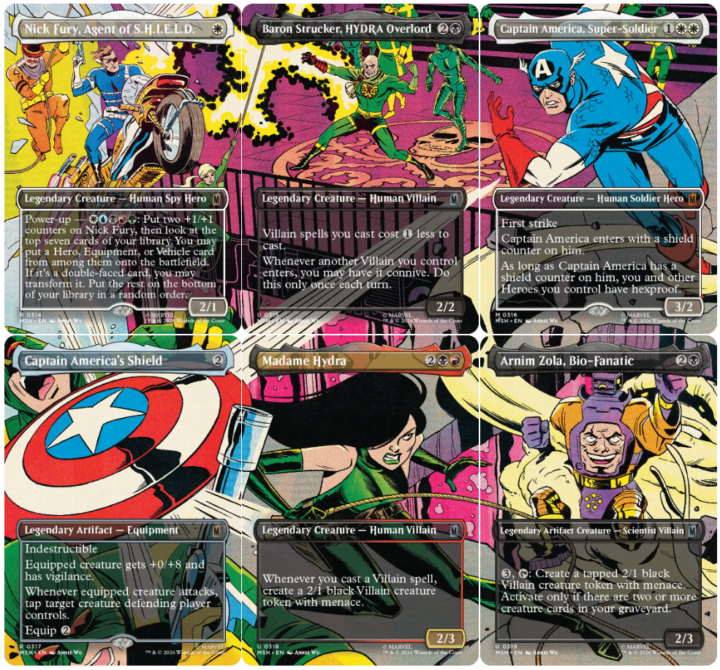
Captain America’s Shield | Madame Hydra | Arnim Zola, Bio-Fanatic
The Captain America scene cards channeling the character’s colorful Silver Age style are probably my personal favorite in this whole set! Annie Wu’s “Cap Versus HYDRA” so perfectly captures the best parts of his identity. It just makes me sad that there’s no Red Skull card to complete the scene – but there was clearly a decision to focus on other H.Y.D.R.A villains in the set, probably for the same reasons there’s no card recreating the iconic image of Cap punching out Hitler.
It’s equally interesting to see some of the other scene cards utilize a more realistic, even cinematic art style. The details and lighting of the “Hulks Smash” scene feels evocative of a glossy collected edition or MCU film. It helps that this depiction of Hulk has some resemblance to the way he’s animated in more recent Marvel movies.

The Incredible Hulk | HULK SMASH! | Abomination, Terrifying Titan
I’m mostly surprised that it was the Hulks of all comic book “families” which were chosen to be illustrated this way. Red Hulk and Leader are some of the most exaggerated, literally cartoonish character designs you’ll come across, and it’s hard to lavish such detail on them without it starting to look silly. Shoutouts to artist Adi Granov for pulling it off – and also giving each of these musclebound monsters their own unique silhouette when they could so easily blend together.
Besides the Heroes United boxed set, this scene is the one most likely to have the cards all be playable in the same deck (or all except Leader), so you might even be able to re-assemble this epic scene artwork on the battlefield!
UN-SCENE POTENTIAL
Scene cards have been around before Marvel Super Heroes, but this set definitely does way more than any before to try and explore their potential. Having six different scenes to collect across the main set is already ambitious.
But Wizards weren’t done yet: they wanted to experiment with the idea of scene cards as a standalone product.
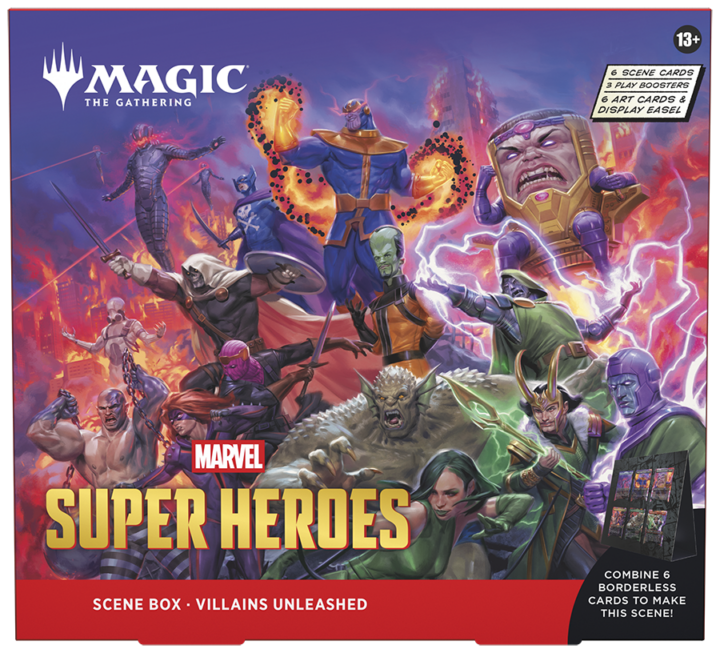
This might sound counterproductive, at least when it comes to the idea that scene cards make sets more fun to collect. You don’t really get that thrill of hunting down the necessary pieces when you buy all the cards in one box, after all.
But what if someone actually does just want to own and display a cool Magic card tableau in a single purchase? I’m sure at least some Marvel fans just want something nice to display – playing the booster pack lottery certainly isn’t a prerequisit for obtaining most other merchandise.
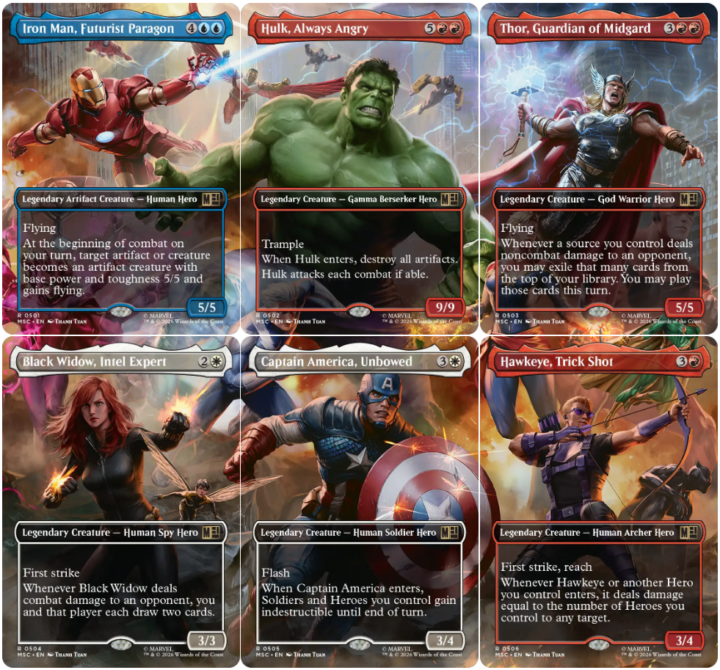
Black Widow, Intel Expert | Captain America, Unbowed | Hawkeye, Trick Shot
These scene boxes also seem like an ideal gift idea for anyone in a collector’s life who wants to get them something related to their hobby. I can say from my own experience that it’s often difficult for loved ones not also versed in Magic to feel confident about buying cards even if they have a detailed wish-list to work off. But a one-box, visually appealing display of cards with Marvel’s most famous characters will surely feel like a bankable option even for your most out-of-touch relatives.
I like that Wizards decided to have these boxes contain unique scenes made up of all-new cards, instead of just reusing or re-illustrating scenes that exist in the main set. Even if they used different artwork, I feel like making the whole scene available in a boxed set would really dampen peoples’ excitement for collecting the pieces normally.
Designing mechanically unique cards for these scenes also does a lot to broaden their appeal, giving Magic’s primary audience of actual game-players their own reason to want these boxes. By far the most ambitious scene in this set is “Clash for the Cosmic Cube”, an 18-card Johan Grenier masterpiece!
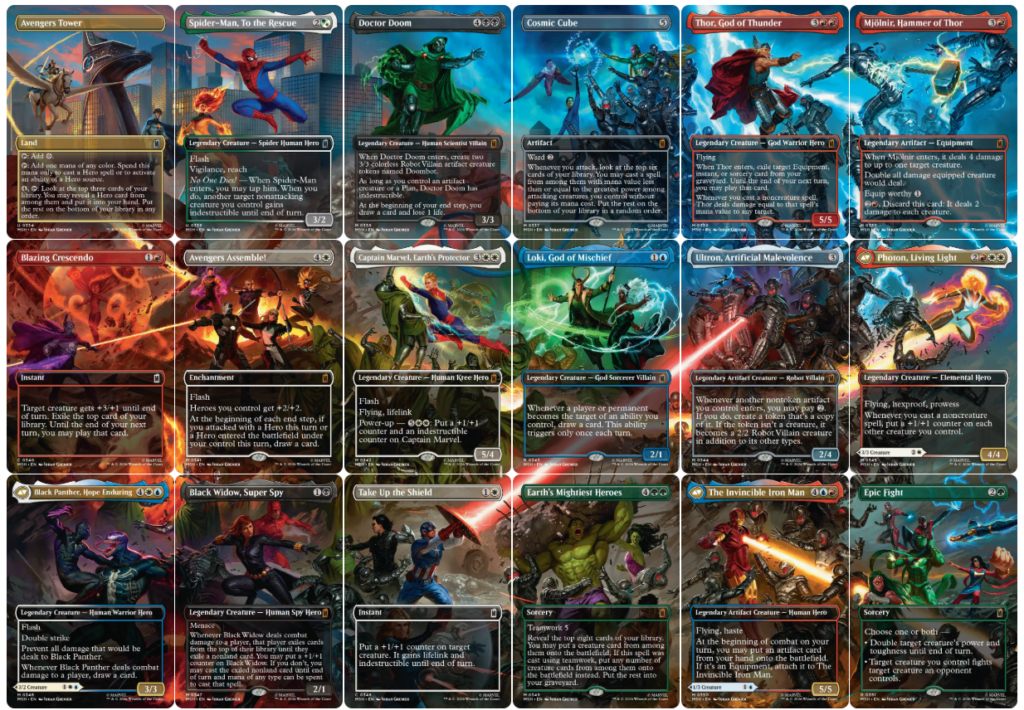
The gigantic scene incorporates not only legendary heroes and villains, but instants, sorceries, a land, an enchantment, and an artifact (the Cosmic Cube itself). The dense action of the battle and its sheer scale makes this more like a mosaic of smaller two- and three-card scenes; the viewer’s eye tracing the arcs of Thor’s lightning or Ultron’s death ray from one fight to the next.
There’s actually even more detail hidden in the scene’s dual-faced cards: their front sides form a more lighthearted bonus scene showing dinnertime at Avengers Tower.
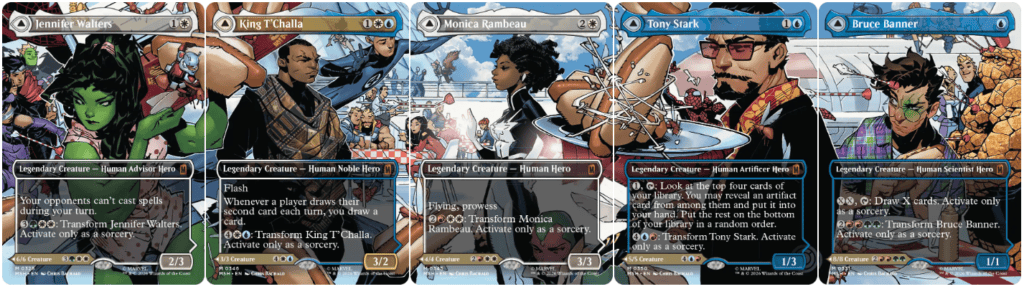
Besides its other virtues, “Clash for the Cosmic Cube” might be the best example of something I feel was done right across all the Marvel Super Heroes scene cards: ensuring all the component cards still look right on their own.
I’m sure it makes planning the composition much more annoying for the artist, but the clever choice to insert extra heroes and evil footsoldiers into the art of each card saves the weirdness of having to force all the action into a neat grid. And with a few more clever decisions about where each card slots into the finished piece, you can ensure those individual cards feature the right backgrounds and poses to “feel right” as standalone pieces.
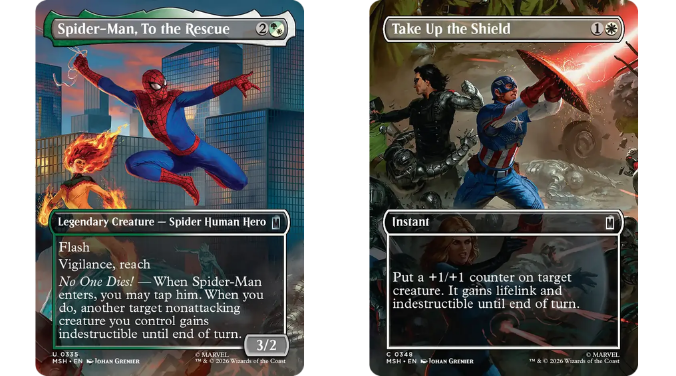
Spider-Man is still framed against a city skyline. Thor and his hammer are wreathed in brilliant lightning. Take Up the Shield features Captain America literally raising his shield to block the deadly beam fired by Ultron two cards away. It’s already the biggest and baddest scene card arrangement we’ve ever seen in Magic, but when you consider how much thought has gone into balancing the art direction of individual cards against the whole, it becomes a truly impressive display of this format’s potential.
I’VE SCENE THE LIGHT
All puns aside, Marvel Super Heroes has really made me sit up and think seriously about the purpose and power of scene cards. I’ve always had a strong appreciation for Project Booster Fun and the general push to make fancy, cool-looking Magic cards available to those who enjoy them – even if I wouldn’t call myself part of that group.
It’s undeniable that this renewed focus on collectability and visual appeal has helped drive the growth of the game in the past half-decade, and Universes Beyond sets are where such efforts make the biggest impact.

Personally, I like the idea of incentivizing collecting that doesn’t just focus on cards with the highest market value. The one-of-one One Ring card and serialized printings of cards have their place, but by definition they will only ever be accessible to a small fraction of Magic’s audience. Scene cards give anybody an opportunity to enjoy going on a collector’s journey and ending up with something notable and cool to display for it – whether that’s in a commander deck, or framed on their wall.

Tom’s fate was sealed in 7th grade when his friend lent him a pile of commons to play Magic. He quickly picked up Boros and Orzhov decks in Ravnica block and has remained a staunch white magician ever since. A fan of all Constructed formats, he enjoys studying the history of the tournament meta. He specializes in midrange decks, especially Death & Taxes and Martyr Proc. One day, he swears he will win an MCQ with Evershrike. Ask him how at @AWanderingBard, or watch him stream Magic at twitch.tv/TheWanderingBard.