

I hate to hand it to Jace Beleren under these circumstances (or ever), but Reality Fracture is a really incredible set. That goes for Limited too. We’ve had a couple of planeswalker-focused draft formats before, but it’s still a rare treat – and none before have done it quite like this.
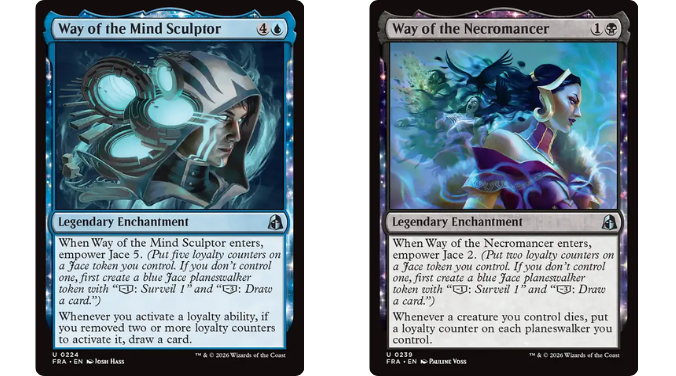
Leaning into his worst self as “The Theorist”, Jace’s unhinged scheme to rewrite reality is even affecting booster packs, where legendary creatures have become entangled with their Echoverse counterparts. It’s a lot to get your head around – so read on and absorb our Card Kingdom guide to Reality Fracture Draft.
SHAPE OF THE FORMAT
Compared to most other Limited formats, Reality Fracture feels quite slow-paced. This seems fitting and probably inevitable in a planeswalker-focused set. For that premise to work well, you need to give planeswalkers time to make their impact felt and space for them to not die.
Be aware then that creature stats are below average and worse, unevenly distributed. Having more creatures be 4/1s and 1/4s instead of 2/2s and 3/3s makes it hard to find “safe” attacks. When even cheap creatures can trade up and destroy those several times more expensive, it makes blocking stronger since it’s the defending player who chooses those trades.
This is also a set where you really feel a meaningful gap between “big” creatures and the little ones, with not as much in between. Four toughness is a breakpoint where you become safe not just from No Admittance and Last Gasp, but the vast majority of creatures below five mana!
There is removal for these large creatures, but it always seems to come with drawbacks and conditions. It doesn’t feel great to give opponents a card with Prophesied End, or for Multiply by Zero to not cleanly answer a creature with +1/+1 counters on it… and those are the good options. It still feels necessary to take as much removal as possible though, big or small, since there’s so many nasty utility legends in the set.
Every booster pack contains at least three legendaries (a matched “normal vs. echoverse” pair plus a third one) and even those which aren’t major combat threats are usually something you don’t want to let opponent’s keep alive for too long. You’ll have to make some tough decisions about target priority – a skill which will also be tested by the constant presence of planeswalkers.
ONE MAN SHOW
Okay, “planeswalkers” might be a bit of an exaggeration: there’s really only one who matters most of the time. With how the plotline for Reality Fracture plays out, this may well be the last set to feature Jace Beleren, one of the iconic faces of Magic. The designers wanted to make sure nobody left this format wanting more Jace – and that’s where the “empower Jace” mechanic comes in.
Whenever a spell effect instructs you to “empower Jace N”, you create a Jace planeswalker token with N starting loyalty. The token Jace always has the same abilities, and because it’s a planeswalker you can’t control more than one of him; if you already have a Jace token when you empower, you put N loyalty counters on the existing token instead. Note that you can’t use this to empower extra loyalty onto nontoken versions of Jace, even though he has two actual planeswalker cards in Reality Fracture.
We’ve never seen planeswalker tokens and loyalty counters being generated as often or as easily as this, and the biggest challenge in Reality Fracture Limited is figuring out how to evaluate and prioritize these Jaces. Normally the common wisdom is to kill planeswalkers on sight, or protect them jealously if they’re yours. But a token Jace only has two abilities: surveil 1 and draw a card. Neither of them affects the board directly or increases Jace’s loyalty.
This means that leaving a Jace token in play doesn’t necessarily benefit its controller: either he draws you cards now, or he draws you the same amount of cards later. Yes, additional empower Jace effects could increase his loyalty, but killing the current Jace doesn’t prevent that. Future empowers will still create a Jace, it just won’t have any holdover loyalty from the token you killed.
All that said, not being able to stop Jace permanently doesn’t mean there’s never reason to swing at him. A lot comes down to the math around his current loyalty: if putting a few points of damage into him will knock him below the three counters he needs to draw a card, then that might be worthwhile. This is slightly complicated by the cycle of “Way of” enchantments, which grant token Jace (and any other planeswalkers you control) various new loyalty abilities.

There’s also occasional value in just having any planeswalker around, even a one-loyalty Jace token. It makes the common two-color lands in this set enter untapped, it can fuel green fight spell even if you’re creatureless and you can also sacrifice a planeswalker to cards like Silence the Echo.
Even after writing this guide I’m still asking myself when it’s actually right to swing at Jace, so don’t worry if it’s hard to figure out on your first Draft. When in doubt, just ignore him and hit the opponent in the face.
COLOR THEORY AND ARCHETYPE BREAKDOWNS
Like most sets, this set is fundamentally designed around two-color archetypes, with a bit of extra flexibility in the form of hybrid mana costs. However, the mechanical themes cards care about seem to have their support spread across three colors each.
For example: white-green has the payoff cards for lifegain, but black actually has the most ways to gain life and trigger them. Blue-black advertises itself as the self-mill aggro deck, but white has a lot of recursion and abilities you can activate from the graveyard. Leaning more towards a true three-color deck will make these synergy packages more powerful and consistent – but you’re limited by how much fixing you can acquire, especially in more aggressive decks.
Reality Fracture does feature a lot of ways to ramp your mana, but not quite so many to fix it (unless you specifically need red or green). My advice is to try and gravitate towards a specific color pair early and simply draft strong cards that you can cast. Most of these synergy cards are designed to be solid contributors even with zero additional support. But if you find yourself contested or you simply open a million off-color bombs in Pack Two, be prepared to turn one of your colors into a splash and continue drafting the same gameplan in an adjacent color pair.
WU: Surveil and Scry Control

Each allied-color pair in Reality Fracture features a specific college from Hexhaven: the Echoverse counterpart of Strixhaven. Where Strixhaven encourages individuals to develop their diverse talents, Hexhaven colleges teach every student the exact same magic. That means every Strixhaven creature from that college casts the same prepared spell, which is a useful indicator of what that color pair is trying to do.
The white-blue college is Fatehold, the “school of Future History”. Their prepared spell, “Peer Review”, neatly covers both their major mechanical themes: it produces a Cadet creature token, and it surveils. As we covered earlier, this is not a set where it’s easy to attack into a mass of small creatures. Building board presence while improving your next draw is an ideal “holding pattern” play, and either part might generate additional value from cards like Prudent Fateseer or Proft, Consulting Detective.
Don’t get too hung up on hunting for these kinds of synergies though – the mechanical themes in Reality Fracture aren’t actually that well supported in the card pool and tend to just be a nice luxury on good cards you were already going to play. If you do have a deck full of Desperate Futurescribe and Surveillance Phantasm, remember that your main source of surveil is the empower Jace token: you can easily run the -1 every turn with the help of cards like Mindseeker Oculus and Academic Ascent.
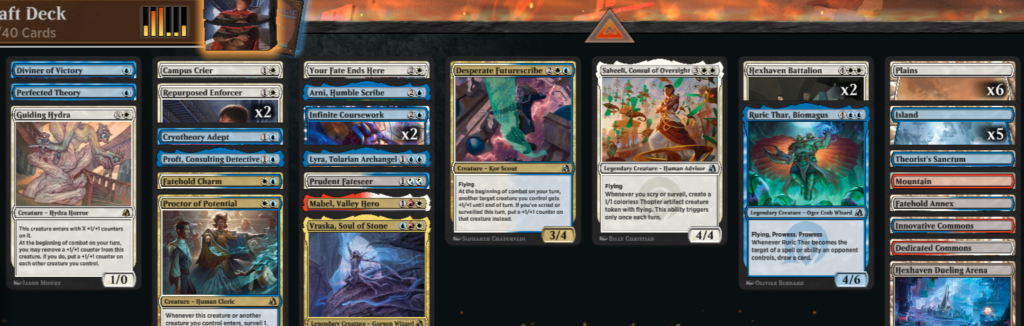
Your win condition is flexible and depends on what you open. Multiple Hexhaven Battalions or a splashed Recursive Recruitment can let you play for lategame, as a wide board of pumped tokens is hard to defend or attack into. Otherwise, you might need to play for opportunistic damage through the air, or tempo them out with Unsummon and combat tricks.
WB: Aristocrats Aggro

Since the enemy-color pairs don’t match Hexhaven’s colleges, their cards have a more diverse aesthetic: simply combining heroes and villains from across the multiverse. The mechanical theming is still tight though. For WB, that theme is a small-creature aggro deck which uses its expendable minions both as attackers and as sacrifice fodder. This strategy is commonly called “aristocrats” since the creatures which do the sacrificing are usually nobles – and often the vampiric kind, as the case is here with Edgar, Ancient Bloodlord.

Ideally, WB starts fast and scores some free attacks with Gallia, Tragic Host or even just a Rank Rat – we’re all about the small increments here. It’s usually worth spending removal on mediocre blockers or offering the opponent the chance to make favorable blocks if it means getting in for an extra three or four damage at this stage of the game. Soon enough though, opportunities to attack straightforwardly with 1/1s and 2/2s will dry up. Then the little bodies become a wall, slowing down any potential counterpunch while you chip away at their remaining life using flyers and direct damage.
If you don’t have the tools to bleed them out there are other ways to ensure inevitability: accumulating counters on either Danitha or Unflinching Hortimancer, using sacrifice engines to loop Gallia and Blessed Ghoul, resetting enters triggers with Rescue Girl, and so on. Whichever one you’re working with, lowering the opponent’s life total early is what forces them to play slow and scared, which is how you buy time to grind them out – make sure you draft enough aggressive cards to create that pressure.
WR: +1/+1 Counters Aggro

It’s really stretching the definition of “theme” to call this a +1/+1 counters deck; for the most part, it’s just classic RW aggression. While a lot of red and white creatures can gain +1/+1 counters, there aren’t really any game-winning synergies with them. There’s not even many extra ways to benefit from inflating a creature’s stats, unless you splash green for Ghalta and other sources of trample.
That doesn’t mean the +1/+1 counters aren’t key to RW’s game, however. Reality Fracture is not a great set for combat tricks, with only Academic Ascent and the expensive Charge the Sanctum actually offering the keywords to avoid or discourage blocks. That means forcing through damage relies on a more gradual process of stacking counters until most of your army outsizes theirs, then using removal to pick off their last good blocker or two and smashing in. All-creatures pump effects from Winter, Team Player or the first mode of Charge the Sanctum can also become a win condition if you end up going wide instead of tall.
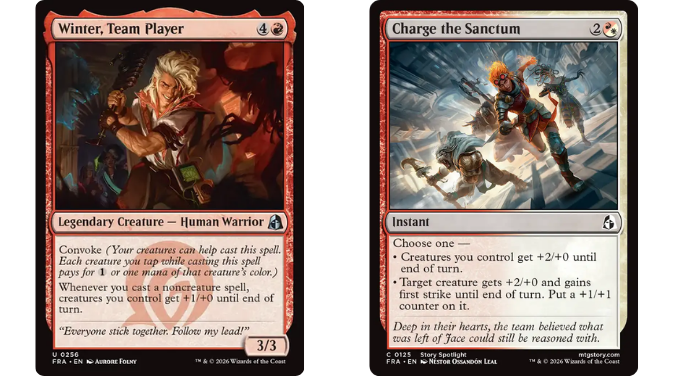
As is the rule for this format, a lot of your skill expression will come from identifying alternative win conditions and building around what tools (and colors) each draft gives you. Grab enough first strikers and you can actually make the combat trick plan work, since Blazing Crescendo becomes immeasurably better on those targets. Even weaker drafts can be redeemed in one or two picks if you’re able to re-strategize around inevitability engines like Command the Stage and Kiora of Fire and Ashes – WR’s exceptional removal makes a pseudo-control plan fairly viable even without a splash.
WG: Lifegain and Heroic Midrange
“Gee Vigorbloom, how come The Theorist lets you have two lines of synergy?”. Hexhaven’s unpleasantly-named “school of Invasive Healing” is all about upgrading your creatures, and they are NOT fussy about how they accomplish that goal. Hence, this archetype’s odd little mixture of +1/+1 counters (mostly generated by lifegain triggers), equipment, combat tricks and auras.
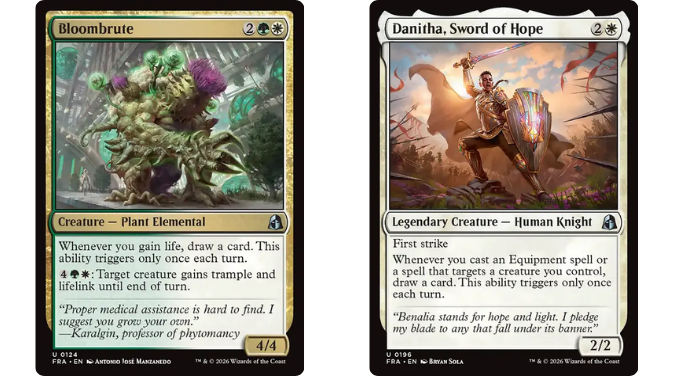
The real key to success is their powerful draw engines and mana sinks, which position WG to actually win the kind of long games their lifegain creates. Bloombrute and Danitha, Sword of Hope are the gold standard for this (remember that Vigorbloom’s signature prepared spell triggers is a one-mana Danitha trigger). But don’t overlook the potential for these colors to empower Jace for his -3 draw effect, or the many recursion and pseudo-advantage sources like Marwyn, the Preserver or Rescue Girl.

Vigorbloom’s lifegain theme is probably the most “real” of this set when it comes to density and quality of payoffs. If you’re trying to maximize Bloombrute, Titanbones, Way of the Mentor and Unflinching Hortimancer, remember to look for the cheapest, most repeatable lifegain sources. Repeated triggers like Screeching Soulbreaker and Way of the Paradox are best, then lifelinkers and creatures that prepare Seed Suture, and then cards which replace themselves like Vigorbloom Charm, Restore with Empathy, Something Worth Saving, and Surgical Precision. Note that many of these desirable effects are actually in black, and prioritize black-white or black-green fixing lands during your draft accordingly.
UB: Threshold Tempo

Theorix is the Hexhaven “School of Esoteric Mathematics”. “Esoteric” is apparently a polite euphemism for “so paradoxical the equations are deadly to both students and reality itself”, which is definitely some cool and inventive flavor for evil math-wizards. If you’re a fan of psychological horror, full-dive hacking in cyberpunk stories, or HORUS from the Lancer tabletop RPG, you will definitely enjoy the vibes on offer here.
Mechanically, this is another blue archetype where you’ll need to judge where each individual draft should live on the spectrum between “tempo aggro” and “grindy control”. Your Theorix-branded cards definitely lean aggressive: cheap and cheerful creatures which become extremely efficient once you accumulate seven cards in graveyard to turn on the threshold mechanic. Those same creatures have your best self-mill tool built in with their prepared spell, but good decks will make sure by playing lots of cheap interaction and cycling/looting effects.
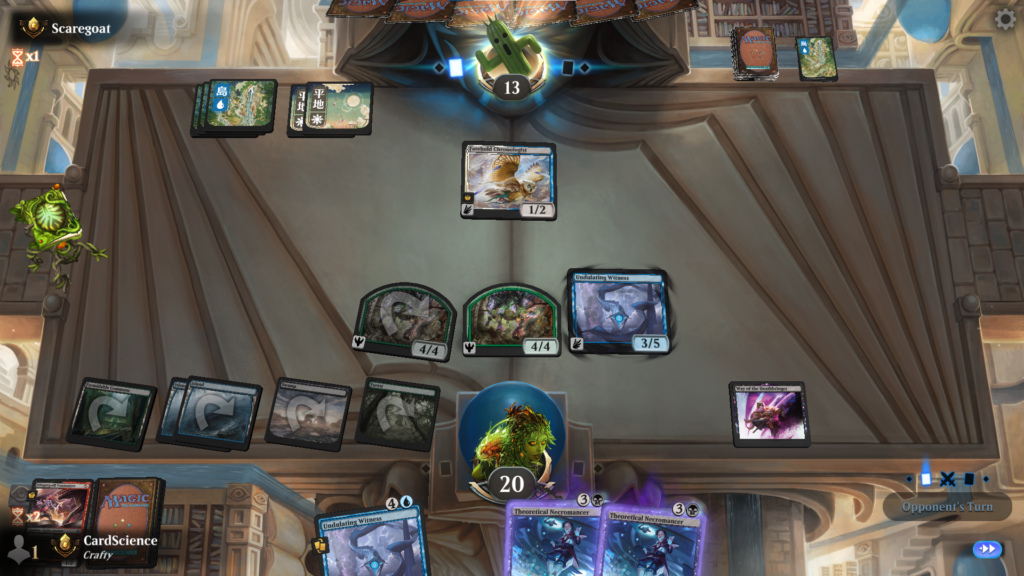
UB does not have a lot of cards which gain +1/+1 counters or deal direct damage, so like WB you’ll need a specific plan for how to finish games. I like options which make use of the various small creatures you usually have lying around after the opponent stabilizes to a board stall. Theoretical Necromancer and many of your other best commons are suddenly unblockable with Tetsuko Umezawa, Fugitive. There’s also Way of the Deathbringer, which feels like the sleeper card of the set so far: a 4/4 trampler is a premium threat in this format. Recursive Recruitment is slow and perhaps overvalued at this point, but incredibly hard to beat in multiple copies.
UR: Prowess Tempo
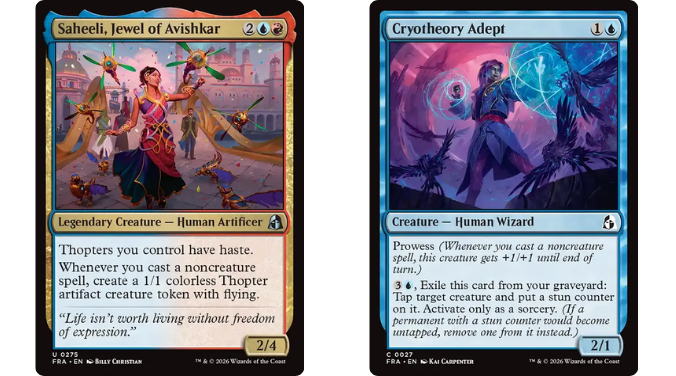
Another of the faster and more aggressive color combinations, so once again we’re going lightly on the central theme in favor of whatever cards will consistently apply combat pressure in the early game. Prowess as a keyword feels amazing in Reality Fracture, since creature stats are low enough for +1/+1 to feel big and there’s plenty of cheap noncreature spells around – three of the colleges’ prepared spells cost a single mana!
But prowess is not the only way to benefit from casting noncreature spells here. Saheeli, Jewel of Avishkar, Chandra’s Emberling, and Traxos, Academy Guardian all permanently increase the size of your attack force when you cast noncreature spells, which helps compensate for spending less mana on creatures overall. You can find more payoffs by expanding your search to anything that rewards consistent attacking and the overall “momentum” or tempo you’re relying on.
Fblthp, Impossibly Lost and Blazing Crescendo become excellent card advantage when you’re already committed to forcing unblocked attacks. Arni, Humble Scribe can help dig past bad topdecks and still untap to attack that turn (or untap to block if you play a creature in second main phase). Looting in general is very powerful since some of your best cards (Cryotheory Adept, Twinned Vision, Command the Stage) can be discarded profitably, and other cards like Jiang Yanggu, Alone will benefit from it.
UG: Empower Ramp

The design team decided to make empower an all-colors mechanic, so it’s hard to nominate a single color combination as “the Jace deck”. Nevertheless, UG is the most Jace deck, and that is definitely its intended identity, with several uncommons that convert a sufficiently empowered Jace into a win condition. The way you gradually build up extra buffs to your Jace token through various hard-to-remove enchantments ends up fitting very naturally into UG’s usual schtick of “crude accumulation”. You ramp mana, cast big permanents, use Jace to draw more cards to spend the mana on, and eventually your opponent is simply overwhelmed by the value of it all. In theory.
In practice, it doesn’t feel like the Jace tech quite works as your Plan A. Way of the Wildspeaker and Kiora of Salt and Sand are meant to be how you end games, but the loyalty costs to create tokens with them is just too high. This is especially true when you consider the need to consistently -3 Jace throughout the game, since Reality Fracture uses empower Jace to replace traditional draw spells you’d run in this archetype. It makes sense then that the actual game-winner among these enchantments is Way of the Mind Sculptor, which doubles the effectiveness of those -3s, but you still need other quality cards to draw with it.
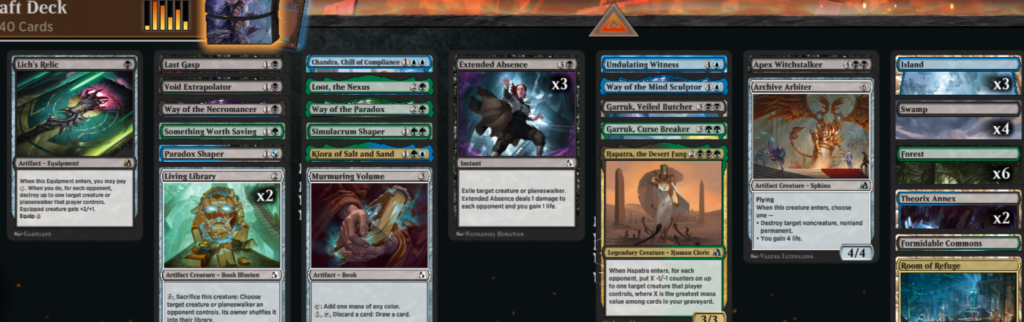
You’ll get best results with UG by just drafting “ramp spells plus payoffs” rather than tunnel-visioning on planeswalker synergies – except for if you’re lucky enough to pull multiple non-token planeswalkers to boost their value. But as seems to always be the case in recent Limited formats, UG is realistically more of a base for three-plus-color decks than a true standalone archetype. So, once you start including red sources in the form of Heartwood tokens, you might as well consider it a Temur draft and pick up some of red’s tasty bombs and removal.
BR: Direct Damage Aggro
It’s been a long while since we had a proper burn or direct-damage theme in Limited, so I’ve had an absolute hoot playing red-black in Reality Fracture. This isn’t just casting seven Lightning Bolts to the head though. Abilities that trigger when you deal noncombat damage force players back to a combat-centric aggro plan, rather than sitting back defensively while you burn them out. You also have more familiar abilities like prowess to promote this playstyle.
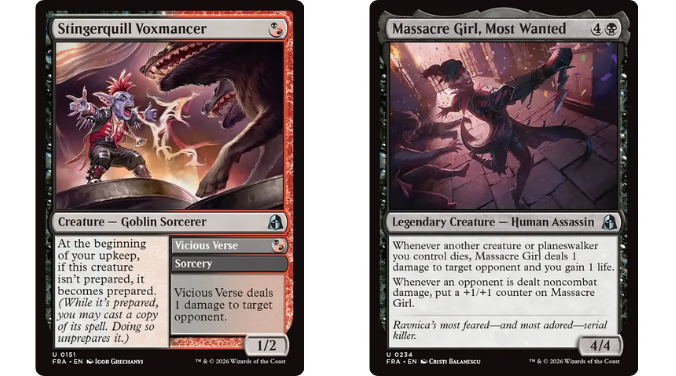
Stingerquill is known as the “school of Painful Words”, and Vicious Verse is its signature prepared spell for. While straightforward, it is more strategically essential than any of the other signature spells are for their colleges. For one mana you trigger all your other cards for the turn, AND deal some useful chip damage which can really add up if you’re casting it repeatedly from Stingerquill Voxmancer. Like lifegain in WG, you also want to priority pick other cards which deal damage for little or no mana investment: Koth, the Geomancer, Tetsuko Umezawa, Pursuer, Screeching Soulbreaker and Massacre Girl, Most Wanted.

I won’t pretend the gameplan for RB is overly complicated, but the multitude of tiny card-specific interactions do make this feel like an intricate and skill-testing archetype. All the aggro decks in this format tend to feel like they’re working on fine margins to get a win before they’re outscaled, and with limited access to card advantage RB definitely needs to make the most of every turn cycle.
BG: Recursion Control

BG is a more subtle kind of graveyard deck in Reality Fracture, built around a very deep suite of recursion effects. This encourages a slow, trade-happy playstyle where your ability to rebuy your best cards can shine. Prioritize deathtouchers, removal, and anything else that trades well. Danitha (both versions, if you splash white) and the little package of Hunter’s Axe and Ferocity of the Hunt are exceptional here, despite having nothing to do with graveyards at first glance.
Looking more closely at that recursion suite, we see it comes in a few styles. We have outright reanimation spells like Rewrite Regrets, cards like Gallia, Tragic Host which are playable from the graveyard, and a density of graveyard-to-hand recursion like Something Worth Saving, Restore with Empathy, or Theoretical Necromancer. It doesn’t matter too much which ones you’re able to draft so long as you get a handful (though it will impact smaller decisions, like playing more landcyclers if you have Rewrite Regrets).

It’s best to still play a little self-mill where possible to ensure your recursion spells aren’t waiting in hand for good targets. If you’re not lucky enough to get multiple Primal Witchstalkers, the Theorix creatures which cast Omit Variables are all playable with only black mana. You can get a bit more help from random empower Jace surveils, or discard effects like Pia, Aether Ascetic.
RG: Turbo Ramp
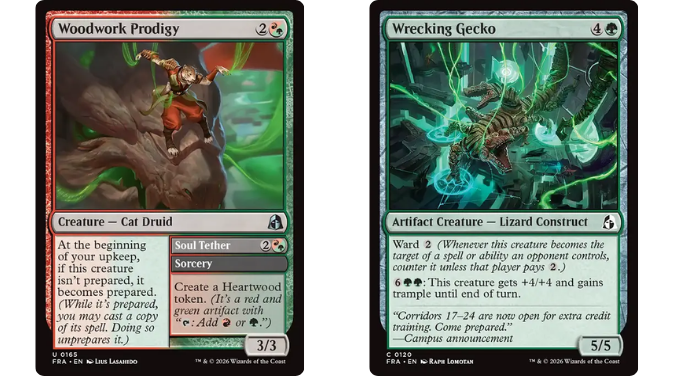
The RG archetype is based on Konstrari, the “school of Constructive Arts”. Their theme of building industriously is reflected by their prepared spell, Soul Tether, which is basically a three-cost mana rock stapled to your creatures. Since the set is relatively slow, and the bigger creatures are hard to remove efficiently, curving Soul Tether into an early five or six-drop is extremely hard to beat, often leading to fast snowballing victories if you have any follow-up threat.
To me, that suggests RG is an archetype where good drafting and deckbuilding is going to be most rewarding. You want to grab as many early ramp cards as possible, while keeping the right balance with threats and maybe a little interaction. Mana sink abilities – whether on big creatures like Wrecking Gecko or small ones like Inspired Tethermage – are great to fit in where possible to ensure you’re never wasting resources.

The next layer is optimizing card quality, which almost always means fitting in extra colors. Take color-fixing tools opportunistically in Pack One so you can aggressively steal off-color bomb rares in Pack Two. I tend to prefer landcyclers to Loot, the Nexus or Murmuring Volume since they become action spells when you draw them late. If you find it hard to get enough true game-winning bombs, multiple copies of Restore with Empathy and Something Worth Saving can help a single Craftwork Crusher carry the game.
REDEFINING REALITY
From a design perspective, this is definitely the biggest most ambitious swing we’ve seen Wizards take in a long time. I would have been skeptical of both the lore and mechanical premise if you showed me a summary on paper, but the actual implementation has been extremely clever. Reality Fracture somehow manages to deliver character-driven storyline beats, fun “what-if” alternate reality ideas, and the entire concept of Hexhaven all in one package, without any of them really feeling underserved.
When it comes to gameplay, empower Jace is easy to understand, useful without being broken, and very interesting as a centerpiece mechanic for Limited games. Whether it will remain interesting in the long term or prove any use in Constructed formats is a worthy question, but not one we have time to go on with today. Perhaps the Echoverse version of me can write a blog about that one…
BONUS POSTSCRIPT
Thanks for reading to the end! Here are my top five picks from each color for early Pack One where you’re not committed to any lane:
WHITE – Danitha, Sword of Hope, Memory Trap, Your Fate Ends Here, Hexhaven Battalion, Vigorbloom Vanguard
BLUE – Ruric Thar, Biomagus, Traxos, Academy Guardian, Way of the Mind Sculptor, Cryotheory Adept, Infinite Coursework
BLACK – Last Gasp, Multiply by Zero, Extended Absence, Break Under Pressure, Recursive Recruitment
RED – Stingerquill Voxmancer, Koth, the Geomancer, Wrath of the Bloodmane, No Admittance, Violent Echoes
GREEN – Woodwork Prodigy, Konstrari Improviser, Compel Brutality, Hunter’s Axe, Ferocity of the Hunt

Tom’s fate was sealed in 7th grade when his friend lent him a pile of commons to play Magic. He quickly picked up Boros and Orzhov decks in Ravnica block and has remained a staunch white magician ever since. A fan of all Constructed formats, he enjoys studying the history of the tournament meta. He specializes in midrange decks, especially Death & Taxes and Martyr Proc. One day, he swears he will win an MCQ with Evershrike. Ask him how at @AWanderingBard, or watch him stream Magic at twitch.tv/TheWanderingBard.