
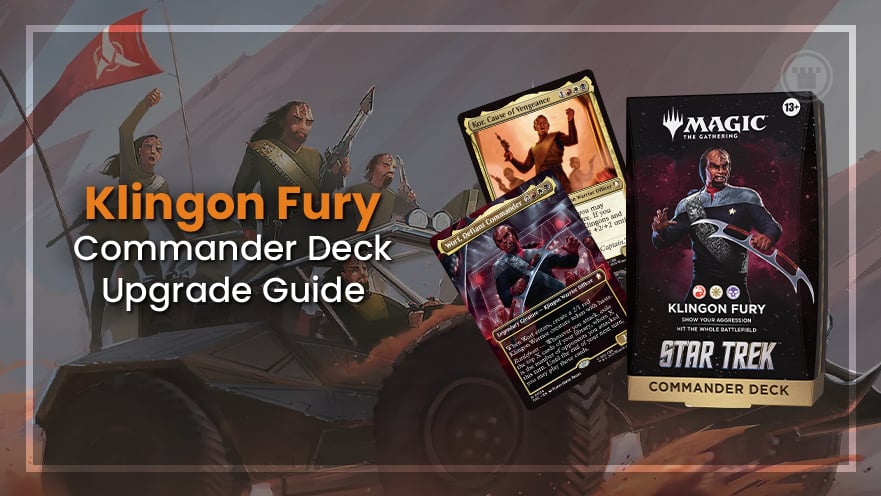
Star Trek is one of the absolute foundation-stones of nerd/geek/fandom culture. As a pioneer for science-fiction storytelling on TV, Gene Roddenberry’s creation is distinguished by its scope, moral principles, and worldbuilding.
The Star Trek universe is vast and multifarious, with strange new worlds to explore and colorful aliens to encounter. Sometimes those aliens have great space empires of their own, enough to challenge the human-led Federation.
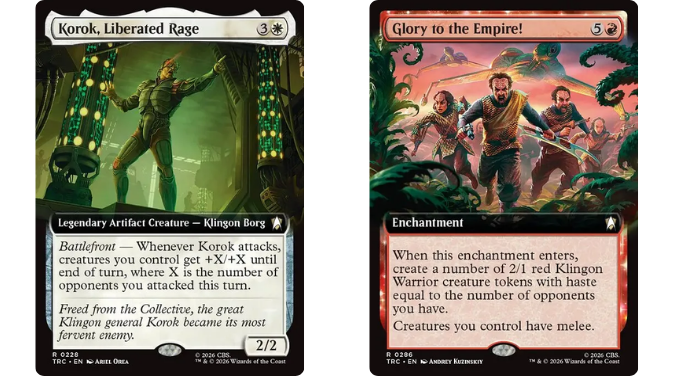
So it is with the Klingons: fierce, powerful warriors from a culture built around military ideals, rather than those of pacifistic co-existence. When their interests conflict with those of Starfleet, the Klingons prove stubborn foes.
But they are not without reason, and when faced with a common threat Klingons have also fought bravely alongside the Federation and its officers. The most important thing with Klingons is simply not to underestimate them.
MEET THE COMMANDER
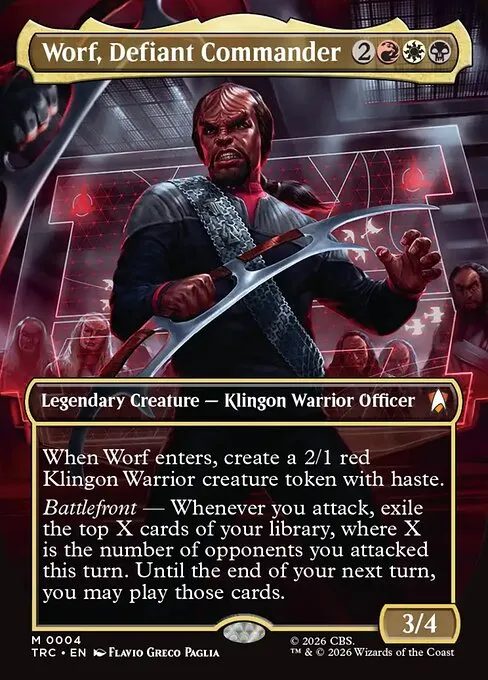
The Klingons have a rich history across all sorts of Star Trek media, with many different heroes and prominent characters to represent them. Still, Worf is the most beloved and recognized among the fandom, due to his service aboard the USS Enterprise-D in Star Trek: The Next Generation. So Worf gets the nod as the default commander, even in a deck chock full of badass Klingon warriors.
Mechanically, Worf looks fairly similar to another favored legend of mine: Commander Liara Portyr. Comparing them, Worf doesn’t give you a cost discount on cards he “draws”, which is meaningful but not disqualifying. You can only discount spells with generic mana costs, so a three-color deck with an aggressive creature base might not be where Liara’s ability shines the most.
Other upsides to Worf include getting an extra turn cycle to play the exiled cards. This does help you feel better about building with instants and other reactive spells. The wider window to play exiled cards – which might easily overlap with next turn’s haul – lets you happily cast spells in your first main phase and just makes the deck operate more smoothly overall.
Worf also provides 5/5 of stats over two bodies, which helps you more easily set up big turns where you attack everyone even if you’re recovering from a sweeper effect. Attacking multiple players at once turns out to be very important for the Klingon Fury deck in general. Prudent strategists might shy away from making so many enemies, but the Klingons despise such cowardly concerns.
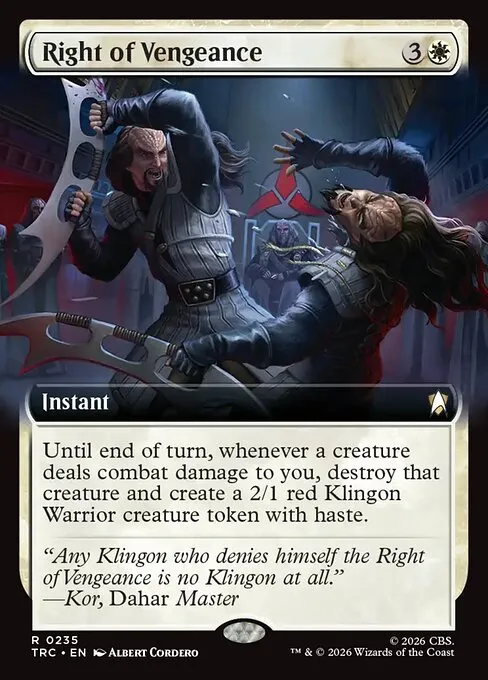
If you attack everybody all the time, you deny foes the chance to stab you in the back, and you force a fight on your own terms. Mechanically, a lot of the new Klingon cards in this deck have the same “battlefront” wording as Worf, meaning they’re literally more powerful when you spread the aggression around.
Take note, Klingon customs are very strict about what counts as “attacking a player”. Attacking a planeswalker doesn’t count as attacking the player who controls it, and abilities like Mobilize or Myriad (which put creatures into play already attacking) never count even if you resolve those before the battlefront trigger. You must swing at least one creature at each player’s life during your declare attackers step.
The Klingons are not fools or savages, however. There are still levels of nuance to explore within this hyper-aggressive doctrine. For your battlefront abilities, attacking someone with 200 creatures is the same as attacking with a single token – but I’m sure the defending player would appreciate the difference!

Do some space-gunboat diplomacy and make sure opponents understand the difference between REAL Klingon Fury and the “chump attacks” you throw at them to trigger battlefront. There’s no reason that this deck has to be the archenemy every game or even give up on making friends. After all, the Klingons in the show managed to ally with the Federation (after 100 years or so).
NEW CARD REVIEW
In order to properly cover the full range and depth of Klingons across the Star Trek franchise, Klingon Fury adds 33 new mechanically unique cards to the game – way more than your average Commander precon. Many of them are clearly designed to specifically support this kind of Klingon-themed deck. But I’ll take a moment to shout out some of the cards which might also be relevant in other contexts.
Kor, Cause of Vengeance
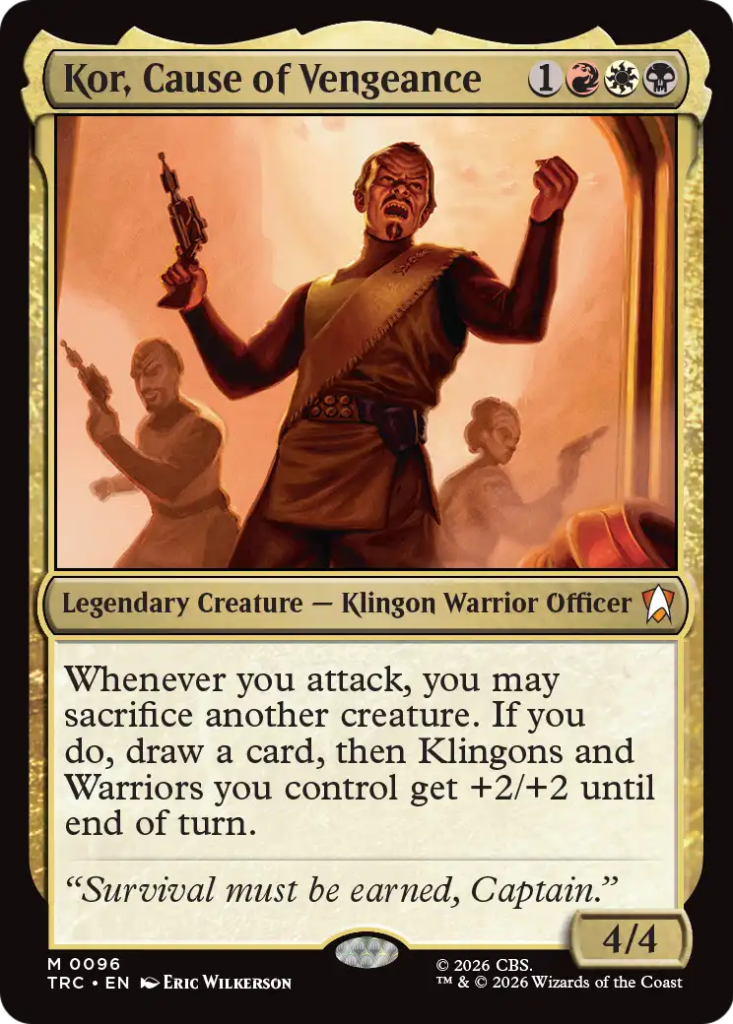
The alternative commander choice within the precon is Kor, and he might actually be stronger than Worf depending on your metagame. If boardwipes are uncommon and committing to a large board of creatures seems viable in your games, Kor adds a TON of damage to your attacks even on the turn you cast him. He’s not even a total loss in the card draw department, although Worf will generate a lot more advantage in longer games.
Using Kor as your commander does also commit you more towards an all-Klingon deck – but not completely. Warrior is actually one of the more common and deep creature types in the format, and I can also imagine Kor showing up as the only Klingon in some warrior-focused lists.
Imperial Hullbreachers
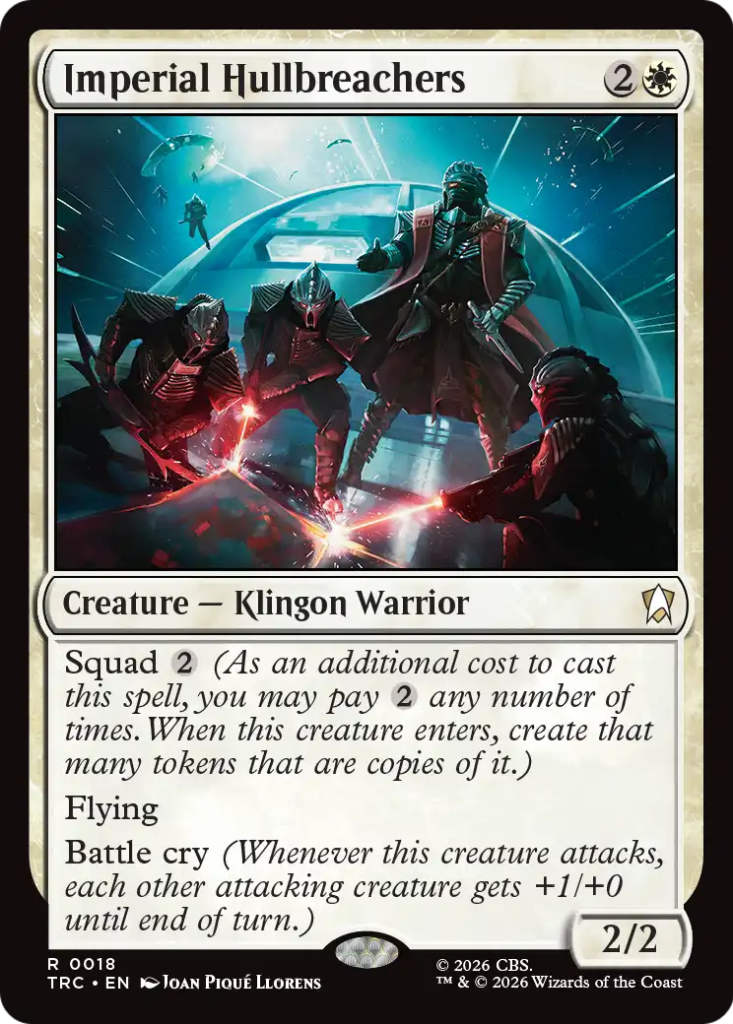
Not a complicated card, but this has the kind of flexibility and inherent “modes” which make it a valuable tool in any deck that wants to go wide. At its base cost, it’s a reasonable team-buff and flying makes it easier to survive despite being a priority to block and kill. If you draw it in the lategame with a lot of mana, squad gives it the potential to end the game out of nowhere – especially if you have Anger or Fervor to grant haste.
Kurn, Son of Mogh

Kurn stands out thanks to his close resemblance to format all-star Tymna the Weaver. In some ways he’s actually an upgrade: most notably, he only requires that you attack each opponent rather than deal them combat damage to get cards.
And yes, I will acknowledge that Tymna’s relevance mostly comes from having partner, not her card draw ability. But being able to access multiple cards a turn for zero mana just by keeping a three-drop alive is still exciting to most black decks, even outside Commander.
Koloth, Tribble Hunter
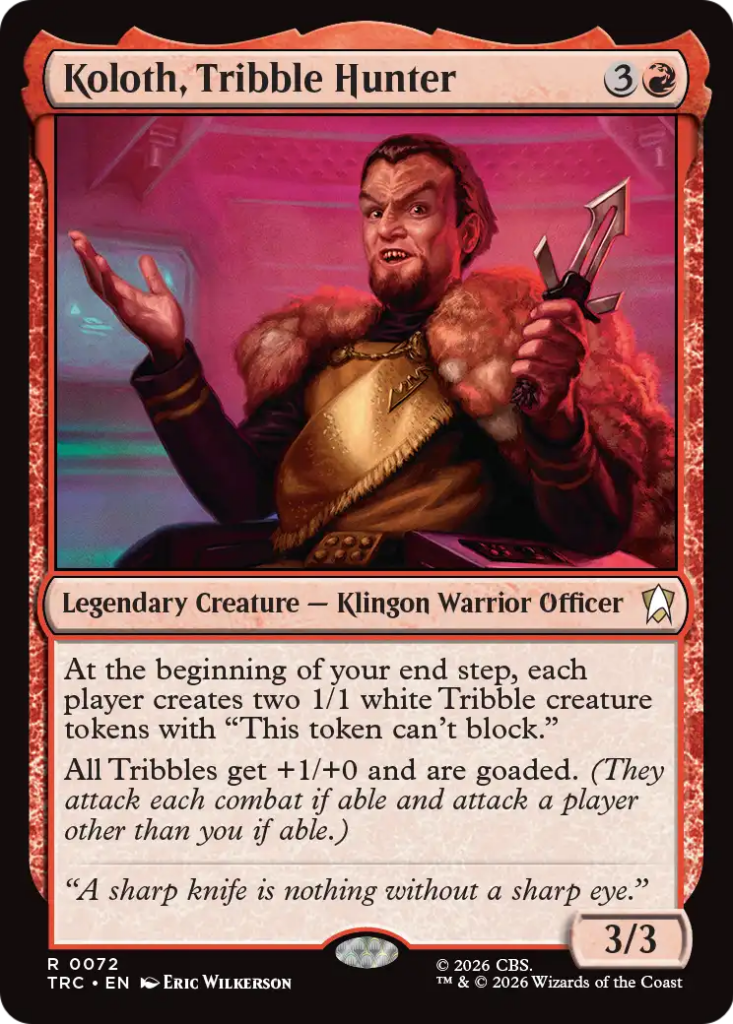
Within the Klingon Fury deck Koloth is simply an efficient token-generator, providing disposable bodies to sling around in combat and max out your battlefront count. But there is a particular niche of red decks which care specifically about giving opponents more creatures or more attackers. Koloth seems custom made for commanders like Thantis, the Warweaver, Kardur, Doomscourge or Baeloth Barrityl, Entertainer; if that’s your pet deck, congratulations on the hot new tech!
Qo’noS Quartermaster
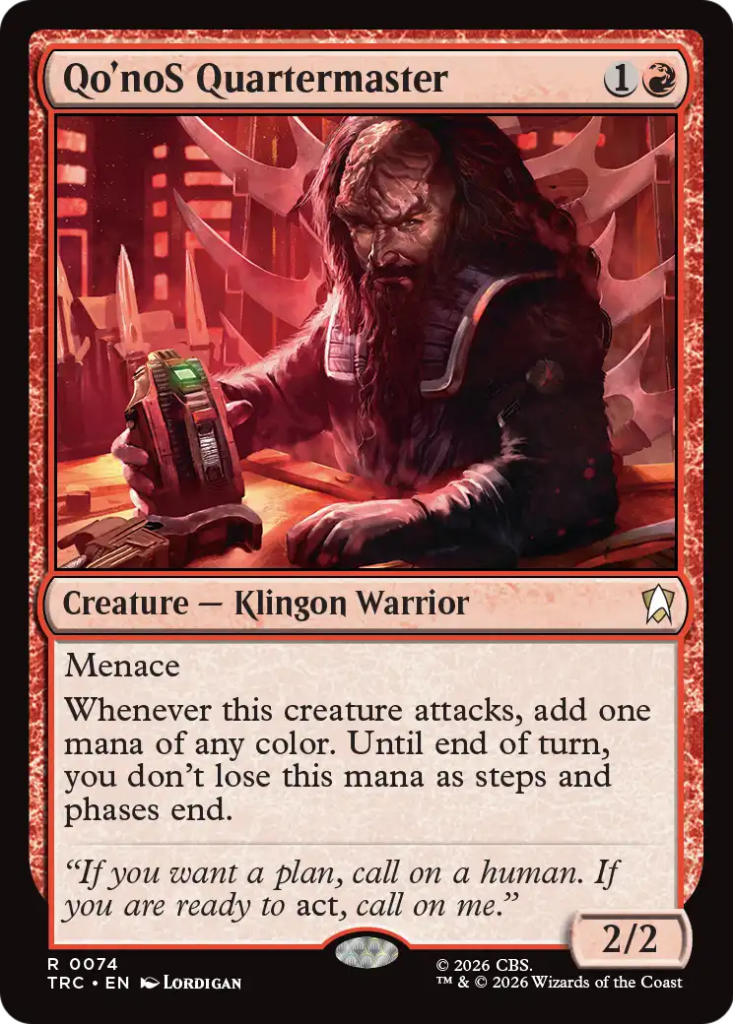
I write often on this blog about red’s “war economy” in Commander, and how cards that generate resources through combat can be an amazing engine to build around. Getting a hard-to-block two-drop that accelerates you is great for any deck which also cares about attacking – now your “mana dork” can fill both those needs at once. The fact this works well with multiple combats per turn is also much appreciated (especially since it’s the right creature type for Najeela, the Blade-Blossom).
Alexander, Ship’s Fool
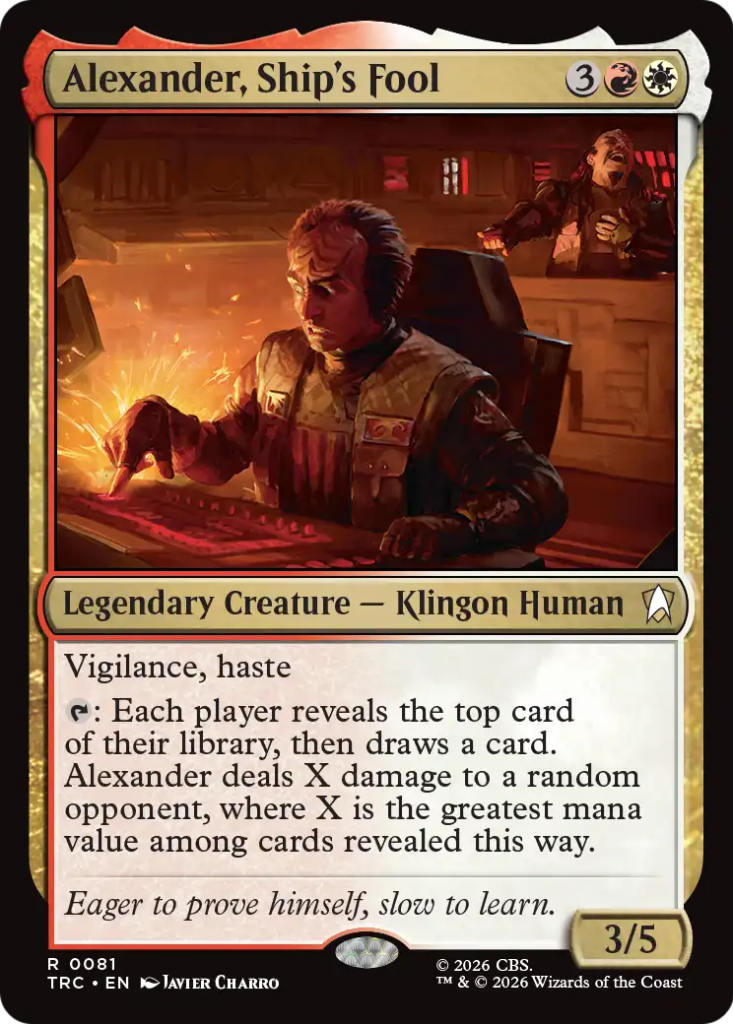
Whatever the name and lore on this guy imply, I think he’s far from a joke on the tabletop. Five mana is very achievable in most games, and the combination of vigilance and haste all but guarantee you’ll be able to activate his tap ability every turn cycle. The steady supply of free card draw and face damage is not something to be underestimated – and as soon as you start finding ways to untap him, Alexander will go from “funny guy” to “serious problem” in a hurry!
Chancellor Gorkon
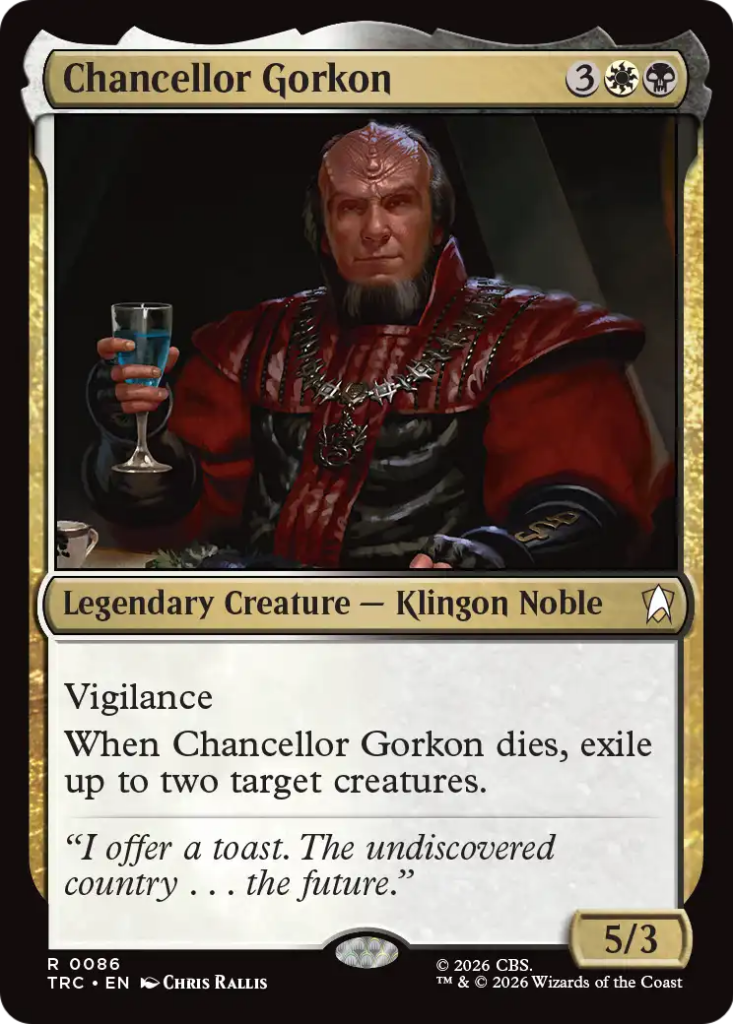
Elegant in his directness, Chancellor Gorkon is up there with Kurn for me in terms of the most broadly playable cards in Klingon Fury. He’s another creature who works just fine without support, making opponents think twice about attacking you even when the rest of your Klingons are tapped out.
Then if you add combo cards to the equation, Gorkon rapidly becomes devastating. I’m thinking about the various ways black can sacrifice and immediately reanimate a creature with a single spell: Infernal Offering, Blood for Bones, Come Back Wrong, or Rescue from the Underworld. I imagine a lot of games where looping Gorkon triggers is not much different to looping Ashen Rider – and that card is double his mana cost.
The Beacon of Kahless

I know that at certain times the community discourse has been highly elitist about three-cost mana rocks in Commander. But whatever your opinion on Commander’s Sphere, you should know it’s not the same when the rock in question refunds its own mana cost the turn you play it. Sure, attacking three players on turn three takes a bit of effort. But having to play one-drops (or zero-drops) and token producers isn’t that much to ask of an aggro deck, and nor is needing to spend the mana on your own turn. Even if your deck only gets two mana back the turn you cast it, Beacon comfortably makes the elite class of mana rocks.
Own the Day
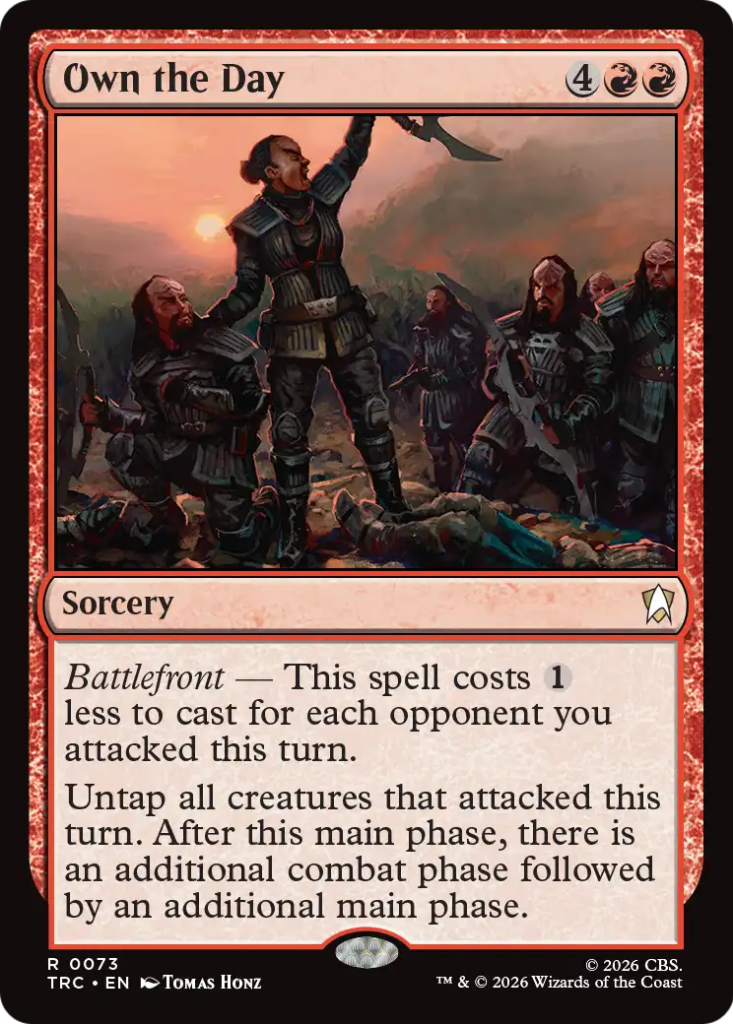
Nothing complicated here, but I’ll always take note of another “additional combat” spell. There’s still not as many as you might think, especially ones castable (we may presume) for just four mana!
My specific interest in decks that go all-in on extra combats makes me despair at the “after this main phase” text, since that prevents you recasting it mid-combat with cards like Surge to Victory. But almost every version of this effect includes that restriction, and it’s still an extremely valuable +1 copy for singleton formats.
$50 UPGRADE GUIDE
I really like a lot of the individual cards in Klingon Fury, but the overall construction of the stock decklist has thrown me for a loop. This is obviously a battlefront-centric deck, focused on attacking all the players all the time. All the best cards in the deck are effects that buff your team when you swing, and the Klingon typal themes also incentivize this “go-wide” strategy. Except… where are our actual soldiers?!?

Despite running a bunch of three mana cards which want us to already be triggering battlefront on that turn, the stock list contains ZERO one-drops and just three two-drops! This dearth of cheap plays makes even less sense when you consider our commander, Worf, is a potent draw engine: surely you want a decklist full of cheap proactive spells to take full advantage of his trigger?
Lucky we have $50 and some free time to correct this apparent oversight. To do so, we’re also going to incorporate some non-Klingon creatures: there’s just not enough variety in the new Star Trek set alone. We do at least gain some leeway from all our typal cards saying “Klingons and Warriors”, so we’ll try and prioritize adding Warriors over other types unless we need specific effects.
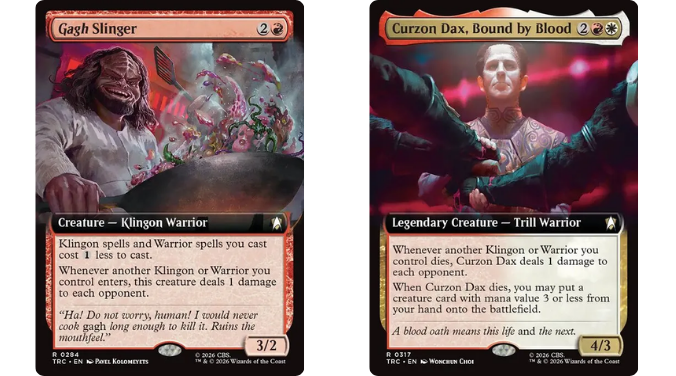
Meaningfully reshaping the mana curve of a deck requires us to change significant numbers of cards. So I apologize to any lore purists who were hoping to try and maintain an all-Star Trek list. I hope you can still take some pointers from this upgrade guide even if you don’t implement all the recommended changes.
So, what are we cutting and what are we looking to replace it with? The cuts are largely made based on mana cost and card type: noncreatures and expensive spells are out.
Our additions start with low-cost warriors whose effects make them hard to keep off the battlefield (Bloodsoaked Champion, Gutterbones) or generate extra tokens (Mindblade Render, D-7 Battle Cruiser, Ainok Strike Leader).

I’ve tried to avoid adding high-cost creatures since we’re intending to fix our curve, but there’s a few specific effects which are worth clearing room for. Worf’s battlefront trigger is our most important and best advantage engine, so any force multiplier for that is high priority.
We can add extra instances with Isshin and Windcrag Siege, get more chances to trigger it with Fury of the Horde, and add similar effects with Smellerbee and Liara Portyr. Iraxxa does not add more card draw on her own, but does have amazing potential combined with Worf or Liara and her tokens have the crucial Warrior type.
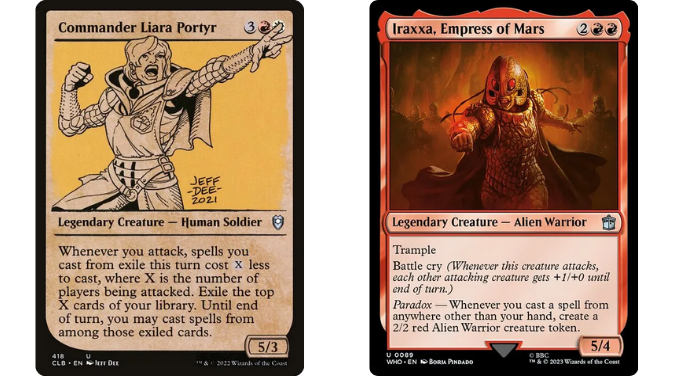
Our last major need is cards to ensure our attackers survive combat. Plan A is simply make them all indestructible on attack with Frontline Medic or Captain America, Skybound. Plan B is simply to use Reconnaissance, which can pull any or all of your attackers out of combat painlessly once you’ve successfully triggered battlefront and seen what blocks your opponents declared.

Check out the full decklist with updates included here!
MAKE WAR NOT LOVE
I love the choice to make a Mardu-colored Klingon deck for this set – rarely have I ever seen a Universes Beyond faction line up so neatly with Magic’s color pie. Organized, aggressive, honorable and without fear of death, the Klingon strategy basically writes itself.
This is why I personally think it’s not that bad mixing in some non-Star Trek cards into the deck: some of them have such perfect fits that I’m shocked they weren’t reprinted with new art in the stock list.

Take Angel’s Trumpet, for example. Not the most Klingon name, I agree, but look at the effect! It punishes creatures for not attacking: first by damaging their controller, and then by tapping them down to ruin them as blockers. At the same time, all attacking creatures gain vigilance – so the only way to keep blockers available is to keep swinging every turn! There aren’t many cards that feel more Klingon than that.
Overall, I think battlefront is a reasonable theme to build around in Commander, especially if your group plays games with more than four players. So long as you attack courageously and never take a backwards step, victory is sure to follow.

Tom’s fate was sealed in 7th grade when his friend lent him a pile of commons to play Magic. He quickly picked up Boros and Orzhov decks in Ravnica block and has remained a staunch white magician ever since. A fan of all Constructed formats, he enjoys studying the history of the tournament meta. He specializes in midrange decks, especially Death & Taxes and Martyr Proc. One day, he swears he will win an MCQ with Evershrike. Ask him how at @AWanderingBard, or watch him stream Magic at twitch.tv/TheWanderingBard.