
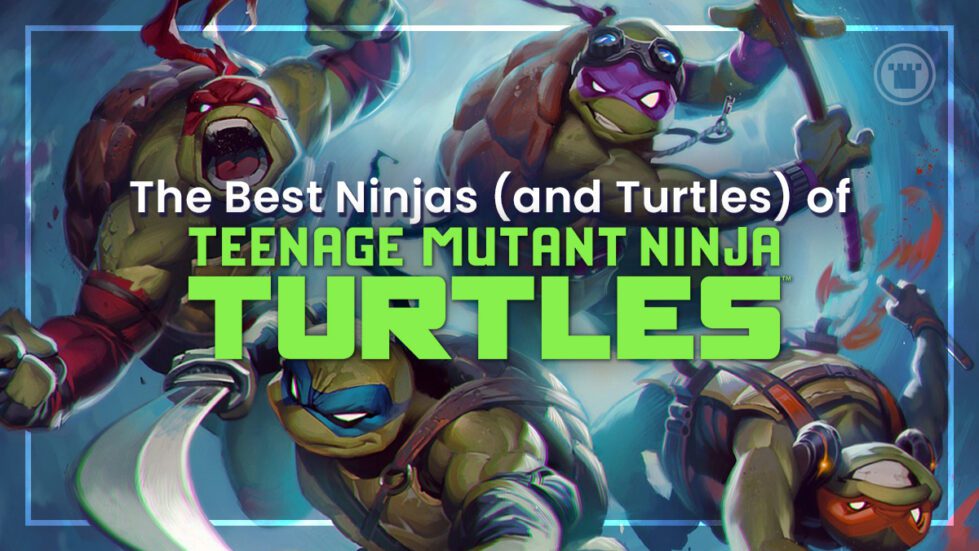
The buzz this week has all been around spoilers for our next Universes Beyond set: Teenage Mutant Ninja Turtles. I’m not familiar with any of the brand’s incarnations, but if I had any expectations for the set going in it would be some new Mutant, Ninja and Turtle cards – and of course I was right.

The goal of Universes Beyond products is to translate outside IP into Magic cards that feel connected to the source material. Creature types are one of the best ways to achieve that, since they’re fully “customizable”: Wizards can just put “Moogle” or “Time Lord” or “Utrom” right there on the card in plain text, as if to say “yep, Magic knows that’s a thing!”
If it’s possible to get a match that feels right for the IP using pre-existing types, even better. That way, those cards will be able to synergize with all sorts of other cards past and present which refer to those types – and generate excitement for any Magic players building themed decks around them.

With three well-established creature types right there in the title, Teenage Mutant Ninja Turtles seems like it should be an easy slam dunk in this regard. But which cards in this spoiler stand out as the best new options for each one?
NINJAS
Ninjas were introduced into Magic in 2005’s Betrayers of Kamigawa. It was a well-defined idea for a creature type with a cool signature mechanic which realized that identity in-game: ninjutsu.
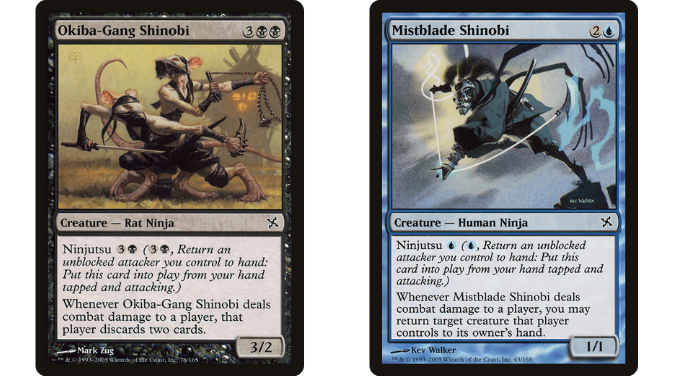
Ninjas use that deceptive ability (and others, like sneak in the TMNT set) to avoid potential blockers and deal damage directly to players, earning bonuses or sabotaging opponents when they hit successfully. It’s a sneaky, aggressive playstyle which places them firmly in blue-black’s color pie, along with similar types like pirates, rogues and assassins.
Unfortunately that color identity is going to be the first barrier preventing TMNT from breaking into these decks. With a whole set of new ninja cards, Wizards had no choice but to spread them across all five colors to some degree, and to give them a less focused spread of abilities.
Leonardo, Sewer Samurai would actually be a pretty sweet effect to have in most Ninja decks, as they tend to play a lot of tiny evasive creatures to set up ninjutsu opportunities. Dark Leo & Shredder is an impressively cheap Ninja Lord with a very nasty effect.

However, both of them have white mana costs, which instantly excludes them from a majority of current Commander decklists and makes for a tricky splash even in other formats like Legacy. Players could potentially switch commanders to something like Morophon or the new Splinter, Radical Rat, but forcing ninja fans to choose between these new cards and their beloved Yuriko is a tough ask.
Luckily, there are plenty of new prospects in the “correct” ninja colors too. Shark Shredder, Killer Clone is an upgrade (mostly) to my favorite ninja card, Ink-Eyes.
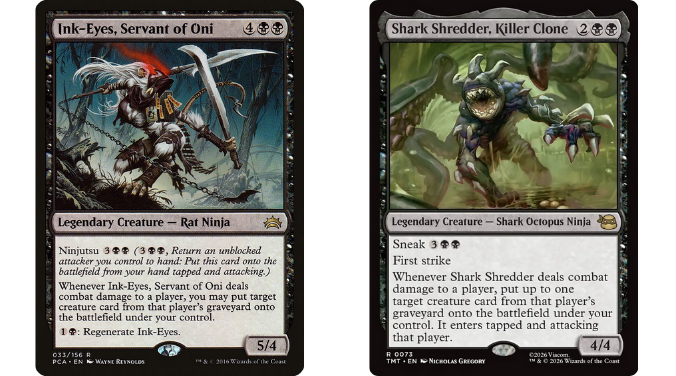
Cheaper to cast and harder to block, my favorite improvement is the chance to reanimate opposing creatures mid-combat as unblockable attackers. Just think about the kinds of high-powered threats and crazy on-damage triggers people usually run in Commander being turned against them!
If there’s nothing decent to bring back, you could even have Shark Shredder revive some tiny creature and then return that to its owner’s hand for ninjutsu activations (though this doesn’t work for sneak, since that has to be activated in the Declare Blockers step).
Other TMNT cards continue an underrated line of synergy linking ninjas to artifacts. Starting from Ornithopter being the cheapest way to get an unblocked attacker for ninjutsu, ninja decks have continued to utilise artifact cards like Retrofitter Foundry, Baleful Strix and Tamiyo, Inquisitive Student.
Kamigawa: Neon Dynasty added a handful of ninja artifact creatures. There are some type-supported equipment in Ninja’s Blades and Shuriken, plus ninjas which create artifacts in Orochi Soul-Reaver and Prosperous Thief.
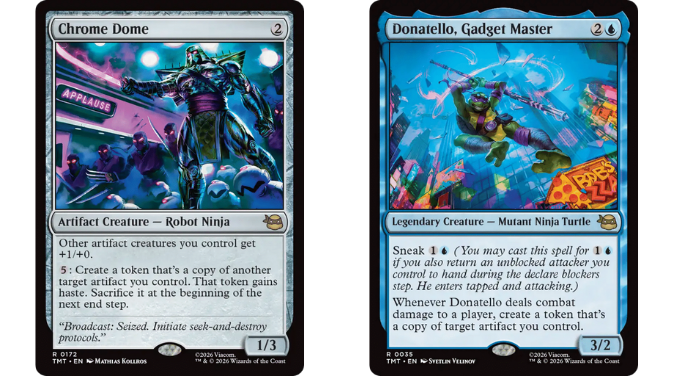
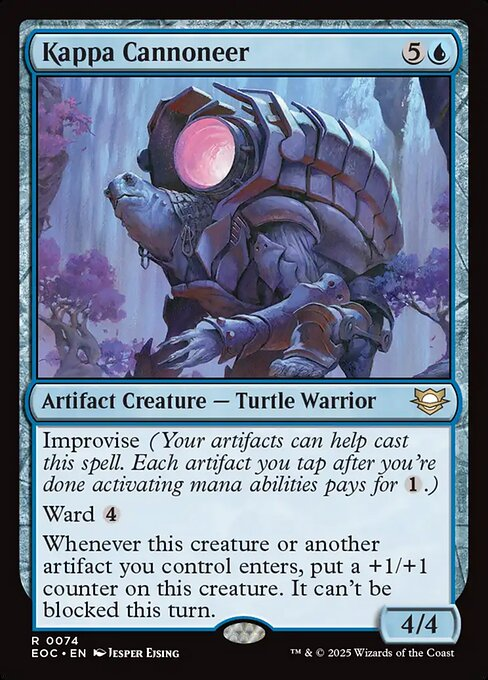
For these reasons I am excited to try out Chrome Dome and Donatello, Gadget Master as artifact-loving ninjas. Donatello has the ability to stack permanent copies of artifacts, which in a ninja typal deck means multiples of Adaptive Automaton, Roaming Throne and Heirloom Blade. For Chrome Dome, who only copies things temporarily, I’m actually most excited to target Magic’s strongest turtle: Kappa Cannoneer.
TURTLES
The turtle type first appeared way back in Legends in 1994 with Giant Turtle. Although creature type mechanics barely existed back then the way they do now, even the original turtles shared a fairly focused gameplay identity.
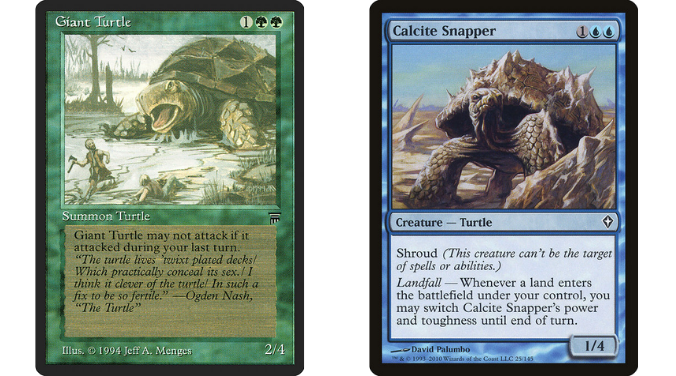
As you might intuitively expect, turtles are defensive creatures: they often feature ward, hexproof, high toughness scores, and limitations on attacking. More recently their portfolio has expanded to feature land synergies (encouraging the long game) and limitations on opposing cards entering untapped (slowing the game down). They overwhelmingly appear in green and blue, with only a couple of cards falling outside those colors.
TMNT is set to almost double the total number of turtle creatures in the game, and a lot of those older cards are simple commons without much relevance to current-day formats. So surely at least a few major upgrades for Archelos and The Pride of Hull Clade decks are going to make themselves known here?
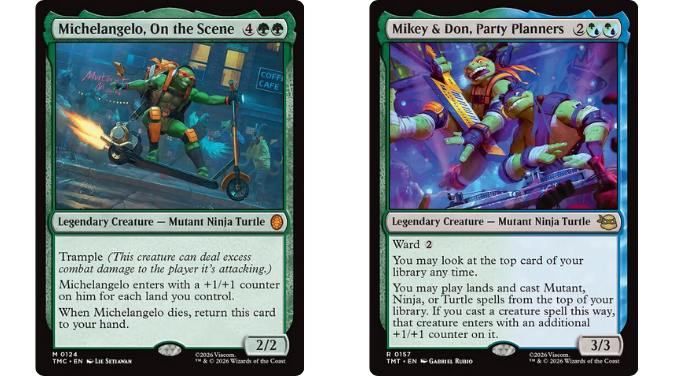
Michelangelo, On the Scene is a great example: he’s hard to permanently kill, and increasingly massive as the game goes on and your land count expands. There’s also Mikey & Don, Party Planners: it doesn’t ramp you directly, but playing cards from the top of your deck is a sure way to “draw” more cards over time and build a gradual advantage.
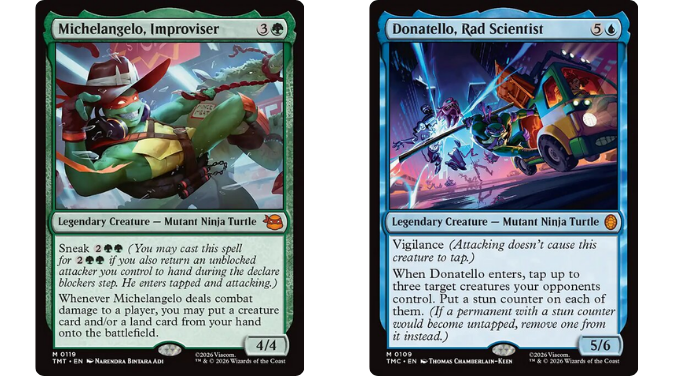
Michelangelo, Improviser can help ramp you on a successful trigger… or simply put any of the bigger turtle cards in your hand directly into play. Then there’s also Donatello, Rad Scientist: a bit less value-oriented than his brothers, but a great stopgap blocker when you’re desperate to stabilize against fast-moving opponents.
Of course the biggest win for these thick-shelled decks isn’t a creature at all, but the aptly-named Turtle Power! The Turtle Van is another useful noncreature support card, and looks better suited for turtle decks than it is for ninja ones.

And… that’s about it for turtle typal synergies, believe it or not. Of course there’s an absolute ton of turtle creatures in the set, and many of them are quite strong. But I’m shocked that we didn’t get any kind of “toughness matters” cards in the set, or even a turtle build-around which cares about ward and hexproof abilities.
It’s almost like the designers were specifically ignoring the usual things turtles do to emphasize that the Teenage Mutant variety are different. Perhaps that means we’ll see a stronger typal connection by looking at the new mutant cards?
MUTANTS

First printed in 2002 (or in 1995’s Ice Age, if you count a later errata update to Goblin Mutant), the majority of mutant creatures were associated with Ravnica and the Simic guild, using +1/+1 counters and mechanics like adapt or evolve to convey the idea of rapid growth. Mutants can also grant or modify activated abilities, as seen on Experiment Kraj and the graft mechanic.
While not strongly supported as their own typal deck, this identity of “UG modification” was quite well defined – until the advent of Universes Beyond. The mutant type has since been used on cards from Jurassic Park, Fallout, Warhammer 40,000, Spider-Man, Final Fantasy, and now TMNT.
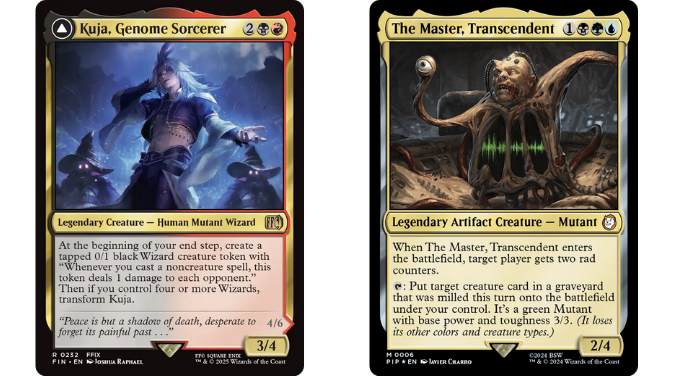
None of these new cards have anything in common in their colors, look or mechanics. Rather, the mutant type seems to have been included as a nod to the lore of the source material; a cool move in a vacuum, but out of line for the way Magic has carefully managed type identity over the years.
The new TMNT set assigns the mutant type to almost every creature, but barely acknowledges it in their actual mechanics. Mikey & Don, Party Planners allows you to cast Mutants from the top of your library, though perhaps only for the fun of having “Mutant, Ninja or Turtle” appear in rules text.
There are a few TMNT cards which tie in decently with the older Simic +1/+1 counter themes too: Michelangelo, Weirdness to 11, Mikey & Leo, Chaos & Order, and Mutagen Man, Living Ooze.
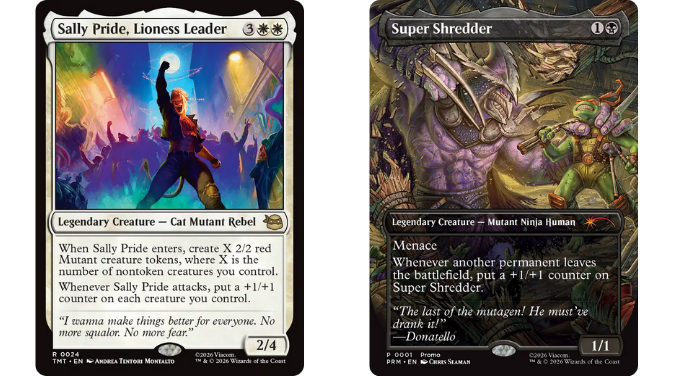
Sally Pride, Lioness Leader and Slash, Reptile Rampager generate mutant token creatures, and Super Shredder is perhaps the strongest creature ever printed with this type. But the clashing colors and mechanics of these cards makes their common typing feel like an afterthought, not something to be celebrated.
Even the unique Mutagen tokens created for this set don’t actually turn creatures into mutants when used! That in particular feels like such a missed opportunity that I have to wonder if any mutant-specific mechanics got cut from this set late in design. But whether or not there was, sadly, we may never know.

BY ANY OTHER NAME…
Perhaps to some readers it seems weird to focus so much on what types creatures have and whether those types are actually reflected in the creature’s abilities. When you’re trying to make cards legible to fans who may not know Magic well, it makes sense to use the typeline as an extension of the card’s name; another plain-text way to spell out the connection to the characters and source material being portrayed.
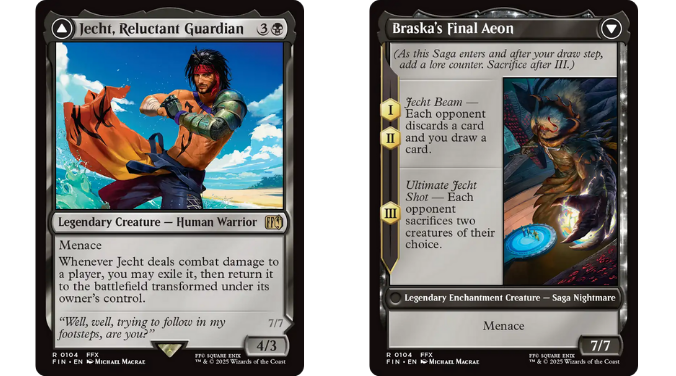
But I believe that building up consistent connections between the flavor and concepts depicted by cards and their actual mechanics has been among Magic’s biggest strengths over the years.
Being able to learn “that’s what an Elf does” helps players orient themselves in a game featuring literally hundreds of unique elves. Imagine how much harder it would be to even talk about Magic if mechanics like “tutors” or “vehicles” were not associated with a consistent concept in their art and flavor?

This is one of the design challenges with Universes Beyond that I barely ever see mentioned, and I think it’s one we should examine more closely as a community. Because if TMNT is diluting the typal identity of mutants, ninjas and turtles today, a different UB product could do the same to your favorite type tomorrow.

Tom’s fate was sealed in 7th grade when his friend lent him a pile of commons to play Magic. He quickly picked up Boros and Orzhov decks in Ravnica block and has remained a staunch white magician ever since. A fan of all Constructed formats, he enjoys studying the history of the tournament meta. He specializes in midrange decks, especially Death & Taxes and Martyr Proc. One day, he swears he will win an MCQ with Evershrike. Ask him how at @AWanderingBard, or watch him stream Magic at twitch.tv/TheWanderingBard.