
Universes Beyond has been the biggest talking point in Magic for years now – it’s been inescapable both in my writing and my casual conversations about the game.
This does at least mean we’ve got a lot more experience with the reality of how different UB products have fared. The discussions we have around them can be much more nuanced – not just whether UB is good or bad, but what has made individual UB releases better or worse than others.
After all, there’s too many different sets out there now to be lazily lumped together. Even the harshest UB critic must have one (relative) favorite; even the biggest UB fan must have one that left them a little underwhelmed.
So why is that? Besides just liking one featured IP more than another, what are the most important hits and misses of the Universes Beyond project so far?
Secret Lair: The Walking Dead – MISS
Anyone who was paying attention five years ago knows that the UB initiative got off to a rocky start.
Maybe leading with a huge brand like Marvel Comics or Lord of the Rings was too much to ask, but The Walking Dead seemed like a rather dated and odd choice even at the time.
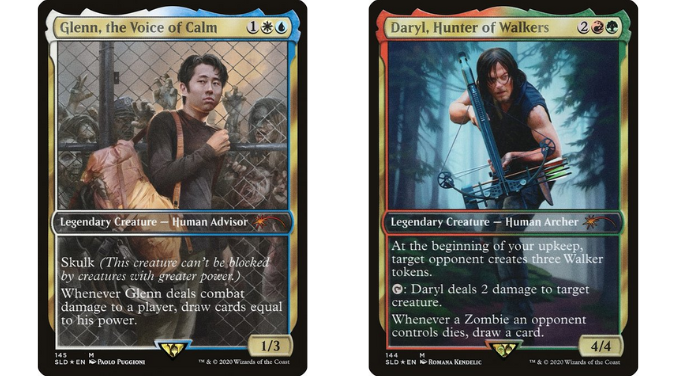
The card art depicted a realistic, modern setting – and even more jarring, was illustrated to resemble the famous actors from the TV show. Magic players were always going to raise a fuss about UB sets clashing with the game’s established look and feel, but they could have at least tried to start off with an IP from the broader fantasy genre!
Another instance of Wizards ski-jumping down the slippery slope with this set was the choice to make the cards mechanically unique. If these first intrusions of outside IP been purely cosmetic changes, the haters in the audience could have just chosen not to use them.
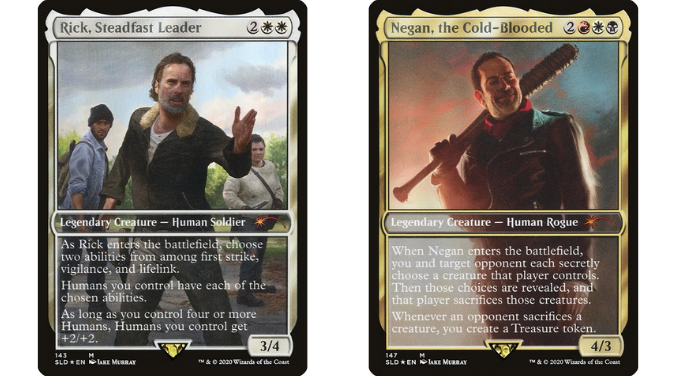
But simply ignoring sections of the legal card pool is a non-starter for most players. The mantra of “not every product is for you” falls flat when opponents can still use those products against you: they will be part of your Magic experience regardless of your consent!
Even if you can avoid these cards at your table, they become part of the conversation and theorycraft of the game. You have to see them in event results; I have to write strategy articles about them.
In short, the first Universes Beyond product put all of the most controversial and challenging aspects of the idea in the spotlight as soon as it was announced. Maybe that was the idea: start out how you mean to continue. But the message sent to players was that the people plotting out Magic’s future did not know or care about their feelings as enfranchised customers.

Godzilla Series Monster Cards – HIT
I’m not sure whether Wizards internally considers these Godzilla cards from Ikoria: Lair of Behemoths to be part of UB or not. Either way, they are an important counter-example to Secret Lair: The Walking Dead; a different approach and execution of a similar idea.

The Godzilla Series also presented a small number of new card designs with art and flavor referencing an outside IP. But instead of outright hostility, the community response was lukewarm-to-positive. Why?
Instead of releasing on their own, unasked for and seemingly at random, the Godzilla Series Monster Cards were announced alongside (and packaged with) Ikoria, Lair of Behemoths. Nobody needed an explanation as to why Magic would be crossing over with the Godzilla franchise as part of the “Giant Monster World” set!

This pairing meant the big rubber dino-dragons blended in with other Ikoria cards on the battlefield, visually and mechanically – which might not have been the case if they released alongside Dominaria or Amonkhet.
Of course, the other big contention around the Walking Dead cards was their mechanical uniqueness. While Wizards had promised that they would eventually reprint Rick and friends with more Magic-canon-friendly names and art, that took another two years after Ikoria to actually come true.
By contrast, all but one Godzilla Series card had their “Universes Within” versions included in the same booster boxes as the crossovers, leaving no room for haters to complain about lack of choice. They even had the equivalent Universes Within name printed on the Godzilla versions, gently reminding the reader that the “Magic name” was their primary and official designation.
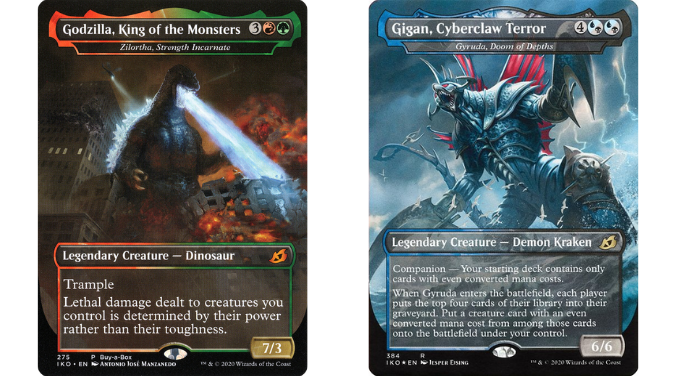
That’s not just a sop to the parts of the community who still wish Universes Beyond never happened. It’s a great response to legitimate concerns for the long-term accessibility of these cards should Hasbro’s rights to the IP expire. Maybe this exact method of release wouldn’t be possible for larger UB sets to come, but the ideas of matching crossover IP to other sets in their release window, and of spotlighting their Universes Within versions, should have been carried over more zealously.
Warhammer 40,000 Commander Decks – HIT
The first seriously ambitious Universes Beyond crossover was also a step up in scale: a set of four Commander precon decks. Capturing the very distinctive feel of the Warhammer galaxy required the invention of many more unique UB cards than before, and even more new card illustrations. But it was absolutely the right decision – there’s no way you could have taken Space Marine and Tyranid cards seriously if they were sitting next to Llanowar Elves.
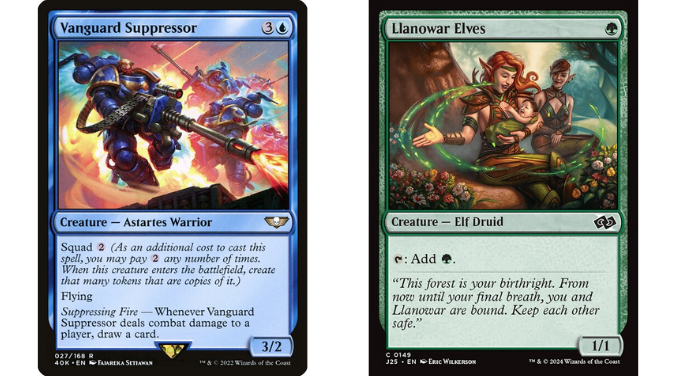
Luckily, 40K is a very deep universe, so there was no issue with finding enough monsters and war machines to fill out those deck slots. Compared to most TV shows, movies or books, there is a focus on the details of (for want of a better term) NPCs and their methods of fighting.
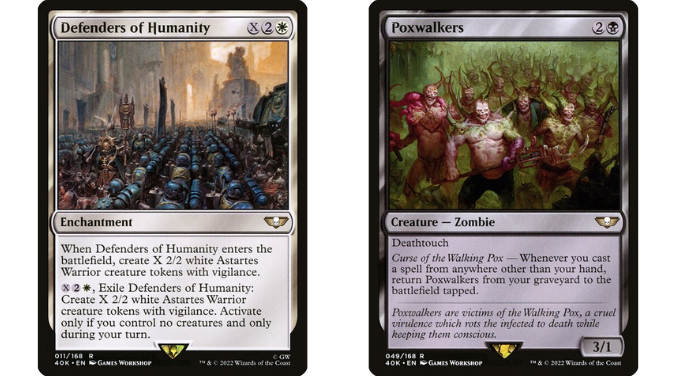
This ensured there were plenty of non-legendary creatures, tactics, wargear and locations Wizards could depict on cards to fill out the lists, and that every deck had a naturally strong identity, representing one faction within the 40K canon. The decision to commission so much new artwork was truly inspired – I don’t know that generic, reprinted land art would have instantly ruined these decks, but they would not have been anywhere near as cool.
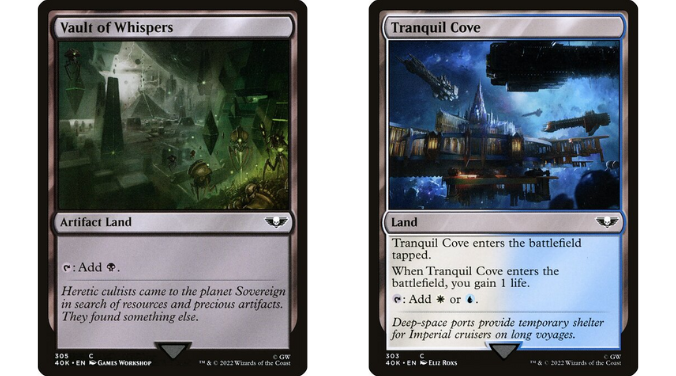
This commitment to immersing players in the atmosphere of the source material extended through every level of play design. The Warhammer lore was not written with Magic’s color pie in mind – every faction is fanatically dedicated to destruction in a way which demands black or red mana. So the design team chose to make a set of Commander decks, where an overall-skewed color balance would not cause problems.
On the tabletop, these decks are a throwback to an earlier era of Commander, flooding the board with vast armies and then annihilating them with boardwipes – a cycle of pointless bloodshed which feels exactly on brand for the 41st millennium!

Many people love that experience so much that they keep these decks virtually unaltered, and play them exclusively against each other like a boardgame. My sole complaint is that we never came back to complete the set – where are my Ork, Tau, and Light/Dark Aeldari decks??
FINAL FANTASY – HIT
This was the most commercially successful UB product to date – so it must have done something right!
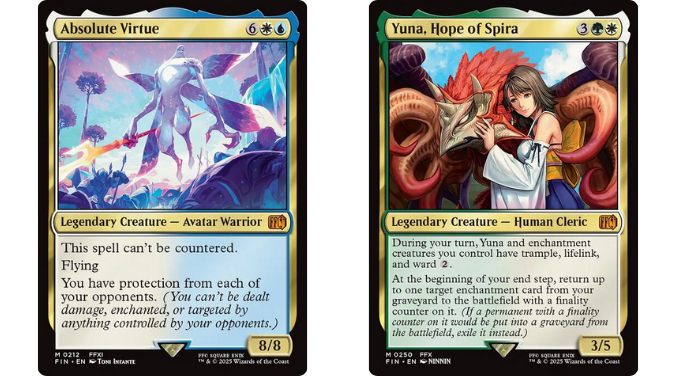
Perhaps it’s simply the size and fervor of the FINAL FANTASY fanbase, since (based on anecdotal evidence) this set made a lot of sales outside Magic’s hardcore playerbase. I can’t really speak to that perspective or what this set did differently to reach those audiences. But I think it was fairly well received by my fellow enfranchised players anyway.
That’s despite this set asking some big questions of the design team – like how to adapt the huge and diverse FINAL FANTASY franchise into a cohesive set. The games at least provide an iconic cast of monsters, locations and gear to fill out the non-legendary-creature slots in the set, but wrangling them all into a set which will pass muster both in Constructed and Limited is not easy.
I think the designers again did a great job identifying common elements between games which would both work as mechanical themes, and feel iconic to the whole series.

Towns, Chocobos, Espers, Equipment (and consumable items), Black Mages, sidequests… a large number of the set’s main mechanics translate clearly to these familiar FINAL FANTASY concepts. Building a birds deck to combine Bartz, Sazh and the Final Fantasy VII chocobo training sidequest is a premise that makes sense (and sounds exciting) even with no prior Magic experience.
But what of fans who focus their love on one specific game in the series? The official FINAL FANTASY card game went so far as to make which game cards are from part of the mechanics, so players could build “FF6 typal” as an archetype. But Magic can’t elegantly support that sort of thing.

I can imagine a world where the pressure to market around the most popular games in the series led to compromises in the set design. But to their credit, Wizards realized the limitations of the product: a set which is meant to fit into the broader Standard metagame cannot afford uneven design choices the way the Warhammer 40,000 decks skew towards black. They focused on simply making each individual card a fun and faithful adaptation of that character/concept.
Then for the fans who wanted something more focused, they offered Commander precons themed around each of the more popular entries – where characters like Cloud and Tifa and Aerith have new cards with much more satisfying synergy between them.

Maybe that maximalist approach, essentially making extra products to suit different audiences, is not one you can just copy-paste for every future Universes Beyond crossover. I’m sure it’s a huge workload for Wizards to manage, and it can only work where the IP being used has deep enough lore to populate those sets. But the powers that be seem to have correctly identified that FINAL FANTASY was the right occasion to go that extra mile. It’s that intuitive feel for the context of each UB release that seems key making a hit.
Marvel’s Spider-Man – MISS
Unfortunately, the UB follow-up to FINAL FANTASY went the complete opposite way: broadly negative reception, trouble finding a market, and fundamental issues trying to adapt the outside IP.
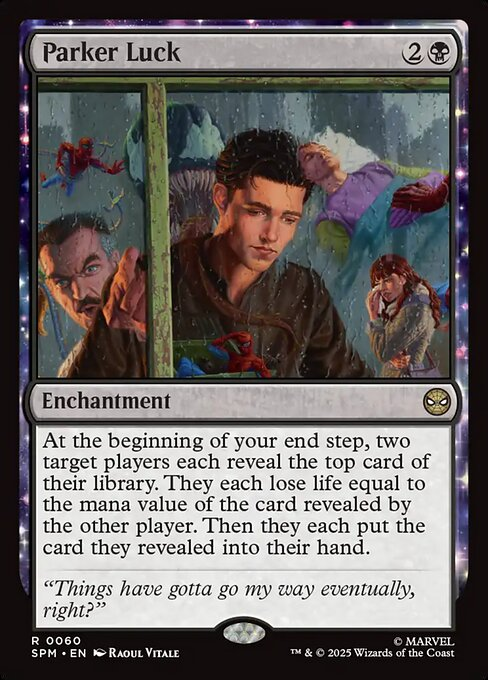
I don’t think Marvel Comics is necessarily a bad choice for a crossover, even if its mainstream relevance has fallen a notch or two from its Avengers heyday. Spider-Man remains one of their brightest stars, and casual fans are a lot more aware of his deep lore thanks to the cinematic success of the Spider-Verse. But if adapting the whole FINAL FANTASY franchise into one set seemed like too much material to cover, Spider-Man alone was definitely too little.
A booster set needs “NPC” type characters. It needs enchantments and artifacts, and between zero and two planeswalkers. It needs creatures in different sizes and types and colors, and mechanics which align to those types and colors to give them a distinct identity. Marvel’s Spider-Man and the mostly-realistic New York City he inhabits struggled to supply all of those ingredients.
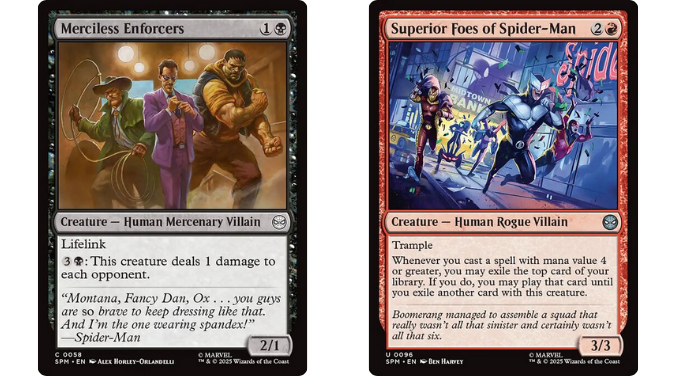
Looking at what iconic concepts that IP does provide, Spider-Man feels comparable to Doctor Who: lots of great named heroes, allies, and villains, and some memorable plotlines, but fairly narrowly focused on those. Imagine if, like with Doctor Who, these Spider-Man cards had been adapted into a set of Commander Decks instead of the set we got?
You could have one deck for the “classic” Peter Parker Spidey and his supporting cast, one deck for the Spider-Verse ensemble, a villain deck starring the Sinister Six, and a Venom-led deck featuring all the symbiote characters and some other morally-flexible folks like Kraven the Hunter.
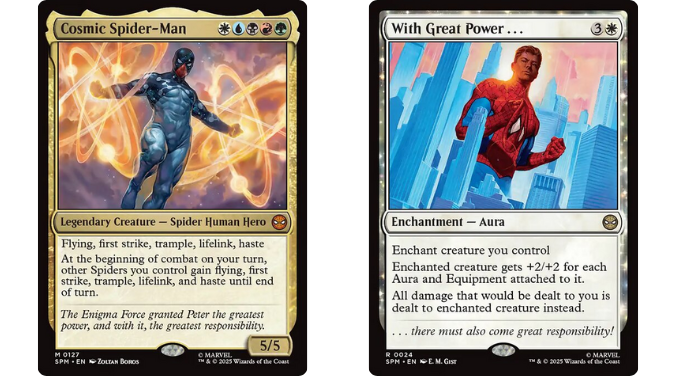
Precon decks as a product allow for designing cards around these sorts of narrative associations, but a booster set can’t. FINAL FANTASY understood this and used precons to provide the “FFVII theme deck” experience some fans wanted. But for whatever reason, Marvel’s Spider-Man tried to fit a web-shaped peg into a round hole.
The fact the design work for this set (and Assassin’s Creed) suffered from the fallout of the “aftermath booster” idea is just unrelated misfortune. Although the embarrassing rights debacle which forced all art and flavor to be changed for the Arena release is absolutely a negative consequence of the UB project that should not be ignored. Will these painful lessons be learned for 2026 and beyond?

UNIVERSAL TRUTHS
Since we are heading into a Magic future where Universes Beyond will only become more integral to the game’s identity, we can only hope that these early releases are being studied and learned from. It’s certainly frustrating (or grimly satisfying, if you’re a UB hater) to see a banger like FINAL FANTASY followed up by a clunker like Spider-Man.

But it’s not like this proves the products aren’t improving. For one, there’s the eternal excuse that these sets are mostly being developed concurrently with one another, so any lessons learned won’t show fruit until a year or two down the line. Furthermore, I think this review of past sets shows that adapting outside IP into Magic is an ever-changing puzzle; you can’t just copy the formula that worked for FINAL FANTASY and apply it to Teenage Mutant Ninja Turtles!

At best, I would guess that over time we’re identifying different categories of UB release, and coming to understand what makes a particular IP best suited to become a Secret Lair drop, a series of Commander decks, or a full booster set. Perhaps we’ll see even more novel ideas in future, although I think the reception for last year’s Cluedo crossover cooled enthusiasm for that. I just pray that the driving force at Wizards for these products remains a fannish passion for the IP that’s being adapted into Magic – because those high expectations are the ones Universes Beyond is trying to meet.

Tom’s fate was sealed in 7th grade when his friend lent him a pile of commons to play Magic. He quickly picked up Boros and Orzhov decks in Ravnica block and has remained a staunch white magician ever since. A fan of all Constructed formats, he enjoys studying the history of the tournament meta. He specializes in midrange decks, especially Death & Taxes and Martyr Proc. One day, he swears he will win an MCQ with Evershrike. Ask him how at @AWanderingBard, or watch him stream Magic at twitch.tv/TheWanderingBard.