

Commander has a serious problem when it comes to balancing its strongest tier of cards.
As a casual format built on the promise of fun, self-expression and inclusiveness, simply banning cards for being successful is a poor fit. That kind of logic would have seen Sol Ring banned decades ago – after all, it’s been included in nearly every Commander deck to ever win a game!

But if you don’t keep a banlist, that means your casual player-base is at the mercy of all the most egregious design mistakes in Magic history. If a card is so broken that it made people quit attending competitive tournaments, it seems obscene to have no restrictions on it in a format full of casual and preconstructed decks.
The most recent compromise by Wizards has been to publish an official list of “Game Changer” cards, which allows players to power-rank their decks based on how many cardboard superweapons are included. But is that the really the best way to handle this issue, or could Commander steal some tricks from other formats to improve its balance?
WHEN THE BANHAMMER ISN’T THE RIGHT TOOL
Commander did have an official list of banned cards which stood for many, many years. But those cards were sanctioned because the community considered them to be “un-fun”, not unbalanced.

This was a great tool for normalizing and communicating the basic rules of “polite” Commander gameplay. It became a kind of constitutional document for the community, a concrete foundation for the otherwise subjectively defined and interpreted social contract that governs Commander tables.
But once the popularity of the format started to really take off in the 2010s, it become much more difficult to update that social contract to keep up with the times. The play patterns of the “average” casual game evolved significantly, and new problem cards dominated the metagame, but the banned list remained more or less the same.
In fairness, it’s not clear that the Commander Rules Committee (who were nominally in charge of the list) could have actually effected any changes – by that point, only Wizards had the platform and authority to properly promulgate new bans.

When the Commander Rules Committee did try and take steps to update the banlist, the result was a week-long internet riot. The controversy over Dockside Extortionist and Jeweled Lotus was so massively incandescent that it drew mainstream media attention, and likely triggered the decision by Wizards to officially take over management of the Commander format themselves.
I have a lot of sympathy for the Commander Rules Committee in this case: they targeted cards which had been causing balance and play experience issues for a very long time, were widely complained about to the point of being memes, and which were also major “pay-to-win” cards that made the format more expensive to play.
Reading the public backlash against the bannings shows that basically nobody disagreed on any of those points – most people were upset precisely because they had invested a lot of money in cards they now couldn’t play. But for every player had wished for Dockside Extortionist and friends to no longer be part of Commander, there was another who had happily bought into the format as it was and found the banning to be arbitrary.
THE GAME HAS BEEN CHANGED
What this debacle really proved was that modern Commander cannot be governed by something as simple as a banlist. This format needs to be too many things to too many people, and no single solution can satisfy them all.
The old minimal banlist had only worked because it was so irrelevant, with only a handful of cards which would potentially be in consideration for the average 2020’s deckbuilder. It was an acceptable placeholder for the title of “official banlist” while allowing individual stores and play groups to effectively set their own deckbuilding restrictions via Rule Zero.

Now, just relying on Rule Zero can work just fine for many gaming groups. But Wizards didn’t take official responsibility for Commander just to turn around and tell players to make up the rules themselves. Wizards needed a ruleset that was straightforward and unambiguous like the old banlist, but with a more flexible set of possibilities than just “banned” or “legal”.
What they came up with is the Game Changers list – and honestly, it’s a pretty good solution.
The softer status of “Game Changer” lets you put more cards on the list than you could the old banlist, including cards which are very, very strong without being obvious game-wreckers. I believe the list has genuinely educated a lot of players about which kinds of cards are actually impactful in a Commander deck, which is great all on its own.

Game Changers also let Wizards implement a new order without starting another controversy. Any system which tried to suddenly ban or limit staples like Demonic Tutor or Deflecting Swat would likely be rejected outright since so many players – competitive or not – already have them in decks. But the Game Changer list just asks those players to think again about how powerful those decks are.
If you’re just playing those cards “because you own them” and you really don’t think your deck is doing powerful enough things to belong in Bracket 4 or 5, all you have to do is cut back to three or fewer GCs!
At the same time, the top two brackets are completely unrestricted in their Game Changer count and so players who love cEDH or near-cEDH power levels don’t face any stigma for being “illegal”.
PRAY THAT THEY CHANGE IT FURTHER
The Game Changer list seems to have been positively received by most people. But when I look closely there’s still a lot of aspects where I wish it could be better executed or provide more clarity to players.

For example: there are only really three power brackets you can land in when counting Game Changers in your deck: zero GCs (Brackets 1 & 2), three or fewer (Bracket 3) and more than three (Brackets 4 & 5). The dividing lines between brackets 1 & 2 or brackets 4 & 5 are drawn based on arbitrary judgments like “prioritizing theme over function”.
That is a pretty simplistic method of power ranking, and while I appreciate that it’s at least able to be measured objectively (do you have these specific cards or not), it feels like not all of the Game Changers should be weighed equally. Does anyone really think that having a Notion Thief in your 99 is equally threatening as having Tergrid or Yuriko in the Command Zone?
Nor do I really understand putting a disruptive card like Opposition Agent or Aura Shards in the same category as explosive enablers like Gaea’s Cradle or Underworld Breach; is being temporarily annoying in the midgame really equivalent to winning on the spot?
The official descriptions of each power bracket still include vague generalizations like “no mass land destruction” or “no chaining extra turns”, even in bracket three where some number of destructive Game Changers are allowed. Setting aside the question of whether the taboo against land destruction is still reasonable in a game that’s officially allowing things like Tabernacle and Underworld Breach… what’s so special that you can’t just put those nasty land-denial spells on the Game Changer list with the rest of them?
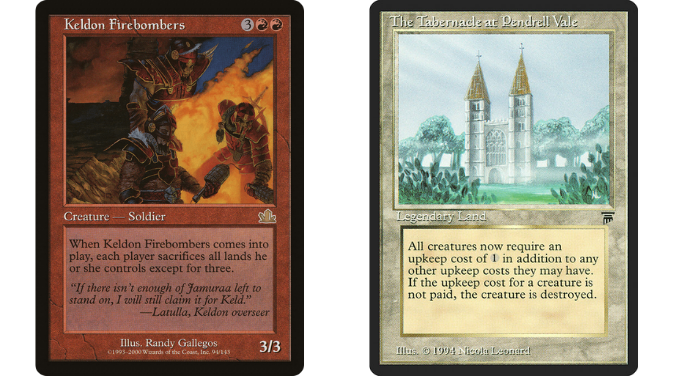
If you really think the card on the right is more pleasant to play against – you haven’t played against it.
By declining to do so you miss the entire benefit of the list, which is to make clear which cards cross the line of being “too good”, and save me the nightmare of a public argument over whether the Herald of Leshrac in my Bracket 1 Ice Age theme deck counts as a form of “mass land denial”.
MAKING A LOT OF GREAT POINTS
Criticizing a functional system without providing some ideas to improve it is mere intellectual vandalism, so let’s consider what more could be done to balance Commander if we removed Game Changers.
I believe the solution has already been prototyped and road-tested by two of Commander’s less famous cousins: Canadian Highlander and 7-Point Highlander. These two community-led formats are defined by a “points list” of high-impact cards very similar to the current Game Changers list.

But instead of all cards on the list being treated equivalently, they are each assigned a points cost based on their relative power level. Instead of deckbuilders being limited to a certain number of Game Changers, the total points value of their cards is measured to determine legality.
So, a deck in 7-Point Highlander (AKA Australian Highlander) might include seven cards each worth one point – or could go all in on Time Walk (five points) and Demonic Tutor (two). This is admittedly another step up in complexity from the Game Changer system, but not much more than that already asked of players changing over from the old banlist.
We also see a lot more deckbuilding and discussion happening online these days, and tools like Moxfield are already capable of automatically tracking and highlighting your pointed cards for you if you’re building in a format with these rules.

Again, this is only barely a step up from the current system of counting game changers, and it’s only a burden during the actual deckbuilding process. Once you’re at the table, you can just tell opponents which pointed cards/GCs you’re running as usual.
In return for doing slightly more math, the benefit to gameplay is significant. Cards can be balanced in an even more nuanced way which acknowledges that there are tiers even within the top 5% of cards in Magic. You could potentially consider taking cards which have been banned in Commander and making them playable but at a very high points cost, to see what other cards people might actually give up to play with them.
A points list can even allow more flexible solutions, like banning a specific combination of cards while leaving them both legal individually, or assigning extra points for cards when chosen as your commander or companion.
LIMITATION BREEDS IMAGINATION
I strongly believe that being pushed to choose between your favorite toys by a points list makes these Highlander formats more interesting to build and play than other Vintage-tier formats.

You get fewer automatic choices that go in every deck (because you can’t always have the best-in-slot), less of a pronounced gap between decks based on color access (because you can’t necessarily play every great card in your colors). You have to choose which cards and effects to prioritize, and those give your deck more of a unique identity, even compared to others of the same archetype.
So long as Commander players prize novelty, balanced games and self-expression, I will be advocating for the points list to be introduced wherever I can. In the meantime – have y’all considered trying 7-Point Highlander to see what I’m talking about?

Tom’s fate was sealed in 7th grade when his friend lent him a pile of commons to play Magic. He quickly picked up Boros and Orzhov decks in Ravnica block and has remained a staunch white magician ever since. A fan of all Constructed formats, he enjoys studying the history of the tournament meta. He specializes in midrange decks, especially Death & Taxes and Martyr Proc. One day, he swears he will win an MCQ with Evershrike. Ask him how at @AWanderingBard, or watch him stream Magic at twitch.tv/TheWanderingBard.