
It might be weird to say I feel sympathy for a Magic set. But Edge of Eternities really got a raw deal: not only was its debut slotted between huge Universes Beyond sets like Final Fantasy and Marvel’s Spider-Man, but it also had the challenge of launching the game’s first “space fantasy” setting. Could this one release manage to make sci-fi feel like Magic while also supporting great Limited play?
Now that EoE is out, we can say that Wizards definitely succeeded with that first challenge. This galaxy of spacecraft and warping creatures is a uniquely memorable setting, and the space-fantasy aesthetic with neon colors and armored voidsuits really pops off the cardboard. But how about the second test? What kind of Draft environment does The Edge create for us, and how do we best approach it?
SHAPE OF THE FORMAT
The defining characteristic of a Limited format is its pace: how quickly do games go? How heavily are you punished for falling behind on board, and how easy is it to stabilize and come back?
Part of what makes this set unique is that it somehow feels both fast and slow – even within the same matchup or the same game. I’d describe it as “bursty” or “swingy” gameplay, where the set mechanics can generate sudden momentum shifts of the kind you more often see in Constructed.

Spacecraft are the most obvious example of this dynamic: they’re often quite low-impact when first cast, so you fall behind when playing them. This unfortunately makes it harder to justify tapping your potential blockers to try and station that spacecraft. Even if you have enough station power to immediately bring it online as a blocker itself, that’s a huge gamble against your opponent having one removal spell!
This creates a tendency for multiple spacecraft cards to just accrue un-stationed at the back of the board while their owner desperately tries to hang in there. But then what happens when that player finally casts (or warps) a big enough body to efficiently station one of those artifacts?

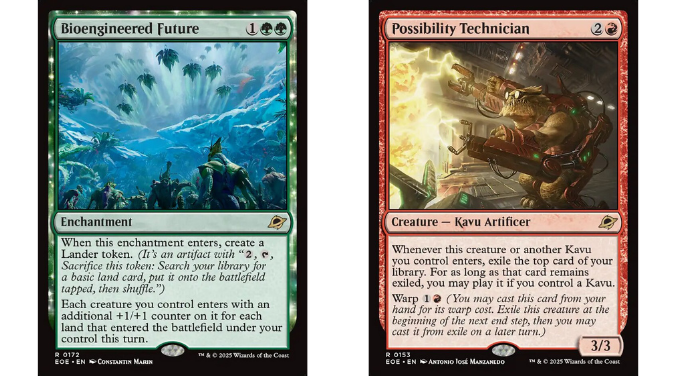
Most of the spacecraft are big enough that the first one probably goes most of the way to stationing a second, and then that one stations the third, and so on. Suddenly you’ve added literally 20 power (mostly flying) to the board in one turn, perhaps for only the cost of a warp!
That’s what I mean by “swingy”: you have to be on the lookout for unpredictable bursts of tempo, because certain cards can convert low-value resources into high-value ones. Lander tokens are generally very good as ramp and fixing, but an opponent who stockpiles them can threaten a later explosion of triggers from landfall, artifacts-matter or sacrifice-matters cards. A wide board of tiny creatures is extremely threatening in a set with the excellent Zealous Display at common, not to mention other pumpers like Syr Vondam, the Lucent, Glacier Godmaw, Dual-Sun Adepts and Memorial Team Leader.

As for the other set mechanics, both warp and void really push you towards explosive, multi-spell turns. Warp effectively increases the number of low-cost plays in the set by turning expensive creatures into pump spells or other utility. Meanwhile, 50% of void cards are one-off effects like instants, sorceries and ETB triggers. This often forces you to double-spell to get their value: a removal or sacrifice effect first to turn on void, and then one or more cheap void cards to cash in.
Of course, the colors that don’t have void get straight-up “second spell this turn” triggers instead! So there’s a set-wide tendency towards multi-spell tempo turns that can blow a game open, barely held in check by widespread and powerful removal. Space is spicy!
COLOR THEORY
For a format where every deck can get multiple Rampant Growths as a set mechanic, EoE is actually quite restrictive about color access. It feels like ages since a Draft format gave us neither dual-lands nor landcyclers at common, so I guess we’ve been spoiled and this is more of a taste of the old normal. But regardless, I would rarely attempt to do more than splash one pip on an off-color rare – and maybe not even then if I’m not in green.
Despite that lead-off joke, Landers are really just a green and red mechanic, with Dauntless Scapbot and the two black cards the only reliable sources outside that pair. Other decks must rely on an uncommon three-cost mana rock and non-basic lands (many of which are rares on the bonus sheet) to cast their splash cards, so don’t be afraid to take those lands highly!
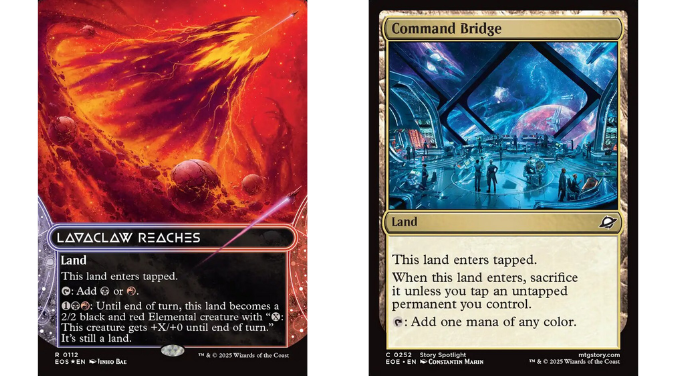
Command Bridge in particular is a priority card for anyone who thinks they might want to splash – the number of random permanents floating around in this set really eliminates any downside beyond it entering. Even the worst case where playing it takes up your whole second turn isn’t that bad most of the time. It actually seems common for the first few turns to pass peacefully as players activate Landers, play Bridges or sit on interaction.
As in most formats, drafting a base green deck lets you comfortably add an extra color or two over the norm. Though if you are planning on a rainbow deck, you’ll need to take Gene Pollinator and green’s Lander spells early in the pack – they’re all strong enough spells that they won’t make it back around the table in most situations. All-Fates Scroll is probably the only color fixer which you’ll find among the dregs of packs, and even in a slow-starting environment, I wouldn’t want more than one of it.

ARCHETYPE BREAKDOWNS
The firm divisions between two-color archetypes in EoE seem to come more from the difficulty of playing extra colors, rather than their mechanics being too exclusive. I would definitely not let the idea that you’re “playing a spacecraft deck” discourage you from drafting Warp creatures or vice-versa. The set mechanics are open-ended enough that you can easily play them together and improvise ways to enable their potential – so keep that in mind as you read these summaries or draft your decks!
White-Blue: “Second Spell” Aggro
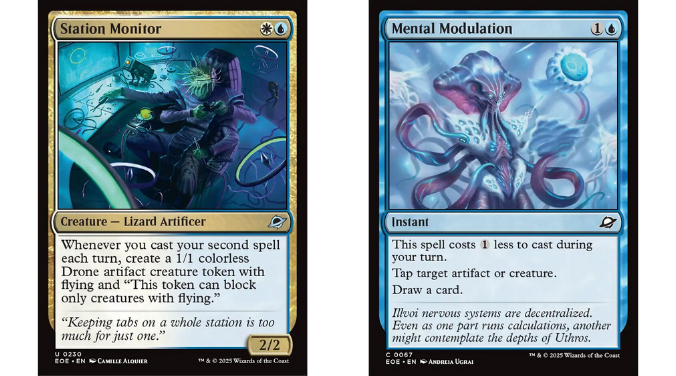
We may as well start with what is clearly the best deck in the format, blue-white. We’ve seen this “second spell this turn” wording as recently as Tarkir: Dragonstorm, and it’s even better here thanks to a generous proliferation of very cheap, often cantripping spells. I can’t say enough about how much it powers up this archetype to have cards like Cryoshatter, Focus Fire, Squire’s Lightblade and Mental Modulation all at common, except that after playing against it many times I’m convinced Modulation should be Mythic Rare.
The gameplan is simple – draft all the cheapest creatures, removal and tricks you can (plus maybe some warp creatures like Starbreach Whale and Mechanozoa) then run people over. You don’t even necessarily need the direct “second spell” payoffs like Station Monitor and Illvoi Operative, although they will make your nut draws significantly nuttier.

You do want to try and finish games fast though. Don’t try and save your removal for big targets – use it any time it would open up a safe attack. White’s +1/+1 counters are vital here for helping your otherwise fragile attackers survive chump blocks. Or if your offense does stall out, stacking power on Illvoi Infiltrator (or whatever’s holding Atomic Microsizer) is a great way to unblockably chip off the last points of life.
White-Black: Sacrifice Control
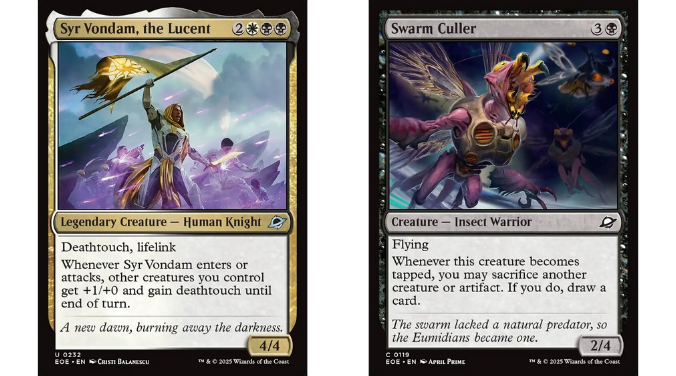
The official Wizards description of this color combination pitches it as a “Go Wide” aggro deck, which meant I initially expected it to focus on creature tokens and pump effects like Zealous Display. But in fact the only non-rare token-making spells are Knight Luminary and Honored Knight-Captain, and as some of white’s best creatures overall they can be hard to get in multiples.
The cards WB can reliably draft lend themselves much better to a traditional grindy sacrifice deck. You trade your cheap, low-value permanents (Virus Beetle, Timeline Culler, Lander tokens) for higher value effects: removal, reanimation, card draw, and so on. Most of black’s sacrifice costs allow you to pay with a creature OR artifact, which significantly expands the range of efficient fodder available. You can also get the most of cards which make tokens on death, like Gravpack Monoist and Rayblade Trooper.
Actually winning the long game takes some combination of plentiful hard removal, void-fueled card draw (Decode Transmissions, Hymn of the Faller and Voidforged Titan) and bigger threats like Syr Vondam. You could also try splashing in bomb rares to serve as win conditions – I’ve had massive success so far with Space-Time Anomaly thanks to WB’s powerful defense and lifegain.

Blue-Black: Artifact Control

Blue-black is more or less a pure control deck. Some light artifact synergies give you a nudge towards picking artifact cards – but no more than all of black’s void spells nudge you towards sacrifice outlets or warp creatures. If you read this section’s introduction about freely combining the set effects instead of treating them like distinct themes, this archetype is the perfect example.

This even includes spacecraft – the set mechanic most other decks don’t want to use. Blue and black have easily the most playable suite of non-rare spacecraft. They ALSO have the best ability to station them: Monoist Sentry is a 4 power one-drop, warping in Perigee Beckoner adds 6 total power to the board for just 1B, and Nanoform Sentinel lets your highest-power creature station twice (or untaps a land, or gives you back a blocker, etc.). And as a true control deck, you shouldn’t have trouble buying time to get those spacecraft onto the battlefield and up to full capacity!
White-Red: “Tapped Creature” Midrange

This color combination is a bit tricky to make sense of. The gold uncommon, Sami, Ships Engineer, sits at the intersection of two distinct archetypes. With a lot of cheap aggressive creatures, Sami becomes a great curve-topper that helps you go wider than your opponent’s blockers on your final lethal attacks. Or, with a ton of removal and big top-end bombs, you can play a slower deck where Sami is enabled by tapping mana dorks or other utility creatures, and their robot tokens help you clog up the ground to buy time.

Red is definitely the color with better late-game cards, including by far the best spacecraft in Galvanizing Sawship. It also has most of the ramp and card draw you’ll have access to in this pair, so the slower RW deck is really just red splashing white removal and Starfield Shepherd. You definitely should NOT splash for Wedgelight Rammer, despite the apparent spacecraft synergy – no reader of mine is paying 4 mana for a vanilla 2/2, even if it comes with a free paperweight.

This is potentially the worst value-for-mana on any card printed in the past decade. Change my mind.
Just run more creatures with tap abilities if you’re desperate about getting your triggers off. Or better yet, fill those slots with combat tricks like Rig for War, Full Bore and Squire’s Lightblade. Then you can pretend you’re making unfavorable attacks just to set up your Sami trigger, baiting opponents into blocks where you can blow them out AND keep your tapped attackers alive.
Blue-Red: Artifact Aggro

UR may be a tick less powerful than its UW cousin, but it has some extra tricks up its mechanical sleeves and is a ton of fun to play. Red has by far the best and deepest early removal suite, with Plasma Bolt, Invasive Maneuvers, Bombard and Cut Propulsion all good enough to play in multiples.
Speaking of multiple copies, casting a string of Oreplate Pangolins is an incredibly satisfying and effective way to start off a game. These self-growing creatures like Frontline War-Rager or Mm’menon help you snowball rapidly from an early lead, hopefully getting too big to handle before your opponent can finally get their blockers past your removal.

Compared to UW I also think UR has much more flexibility to go late-game. Even without rare bombs, these colors have both excellent value engines (Mechan Assembler, Vaultguard Trooper, Territorial Bruntar) and high-impact finishers (Galvanizing Sawship, Specimen Freighter, Mouth of the Storm). So if you can’t get enough of those highly-contested early game spells, consider the in-color pivot a good Plan B.
Black-Red: Void Midrange
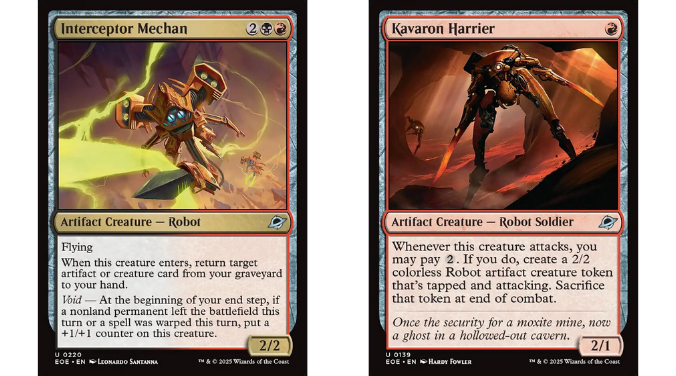
The void mechanic creates a really fun twist on the classic RB grinder playstyle. Spells like Decode Transmissions or Roving Actuator feel like they would normally demand you sacrifice your own creatures to realize their potential – but thanks to void, they will also accept the death of your opponent’s creatures! Needless to say this works out much better for you if you can make it happen, and with the right draws this deck is an unstoppable card-advantage machine that will leave opponents without life OR spells in hand!
Given the best void effects are all card draw or recursion, and enabling void often relies on taking multi-spell turns, RB is yet another archetype looking for a lot of strong, cheap playables which can reliably trade with opposing cards. It’s even better if they can rack up big damage or snowballing value when uncontested (sorry Monoist Sentry), but not essential. A single Hylderblade instantly solves the damage problems of your Hullcarvers and Virus Beetles, and is among the best uncommons of the set as a result.

With the whole gameplan working on such fine margins of board control, we should keep in mind that not all sacrifice effects are worth losing a body over. Embrace Oblivion and Faller’s Faithful are still worth it though (for the record, I see the Faithful as 70% Village Rites, 30% Fatal Blow, and 100% first-pickable). You can fix this math with two key enablers: Timeline Culler and Perigee Beckoner. Not only because they take the sting off sacrifice costs or recur ETBs like Virus Beetle, but because warping them in automatically satisfies void for the rest of the turn!
White-Green: +1/+1 Counters Aggro
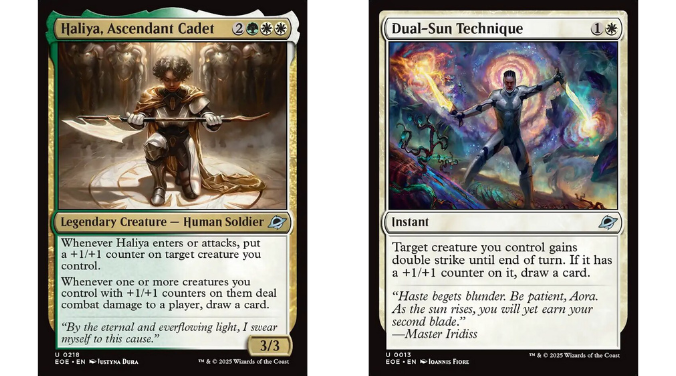
Powerful, fast, and consistent, with a deep pool of playable cards, GW has been my personal comfort deck in Edge of Eternities so far. Even if this format doesn’t have a super-aggressive metagame, having board control early and consistently pressuring your opponent depletes resources they might use to generate a later momentum swing.
GW reliably generates this pressure by starting with above-average two and three drops, and then upgrading them with +1/+1 counters until they clearly outclass opposing blockers. They can often do this while continuing to play extra bodies, or otherwise use vigilance and untapping effects to prevent opponents retaliating and racing them. Inevitably, the opponent is forced to risk either a multi-block or block-plus-combat-trick to try and stem the bleeding, at which point you crush them with a trick or removal of your own.
The only way this formula can really fall apart is if the opponent either has enough removal to kill everything on sight and stop you building momentum, or if they live long enough to slam an expensive spell that either clears or races the green-white boardstate. Both those scenarios are very possible in EoE, so GW decks aren’t a surefire path to victory. But so long as cards like Weftblade Enhancer and Dual-Sun Technique are available late in packs, these colors will reliably overperform.
Black-Green: Reanimator

My fellow GB draft connoisseurs will appreciate the nuance of this being labeled “Reanimator” instead of “Self-Mill” or “Graveyard Matters”. If you’re using your graveyard this set, you’re doing actual graveyard-to-battlefield reanimation: either Seedship Broodtender or Scrounge for Eternity.
Both cards are solidly playable even as “fair” plays, which can help keep you in a match even when you aren’t able to reanimate your ideal target. This is important because the game-winning, totally-unfair kind of reanimation you usually think of is kind of awkward to set up in EoE Draft.

The first problem is a lack of self-mill: the only sources are Broodtender and Fell Gravship, both uncommon. This alone often forces you to splash into red or blue for draw-discard spells that can get the right target in position to be reanimated. But the second problem is that really devastating reanimation targets are also shockingly thin on the ground! There’s also the five-mana-value limit on Scrounge, so in practice you’re more likely to be recurring Voidforged Titan or a splashed Vaultguard Trooper than Glacial Godmaw. Don’t worry though, even this “fair” reanimation plan has had a very high winrate for me thus far…
Blue-Green: Lander Ramp
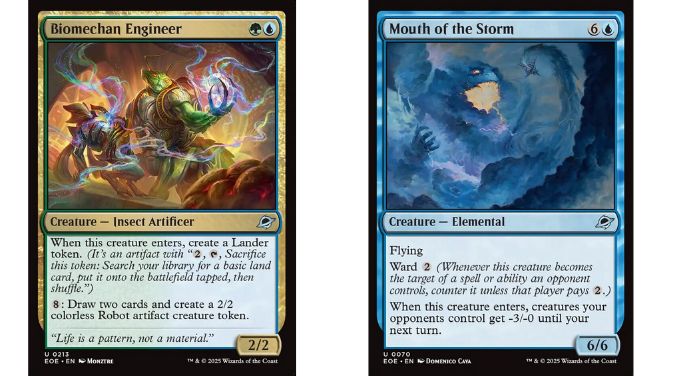
From Aetherdrift to Tarkir: Dragonstorm to Final Fantasy to Edge of Eternities, we are living in the absolute peak era of drafting green ramp decks. The combination of plentiful ramp sources (Landers) and a slow-ish metagame means you win a lot of games by taking the first few turns off and then slamming an endless train of green 5/5s (or bigger) until the opponent has been buried.
Of course, that assumes you’re able to draft (and draw) enough of the right cards to make that plan consistent. Sami’s Curiosity is the kind of card which either makes your heart sing or your eyes glaze over – but if you’re in the second group then you’ll have to learn fast, because having reliable access to a Lander activation on turn two is absolutely foundational here. Edge Rover, Biomechan Engineer, and Seedship Impact are also great early Lander-generation, while Larval Scoutlander and Gene Pollinator add other effective ways to get ahead.

Your selection of top-end threats isn’t quite so big or nasty as it is in other formats, especially if you’re not splashing off-color bombs (though with all the Landers, why wouldn’t you). Mouth of the Storm and Glacier Godmaw are SS-tier if you can find them, but nothing else offers quite the same combination of power and evasion. The most effective route seems to be leaning on spacecraft: they’re easily crewed by your other big stuff (or each other), they fly, and they tend to have strong ETBs which help shut down any hail-mary plays from your beleaguered opponent.
Red-Green: Landfall Midrange
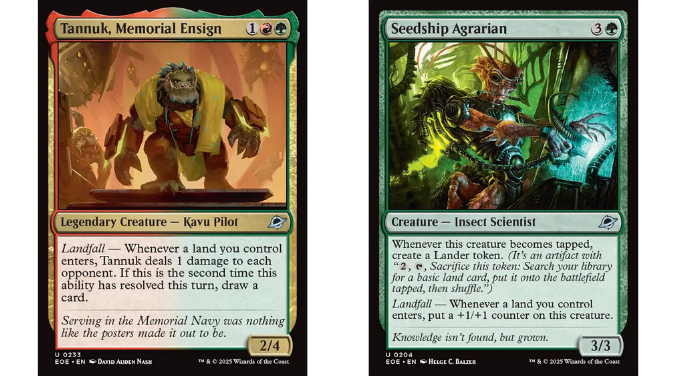
RG has a cool and well-supported identity this format: red’s aggression and green’s ramp are welded together by Kavu creatures and aggressive landfall triggers! It also helps that red’s curve and playstyle lean more top-heavy than usual, as it means this color pair actually competes with or outclasses UG for the deepest pool of big-mana payoffs!
But you don’t need to rely solely on six- and seven-drops to win the game here. Your well-statted creatures can easily control the board in most games, backed up by red’s cheap removal. Lander tokens can even help you replicate the artifact synergy aspect of UR’s game: Oreplate Pangolin is still sneaky good here! As for the landers themselves, deciding when to crack them is an important skill test – you’ll usually want to wait until you’re out of impactful on-curve plays, rather than risk skipping turns to accelerate out a huge threat which gets immediately Gravkill’ed.

The other big reason to hold Landers in play is to set up a potential flood of landfall triggers later on. I will admit to having won a game or two this way with specifically Glacier Godmaw when the board is stalled, but in general I don’t think that juice is worth the squeeze. The more reliable payoff for having tons of Lander generation is that you get to draft any off-color cards you want, comfortable in the knowledge you’ll have ramped into two of each basic land by the time you draw them!
HOW ARE THERE DRAFTS IN SPACE IF THERE’S NO AIR??
That brings us to the end of our cosmic journey through the Edge of Eternities Draft format. I can’t say I was really excited by the premise of a space-opera or space-fantasy Magic set, but once again the team at Wizards have managed to score a black-hole-in-one!

The surprisingly colorful artwork and weirdness of the worldbuilding demands attention, and the actual mechanics and design deliver a unique, mostly-balanced experience. I do wish the spacecraft mechanics weren’t so fundamentally underpowered, but at least some of them are still Limited playable. I’m mostly just glad to see that if we’re getting a reduced schedule of original-IP sets from now on, the ones we do get are still going to be as creative and high-effort as ever.
As a bonus for reading to the end of this guide, here are my top all-rounder commons to pick in Pack One when you’re still figuring out your direction!
WHITE – Focus Fire, Starport Security, Knight Lumninary, Brightspear Zealot, Banishing Light
BLUE – Cryoshatter, Mental Modulation, Starbreach Whale, Mechanozoa, Cryogen Relic
BLACK – Embrace Oblivion, Gravkill, Decode Transmissions, Gravpack Monoist, Beamsaw Prospector
RED – Plasma Bolt, Orbital Plunge, Oreplate Pangolin, Zookeeper Mechan, Kav Landseeker
GREEN – Sami’s Curiosity, Biosynthetic Burst, Gene Pollinator, Drix Fatemaker, Shattered Wings
OTHER – Command Bridge, Wurmwall Sweeper, Pinnacle Kill-Ship

Tom’s fate was sealed in 7th grade when his friend lent him a pile of commons to play Magic. He quickly picked up Boros and Orzhov decks in Ravnica block and has remained a staunch white magician ever since. A fan of all Constructed formats, he enjoys studying the history of the tournament meta. He specializes in midrange decks, especially Death & Taxes and Martyr Proc. One day, he swears he will win an MCQ with Evershrike. Ask him how at @AWanderingBard, or watch him stream Magic at twitch.tv/TheWanderingBard.